
Renaissance Milan: Leonardo, Ludovico il Moro and Santa Maria delle Grazie
A journey into the heart of the Renaissance, standing before Leonardo da Vinci’s Last Supper. Join us on our visit to Milan as we discover the extraordinary beauty of this masterpiece, the story of Ludovico il Moro, and the timeless charm of Santa Maria delle Grazie.
Piero: there are places we are willing to cross entire continents to see, embark on endless journeys for, and wait years to finally admire. And then there are wonders practically on our doorstep, just a few kilometres away, that we keep putting off visiting.
Angela: you're always excited before our trips, but this time you seem particularly fascinated.
Piero: fascinated is an understatement, because today, at last, the moment has arrived to fulfil a long-held dream of mine: visiting Leonardo da Vinci’s Last Supper, a masterpiece I consider one of the most fascinating works in the history of art. I don't know whether it's the power of the figures, the depth of their gazes, or the mystery that seems to surround every detail, but there is something about this painting that has always drawn me in irresistibly.
Angela: we don't need to pack our suitcases, travel hundreds of kilometres, or set off at dawn to reach a distant destination. All we have to do is head to Milan, a city we often associate with modernity, fashion and business, yet one that preserves an artistic heritage capable of rivaling that of Europe's most celebrated capitals. Our destination lies in the heart of the city, within a monumental complex steeped in a history of ducal ambition, artistic genius, faith and beauty.
Piero: but be warned: visiting the Last Supper is not like simply walking into a church or museum. The worldwide fame of the masterpiece, together with the need to protect it, makes it essential to plan your visit well in advance. Places are limited, and availability can sell out quickly. Tickets are released in quarterly booking periods through the official website of the Museum of the Last Supper. My advice is to plan everything ahead of time and, if no tickets are immediately available, check again later, as additional slots may be released.
Angela: the museum is located in Piazza Santa Maria delle Grazie and is easy to reach by public transport. You can take the red underground line, M1, and get off at Cadorna or Conciliazione, or take the green line, M2, to Cadorna. Tram 16 also stops nearby. As you mentioned, advance booking is compulsory for everyone, including visitors entitled to free admission. You must also arrive at least 30 minutes before your booked time, carefully following the instructions provided on your ticket and on the official website.
Piero: there's another detail that makes this experience even more precious: the time spent in front of the painting is limited to fifteen minutes, with a maximum of forty visitors per time slot. It may seem very short, but this measure is necessary to protect an exceptionally fragile work of art. That's precisely why I recommend arriving prepared, perhaps by joining a guided tour or studying the most significant details beforehand. When we finally stand in front of the painting, we certainly won't want to waste those precious minutes wondering where to begin.
Angela: and a little note for those who, like us, love keeping photographs of the places they visit: photography of the Last Supper is permitted inside the refectory, but without using flash. Video recording, on the other hand, is not allowed.
Piero: here, too, respecting the rules is an integral part of the experience. Our goal shouldn't simply be to take home a beautiful photograph, but above all to preserve the memory of an encounter with an unparalleled masterpiece.
Angela: and here we are, then: we're ready!
Before we enter: Renaissance Milan, Ludovico il Moro and the genius of Leonardo
Piero: we've waited a long time for this, so now, don't rush…
Angela: to truly understand what we're about to see, we need to take a step back in time, to Milan in the second half of the fifteenth century. Imagine a city buzzing with activity, one of Italy's most vibrant courts, where artists, architects, engineers, writers and men of science came together.
Piero: at the helm of this golden age was Ludovico Maria Sforza, who went down in history by the nickname il Moro. A fascinating, ambitious, cultured and refined figure, he understood how art could become a powerful instrument of political prestige and dynastic affirmation.
Angela: and his nickname is worth exploring, because its origins offer us a rather amusing little story. Ludovico was born on 3 August 1452, the fourth son of Francesco Sforza and Bianca Maria Visconti.
Piero: at the time, his father was away from Milan, engaged in a war against Venice, when he received a letter from his wife dated 8 August. In it, the duchess happily announced the birth of their child. But after reassuring him about her own health, Bianca Maria added a decidedly unconventional comment about the newborn's appearance. With almost disarming honesty, she described him as “the ugliest of them all” — in the original wording, «il più sozo de tutti li altri» — meaning the least handsome and darkest-complexioned of her children.
Angela: with a certain irony, his mother explained that the little boy had inherited her forehead and mouth, while his hairline resembled his father's. She ended by expressing the hope that, once Francesco saw the baby in person, he would not find him quite so ugly and would love him as much as his other children! It's a tenderly humorous family portrait that suddenly brings a court from more than five centuries ago remarkably close to us.
Piero: the nickname Moro, therefore, did not originate, as one might imagine, from some mysterious connection with the East. The traditional explanation links it to Ludovico's dark complexion, black eyes and dark hair. His father reportedly used to call him Maurum, and the nickname already appears in a document dating from 1461.
Angela: another theory connects the nickname to the mulberry tree, known as moro in Lombardy. Its cultivation was promoted in these lands by Ludovico, eventually making the tree a symbol of his dynasty. Mulberry cultivation and silkworm farming would become some of the duchy's most important economic activities during this period.
Piero: Ludovico was not merely a man of power; he was also a genuine patron of the arts. During his rule, Milan became a centre of innovation and beauty. The Sforza court welcomed some of the leading figures of the Renaissance, offering them extraordinary opportunities. Among them, of course, stood Leonardo da Vinci, who arrived in Milan around 1482 and would leave behind some of his most celebrated works of art.
Angela: Leonardo was far more than a painter. He was a student of anatomy, an engineer, an architect, a theatrical designer, a musician and an indefatigable observer of nature. His curiosity knew no bounds, and his approach to painting grew out of this constant quest to understand reality, movement and human emotion.
Piero: the relationship between Leonardo and Ludovico was therefore much more than a simple artistic commission. The duke sought works that would celebrate his court, while Leonardo found in Milan an environment where he could experiment, design and pursue his research.
Angela: it was in this setting that some of his most famous works came into being, including the Last Supper and the portrait known as Lady with an Ermine, depicting Cecilia Gallerani, a young woman romantically involved with Ludovico. But we'll return to her shortly: her story offers us a fascinating glimpse into the private life of the Sforza court.
Piero: the place that houses the Last Supper also tells a story of the duke's ambition. The Santa Maria delle Grazie complex predates Ludovico's golden age. Construction of the church and Dominican convent began in 1463 under the direction of the architect Guiniforte Solari.
Angela: it was Ludovico who sought to transform this religious site into something truly exceptional, enlisting the finest artists and architects of his time. From the 1490s onwards, the church was enlarged and embellished in a new Renaissance style, thanks in particular to the work of Donato Bramante.
Piero: the complex thus became one of the most extraordinary expressions of the meeting between spirituality, power and art.
Angela: there was a deeper purpose behind this undertaking. Ludovico wanted Santa Maria delle Grazie to become the symbolic home of the Sforza dynasty and, at the same time, a monument that would preserve his family's memory for generations to come.
Piero: he could hardly have imagined that, more than five centuries later, the fame of the complex would surpass even that of the man who commissioned it. Today, the Last Supper and the church form part of a UNESCO World Heritage Site, recognised in 1980.
Angela: but before we let ourselves be captivated by the architecture, it's time to cross the threshold of the refectory. The encounter you've been dreaming of for so long is waiting for us.
Inside the refectory: fifteen minutes before eternity
Piero: here we are at last. Stepping into the refectory feels like entering a space where time itself seems to slow down. The room is long and solemn, its architecture simple and austere, yet it still preserves the memory of the purpose for which it was designed: this is where the Dominican friars gathered to eat, pray and meditate.
Angela: and yet, on the two end walls, two monumental paintings transform this everyday setting into one of the most extraordinary places in Italian art.
Piero: on one side, Leonardo's Last Supper; on the other, The Crucifixion by Donato Montorfano. Two visions of Christ's Passion, created during the same period, yet profoundly different in character.
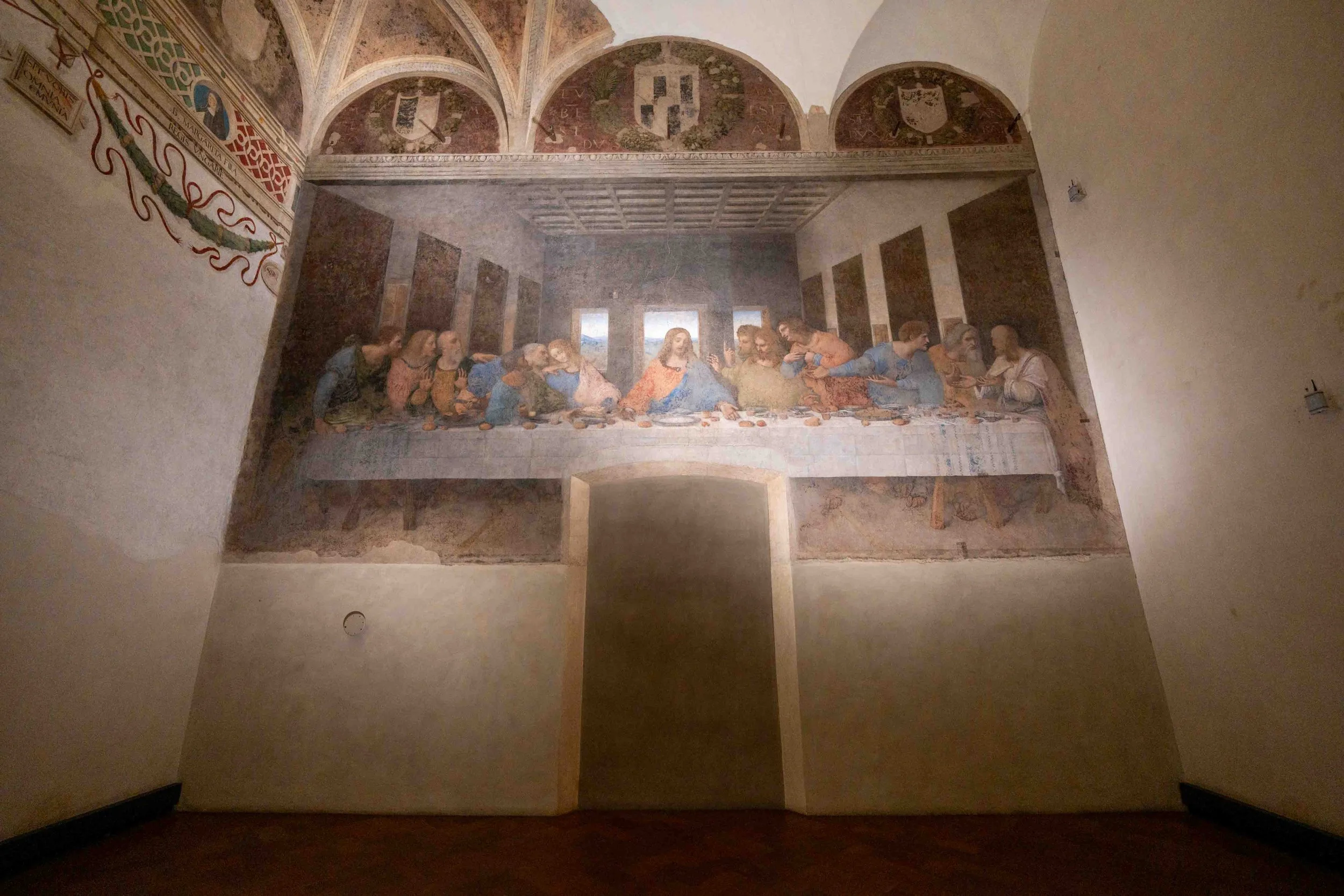
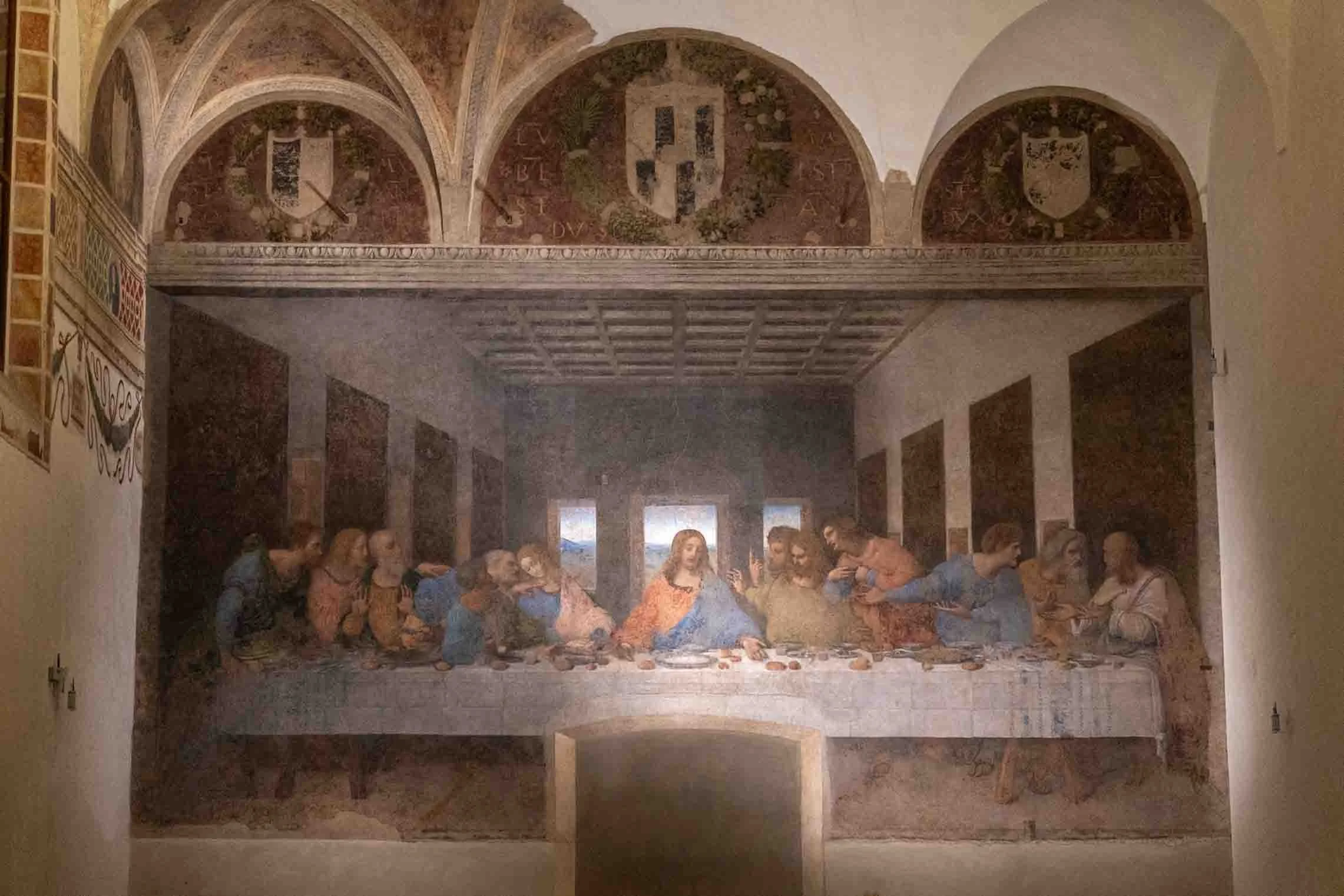
Angela: before us unfolds the Last Supper, a mural measuring approximately 4.6 metres high and 8.8 metres wide, painted by Leonardo between 1495 and 1498. The artist certainly did not work on it every day, but visited the site intermittently, sometimes spending long periods observing and reflecting before returning to his work.
Piero: even before we focus on the faces, the extraordinary use of perspective catches our attention. The scene seems to extend into the actual space of the refectory, as though the wall had been opened up and transformed into a second room, where Christ and the apostles sit gathered around a table.
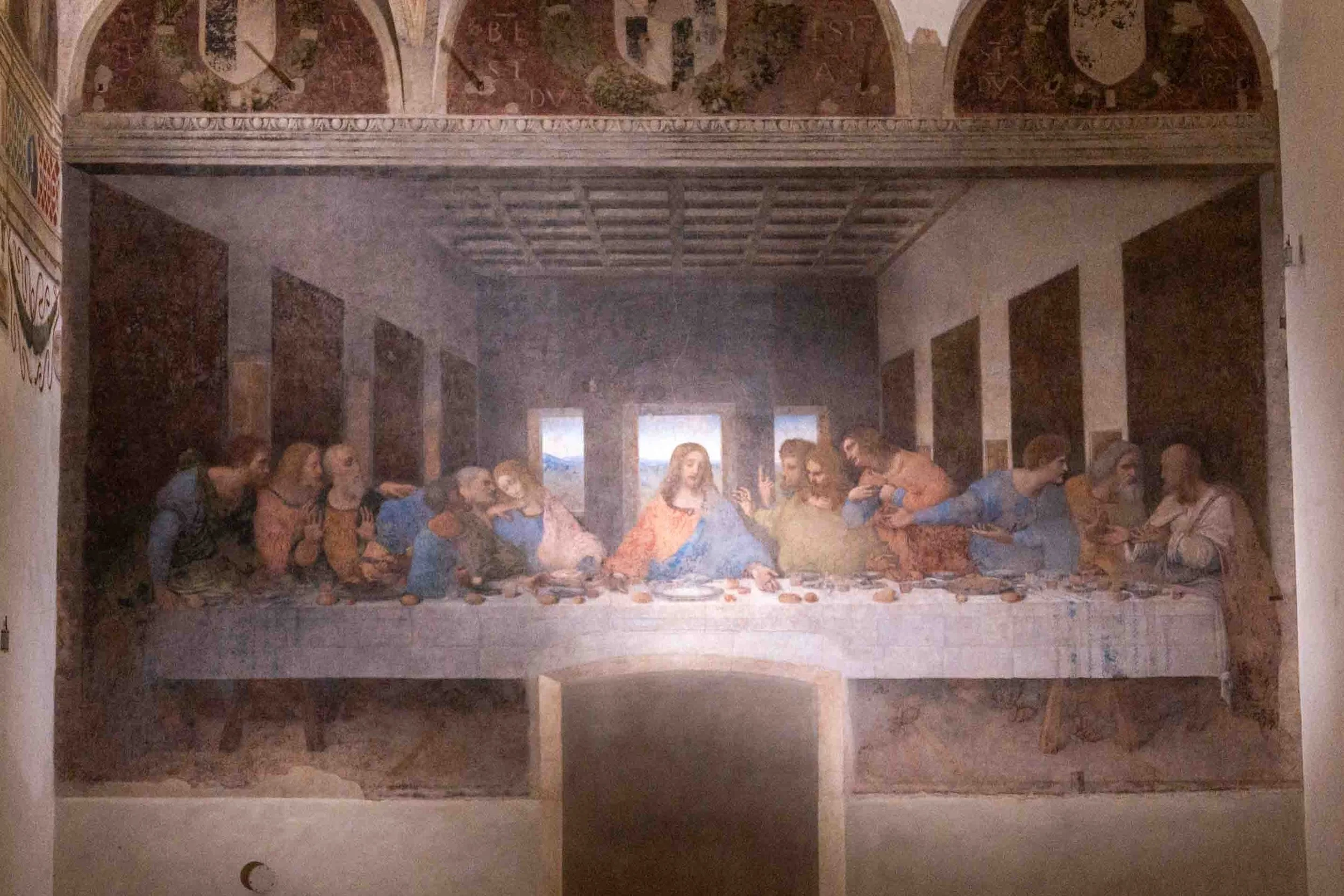
Piero: the architectural lines converge towards Jesus, who dominates the composition without the need for theatrical gestures. His presence is central and balanced, yet profoundly human. Even the light seems to come from the windows behind Jesus, another detail that bears witness to Leonardo's genius.
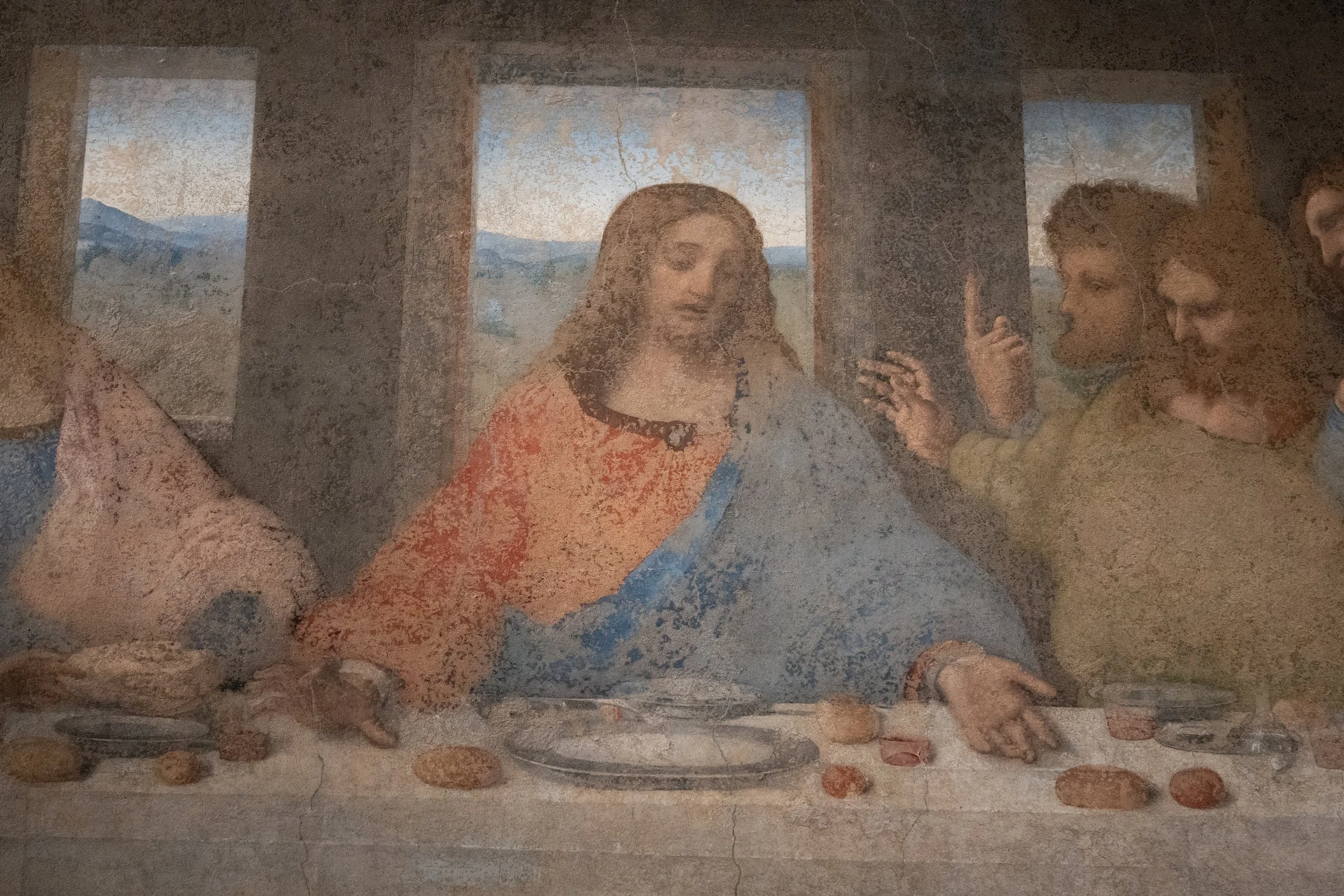
Angela: the Tuscan genius chooses to depict a precise moment from the Gospel narrative: the instant immediately after Christ announces that one of the apostles will betray him. We are not looking at a static scene, but an explosion of emotions. Jesus' words seem to travel across the table, reaching each apostle and provoking a different reaction: astonishment, disbelief, indignation, sorrow and questioning.
Piero: Leonardo arranges the twelve disciples into four groups of three figures, each with its own distinctive dynamic, transforming a religious scene into an extraordinary exploration of the human soul. It doesn't feel as though we're standing before a mere painting; in every sense, it is a scene brought to life.
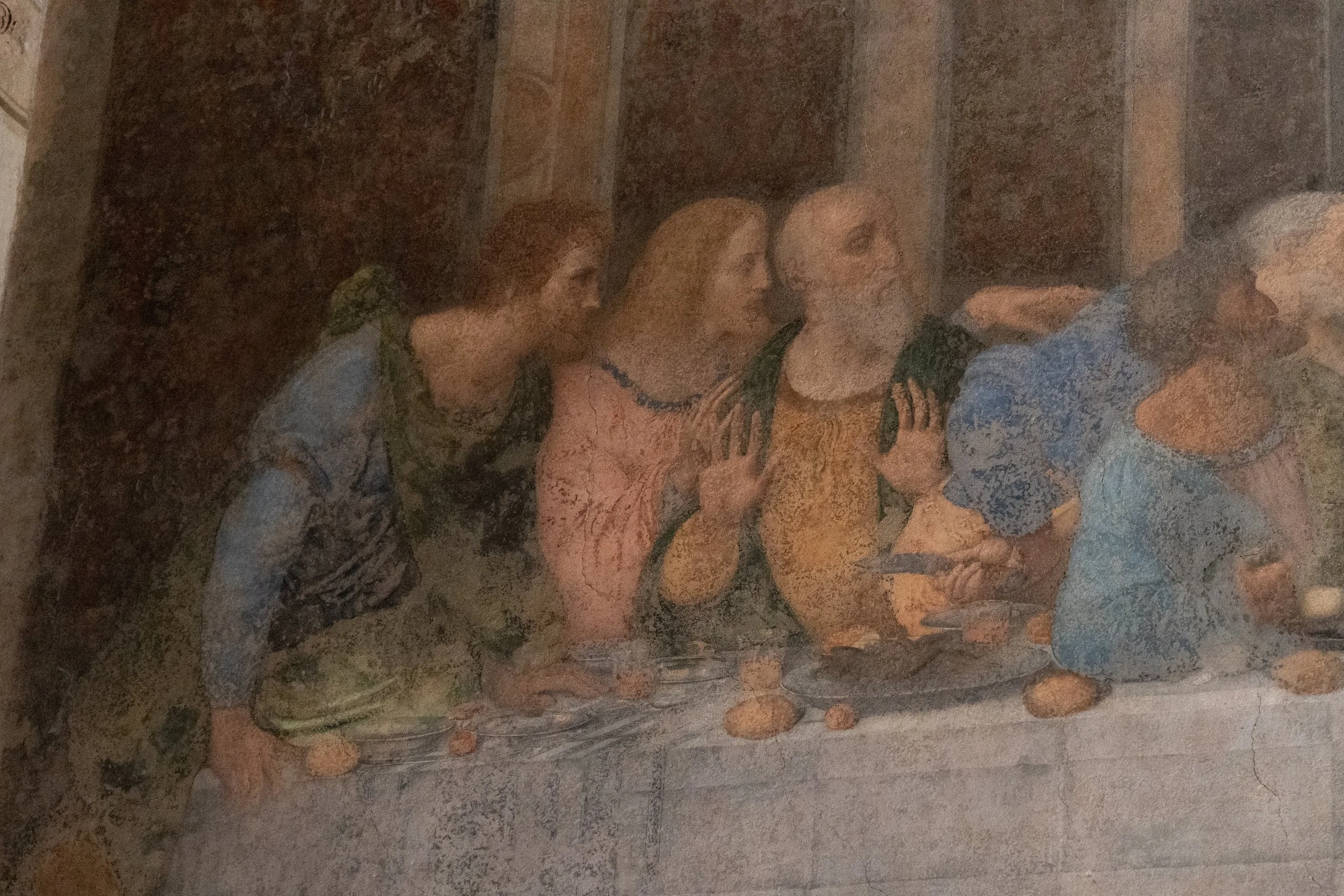
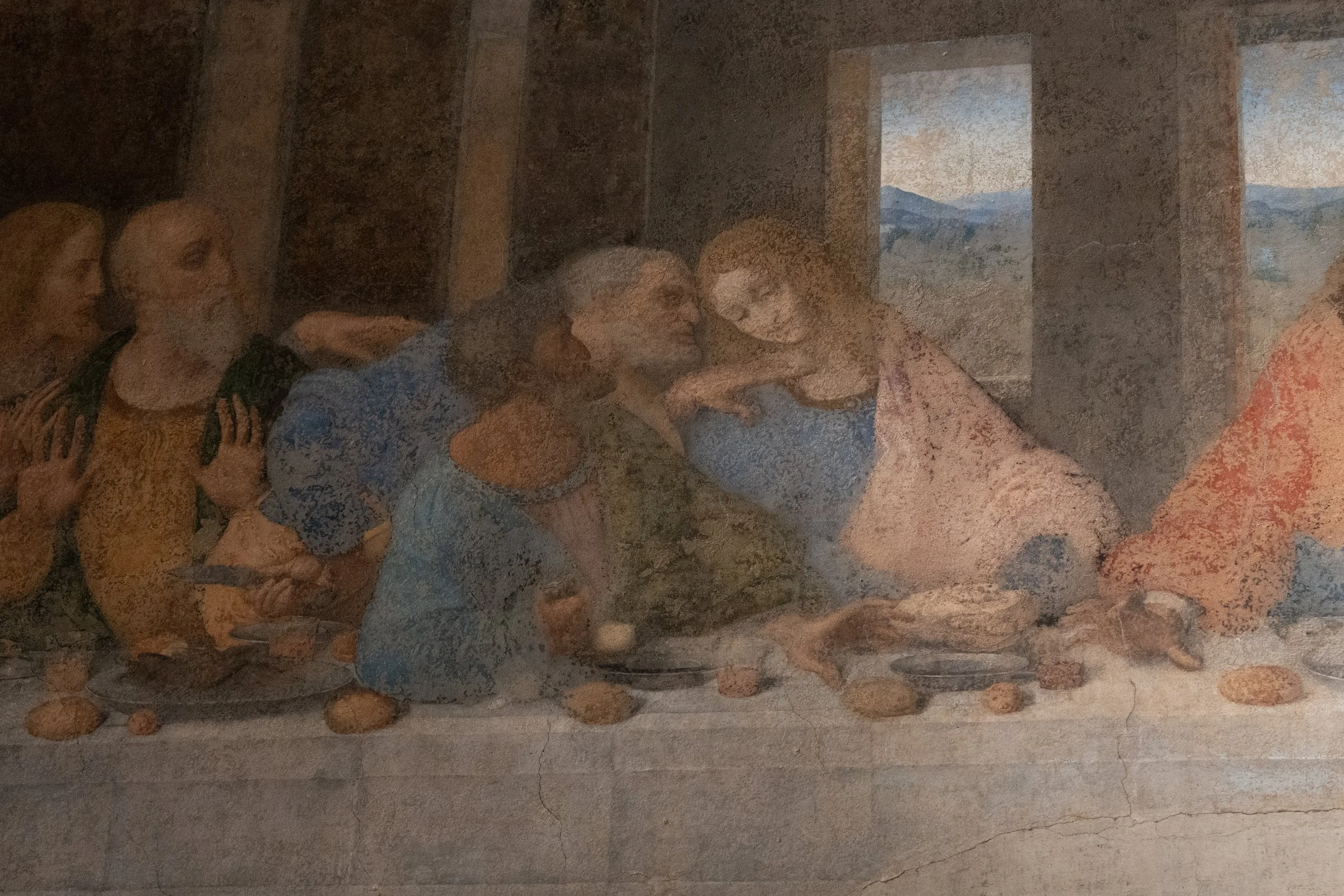
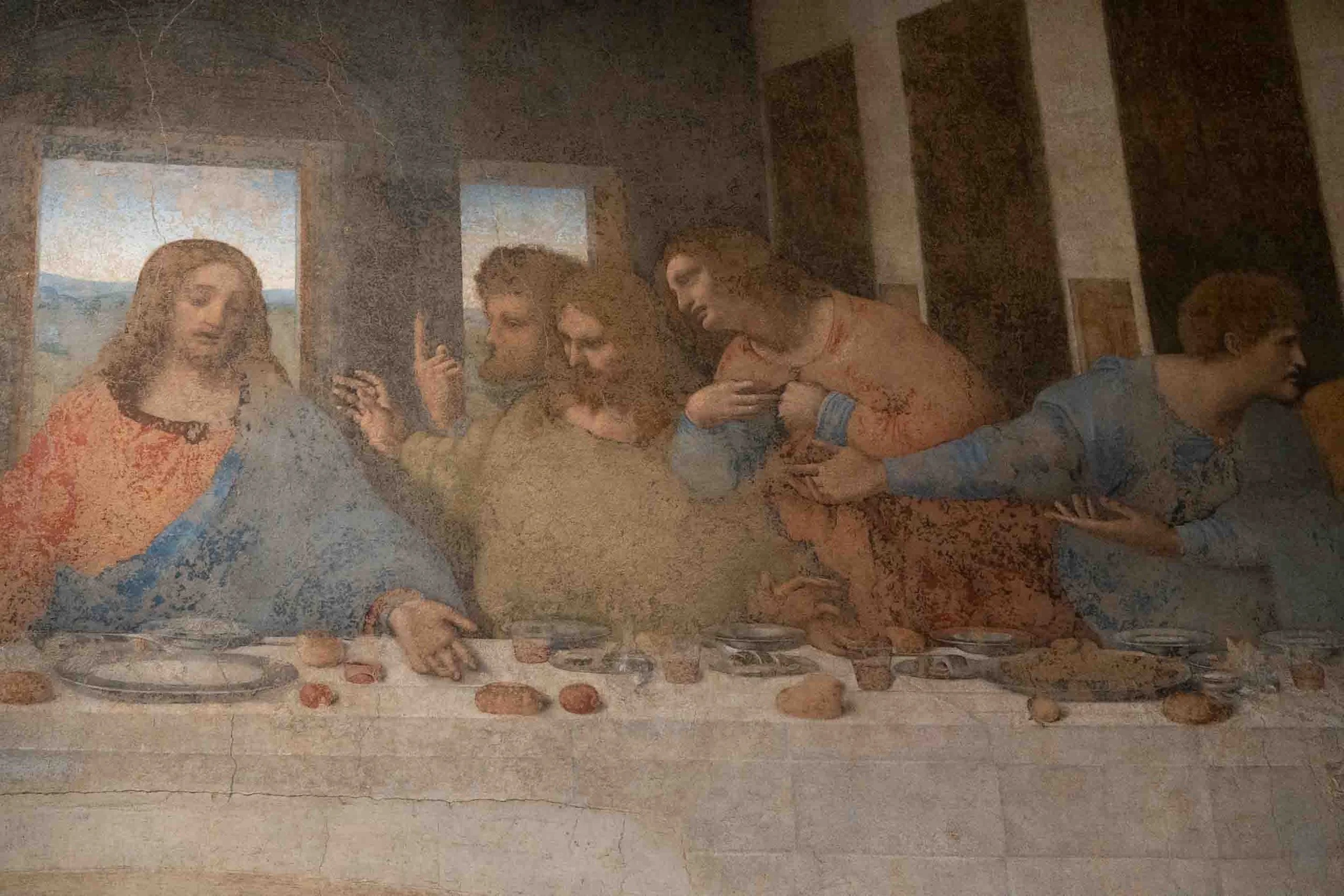
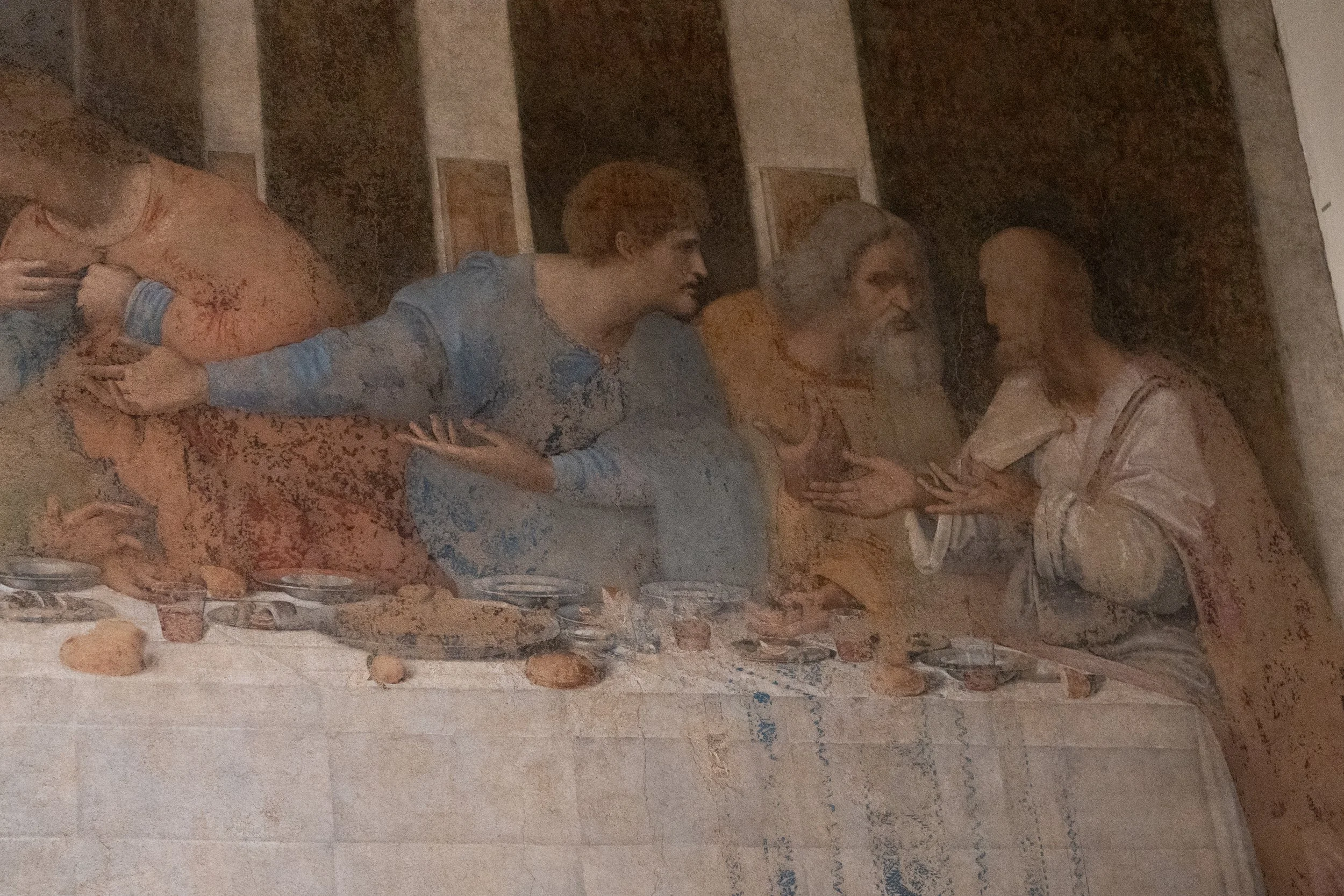
Angela: look at the hands, the leaning bodies, the glances exchanged between the figures. Some apostles reach towards Christ, others seem to seek explanations from their companions, while still others react with sudden gestures. Nothing appears accidental.
Piero: Leonardo studies movement as a language in its own right, capable of expressing what words cannot convey. Jesus, at the centre, remains composed in a sorrowful stillness. His demeanour creates a powerful contrast with the agitation surrounding him.
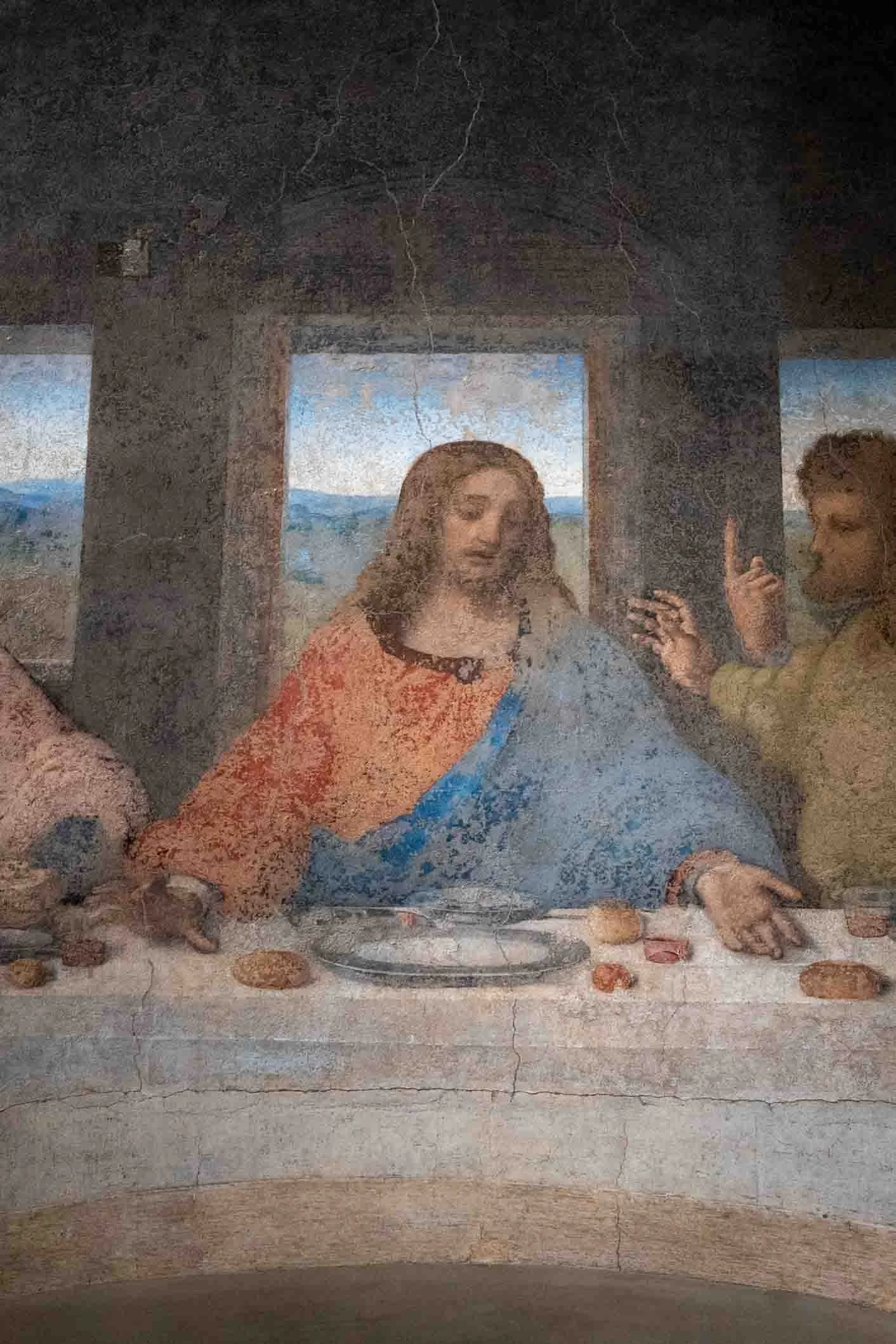
Angela: in the background, the bright openings guide our gaze and enhance the depth of the scene, creating a harmonious balance between the observation of reality and geometric construction.
Piero: one detail deserves particular attention: Judas is not separated from the other apostles, as he was in many earlier depictions. Leonardo places him among the group, using his posture and gestures to distinguish him: his right hand clutches the purse of money, while his left reaches out to share the bread with Jesus.
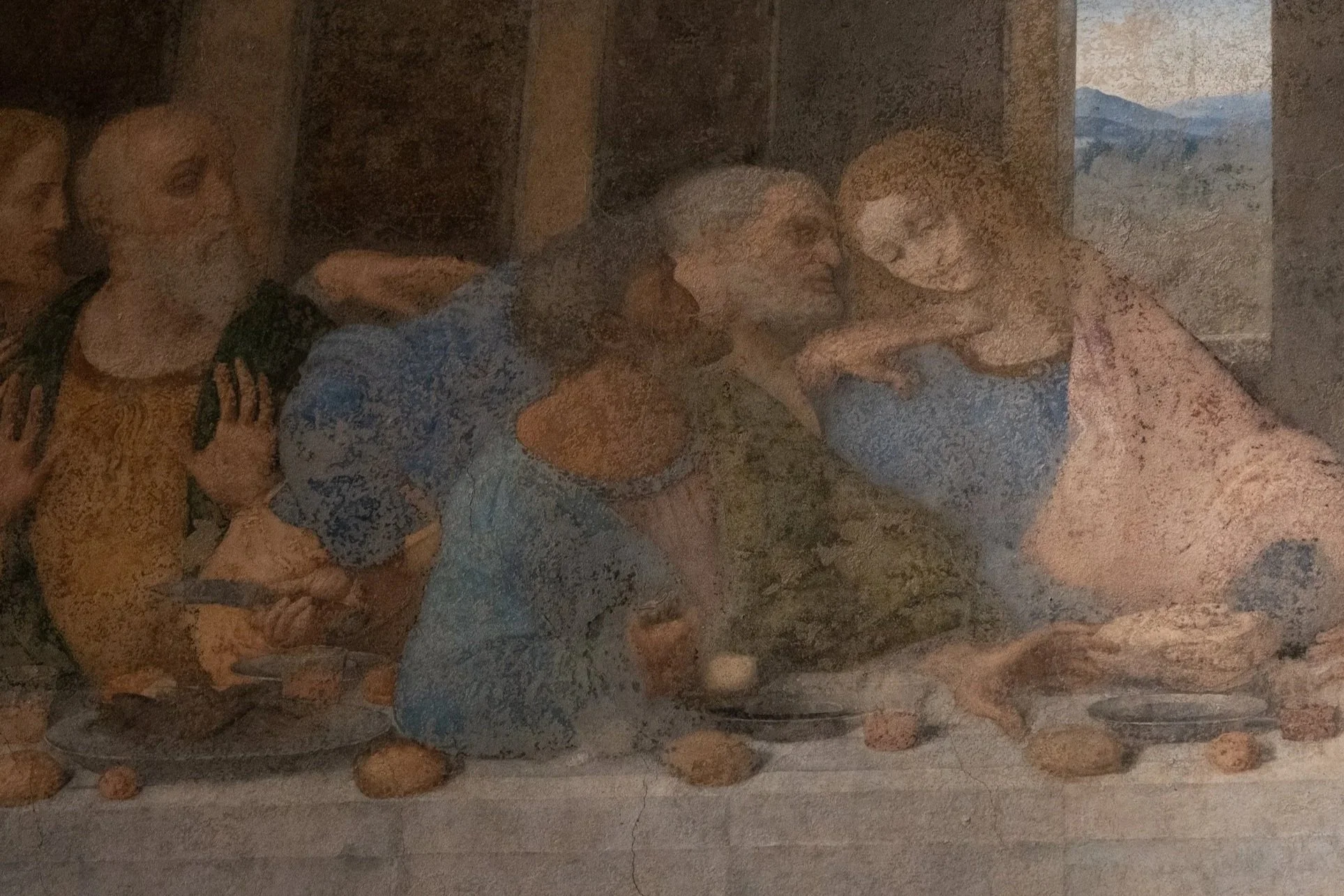
Angela: this is an important detail, because it reminds us that betrayal is not always immediately apparent from the outside. Judas sits at the same table as the others, part of the community sharing this moment, as though he might still have the chance to turn back.
Piero: Leonardo's greatness lies here, too, in his ability to suggest a story without spelling everything out, leaving those who look at the painting room to interpret, question and reflect.
Angela: there's also an interesting and rather amusing anecdote about Judas's face. The lengthy delays in completing the work led the prior to complain to Ludovico il Moro, who passed the complaint on to Leonardo. The artist paid little attention to the criticism, but reportedly drew inspiration from the prior himself for the face of the betraying apostle…
Piero: and yet, this extraordinarily powerful masterpiece is also one of the most fragile works in art history. Eager to work slowly, revisit details and refine subtle shades, Leonardo chose not to use the traditional fresco technique, which involves painting onto fresh plaster. Instead, he opted for a dry-painting technique, applying pigments to a surface that had already dried, using a preparation that allowed him to work in a way more similar to painting on a wooden panel.
Angela: this enabled him to achieve extraordinary effects of light and expression, but the paint did not bond to the wall as securely as it would have with a traditional fresco. Deterioration began relatively early, just a few years after the work was completed.
Piero: since then, the Last Supper has endured centuries of misfortune, beginning with the doorway that was once cut into the wall beneath Christ's figure. Loss of pigment, restoration work and past interventions have profoundly damaged its surface. Over the years, some attempts were made to reconstruct missing sections, often further altering what remained of the original painting.
Angela: only the emergence of a modern approach to restoration, focused primarily on conservation and the recovery of authentic traces, made it possible to address the problem using more rigorous criteria.
Piero: the most recent major restoration, led by conservator Pinin Brambilla Barcilon, lasted from 1977 to 1999, more than twenty years of painstaking work. It revealed the masterpiece we see today, stripped of the layers added by earlier interventions. Nevertheless, some areas no longer preserve Leonardo's original work.
Angela: the history of the Last Supper also includes a dramatic chapter from Milan's more recent past. In August 1943, during the Second World War bombings, the convent and refectory suffered severe damage. The roof collapsed, along with parts of the surrounding structures.
Piero: Montorfano's Crucifixion was damaged, and the complex risked losing a fundamental part of its artistic heritage forever. Leonardo's wall, protected by structural supports and sandbags, survived the destruction.
Angela: knowing that we can still admire this work today thanks, in part, to those protective measures makes our visit even more moving.
Piero: I've mentioned it, and we certainly mustn't forget the other great protagonist of the refectory.
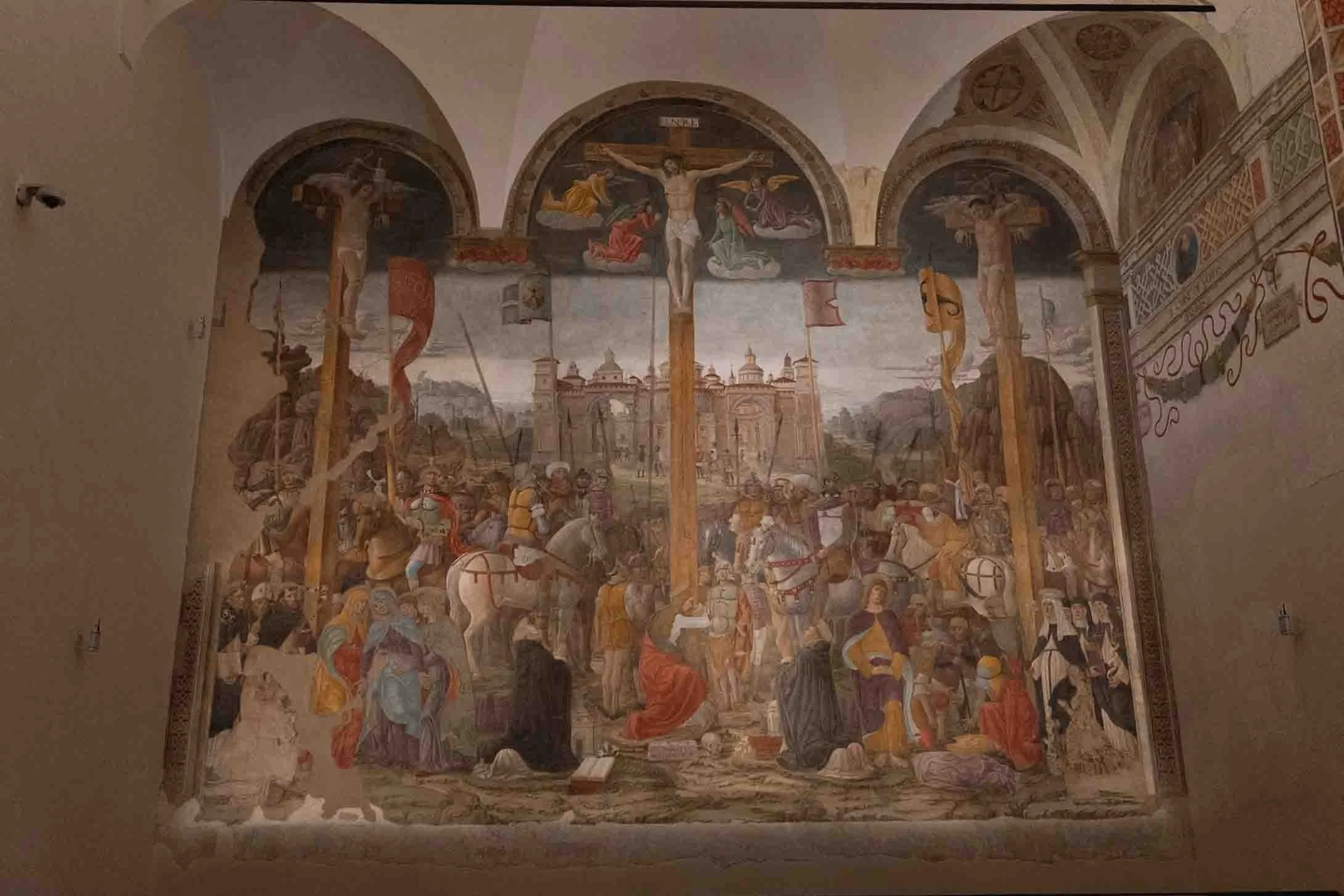
Angela: on the wall opposite the Last Supper stands The Crucifixion by Donato Montorfano, an imposing fresco completed in 1495, making it contemporary with Leonardo's work.
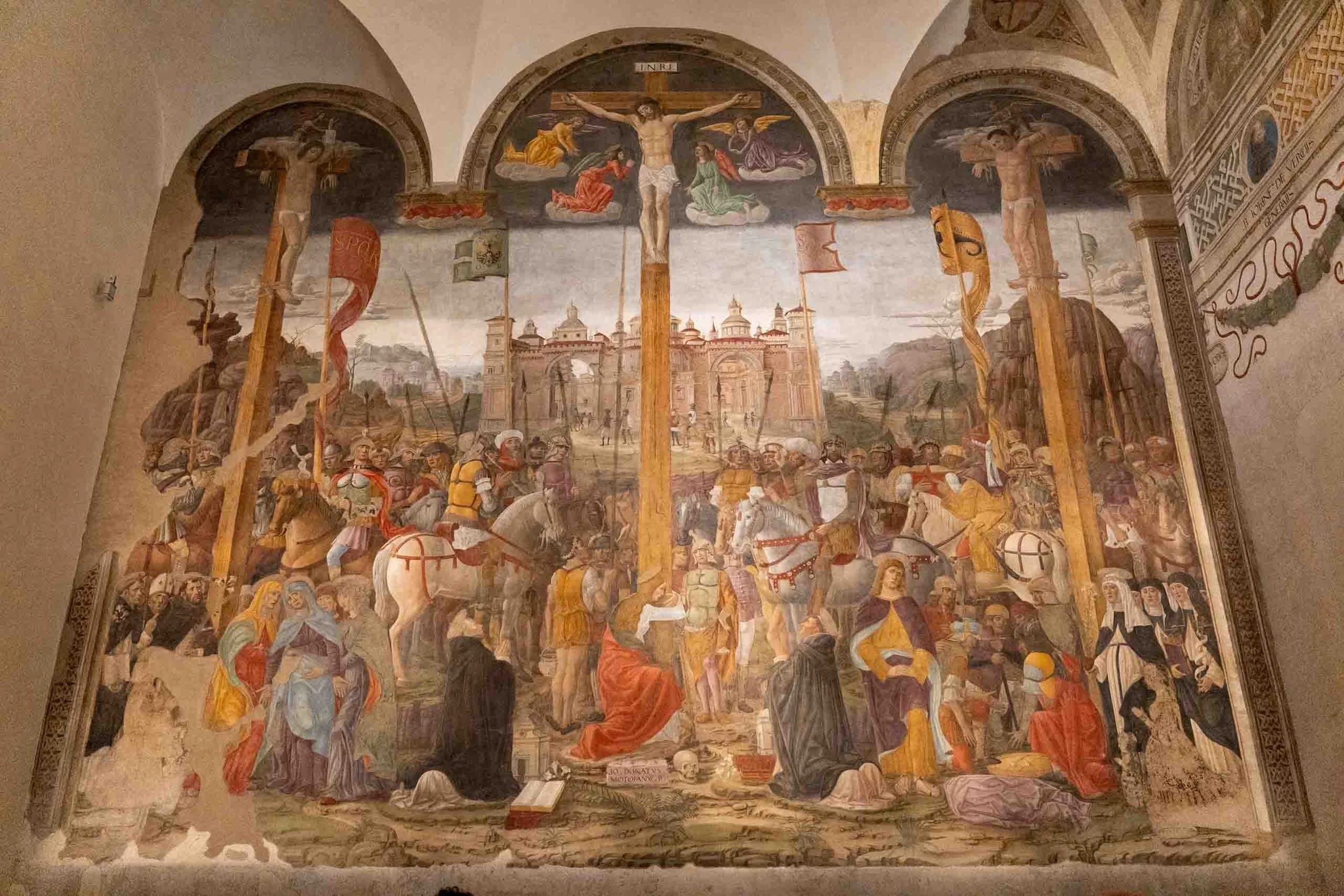
Piero: it occupies almost the entire wall, measuring approximately seven metres high and nine metres wide. The composition is arranged around the three crosses of Calvary, surrounded by a crowd of figures, soldiers and mourners, against the backdrop of a rugged landscape and an imaginary Jerusalem.
Angela: this work belongs to a different pictorial tradition from Leonardo's. Montorfano's figures are more sharply defined, the composition is crowded, and the characters are arranged according to a more traditional structure.
Piero: looking closely, we discover a painting of considerable interest, rich in details, gestures and costumes that tell us much about Lombard artistic culture at the end of the fifteenth century.
Angela: the scene stretches across the entire wall and, in its best-preserved sections, offers a precious record of a pictorial language that Leonardo would help transform radically.
Piero: there's also a curious connection with the family that commissioned the entire project. Along the lower edges of the Crucifixion, despite their very fragmentary condition, traces remain of figures attributed to Leonardo and associated with Ludovico il Moro, his wife Beatrice d'Este and their children. The duke wanted to leave a visible presence within the complex he was helping to finance and transform. Unfortunately, these figures are now difficult to make out, but they provide another link between the history of the Sforza court and that of the refectory.
Angela: it's a real shame that this fresco doesn't receive the same attention as its counterpart. Not because it has less historical value, but because it is inevitably overshadowed by the Last Supper's worldwide fame. When we enter the room, our eyes immediately turn towards Leonardo; when we leave, we're still so overwhelmed by images and emotions that we often have little time left to appreciate Montorfano's work. And yet, both paintings were conceived to give meaning to this space: one depicts Christ announcing his impending betrayal, the other his death on the cross. Seen together, they form a spiritual journey of remarkable intensity.
Piero: with just fifteen minutes available, we must therefore choose carefully where to look. I admit that I spent most of my time in front of the Last Supper, trying to take in every expression and every detail. It's difficult to tear yourself away from that wall: the longer you look, the more it seems to reveal something new. But if I could offer one piece of advice to those who visit after us, it would be to devote at least a few moments to the Crucifixion, even if only to appreciate its scale, understand its composition and recognise its different artistic sensibility. It's a work that deserves to be observed without haste, even though, unfortunately, haste is an unavoidable companion here.
Angela: and speaking of stories that help us understand Leonardo's world, let's return for a moment to his celebrated Lady with an Ermine. The portrait depicts Cecilia Gallerani, a young woman at the Milanese court and Ludovico il Moro's lover between the late 1480s and the early 1490s.
Piero: the painting isn't housed in this refectory, but its story takes us straight into the refined and sometimes turbulent world of the Sforza court. Cecilia was an educated woman with connections to literary and musical circles. Leonardo portrays her with astonishing naturalness as she holds a sinuous, alert-looking ermine in her arms.
Angela: the animal is more than a decorative element. Its meaning has been interpreted in various ways, including in connection with the Order of the Ermine, awarded to Ludovico in 1488, and the nickname White Ermine associated with him.
Piero: scholars have also suggested a play on words between Cecilia Gallerani's surname and the Greek name for the ermine. These interpretations add to the fascination of a portrait that is already extraordinary for the subtlety of its gaze, the twist of the torso and the natural way the figure seems to react to something beyond the frame. Through a painting quite different from the Last Supper, we can once again appreciate Leonardo's remarkable ability to observe and portray human beings.
Angela: we leave the refectory with the feeling that we have seen something that goes far beyond its fame. But our day trip isn't over yet. Beyond these walls, other parts of the complex await us, including a peaceful little cloister and, above all, the church of Santa Maria delle Grazie. They will help us fully understand the ambition of Ludovico il Moro. Because the Last Supper is its most famous treasure, but it certainly doesn't exhaust the beauty of this place.
From the Cloister to the Church: Ludovico il Moro’s Renaissance dream
Piero: having just left the museum, we pause within the Santa Maria delle Grazie complex to admire the Cloister of the Frogs, a small Renaissance cloister connecting the church's tribune with the sacristy.
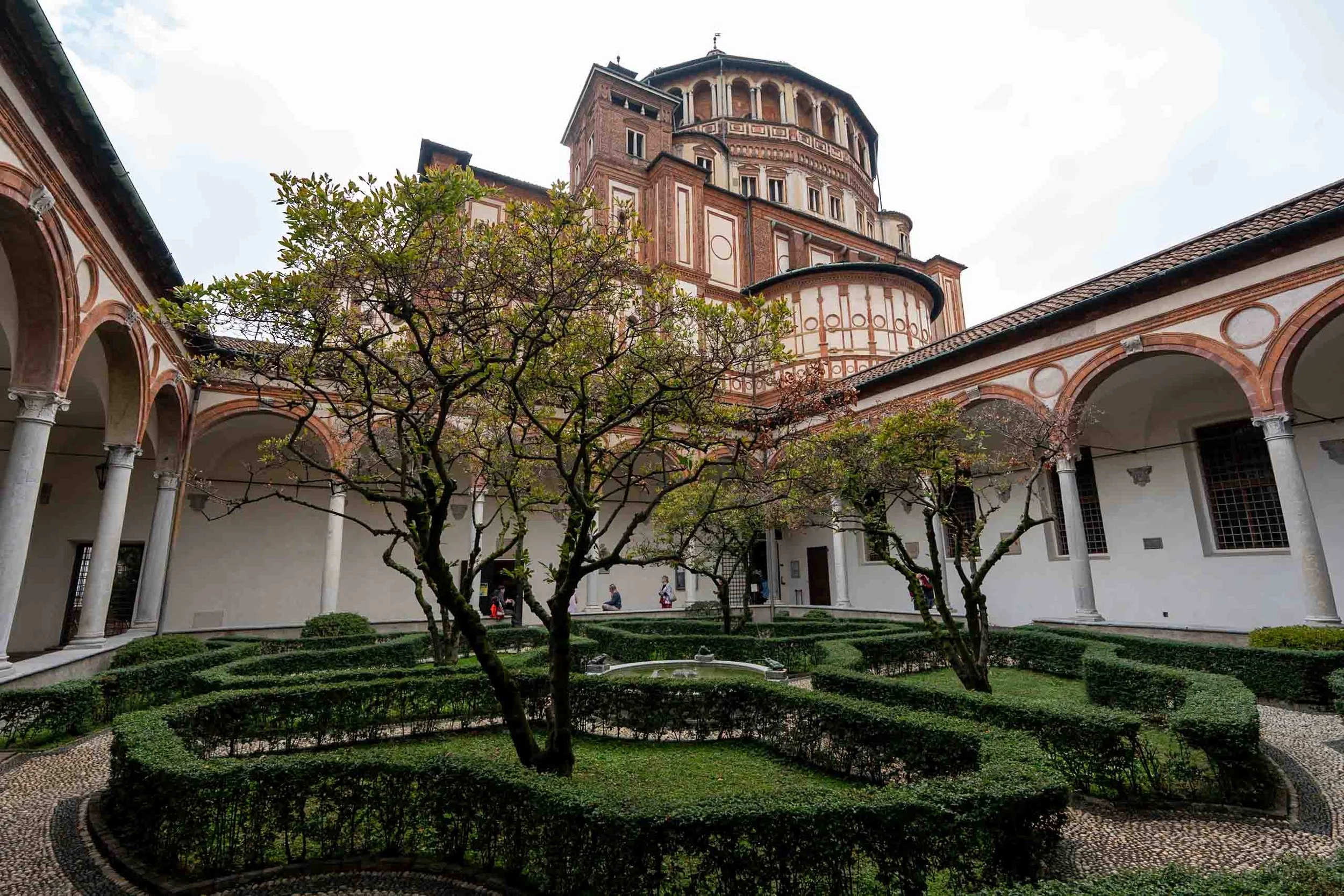
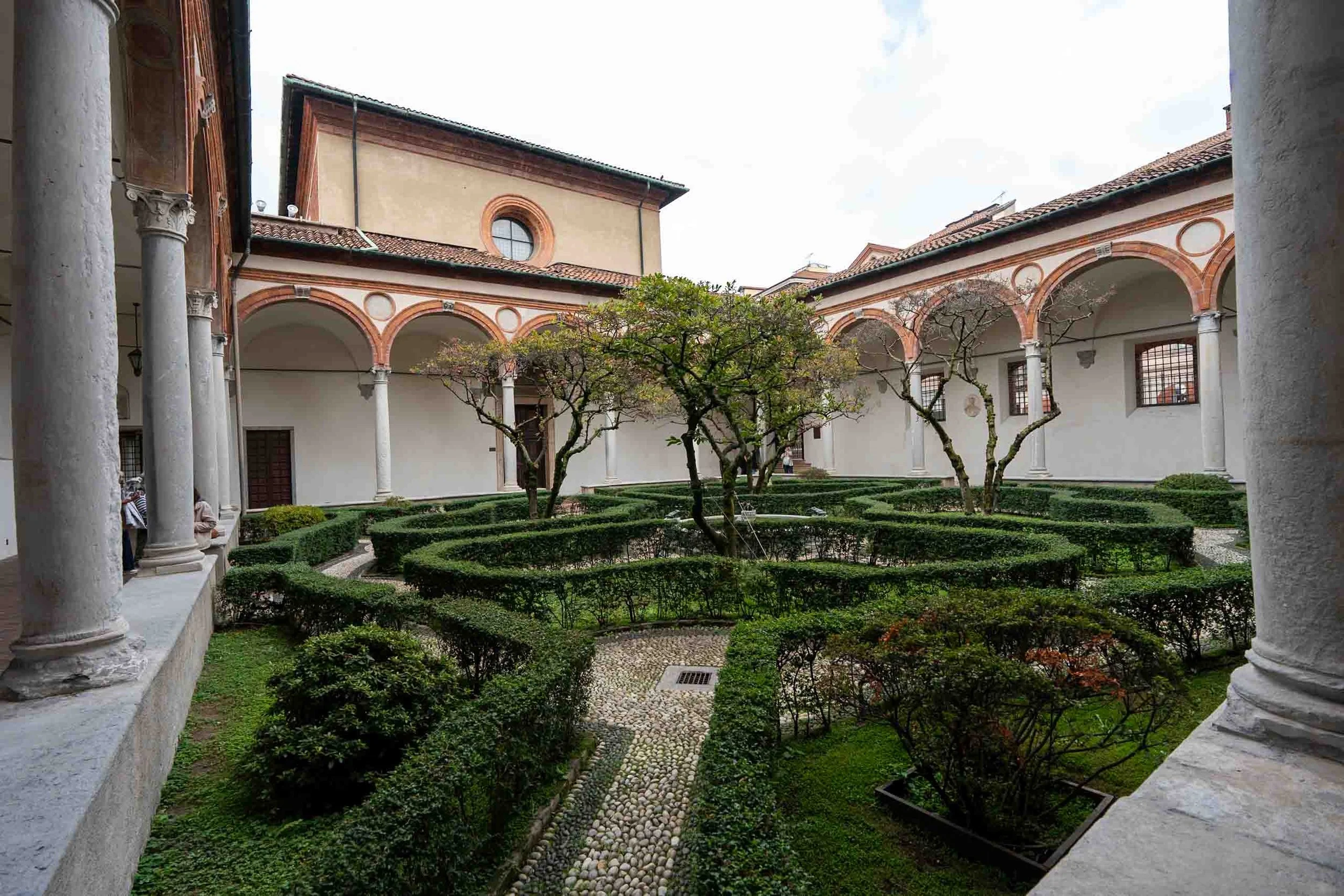
Angela: its name comes from the fountain in the centre of the courtyard, decorated with four small bronze frogs. It's an intimate, almost hidden space, a world away from the fame of the Last Supper, inviting visitors to slow down. The round arches, supported by stone columns, follow one another in a regular sequence along all four sides, creating a harmonious geometric rhythm, while the terracotta of the arches contrasts beautifully with the lighter tones of the stone.
Piero: it's from here that the dome begins to reveal some of its charm. The Renaissance tribune attributed to Donato Bramante rises behind the cloister's structures, offering a glimpse of the great architectural transformation commissioned by Ludovico. On the outside, the dome is enclosed within an imposing sixteen-sided lantern-like structure, articulated with windows, columns, cornices and geometric decorations.
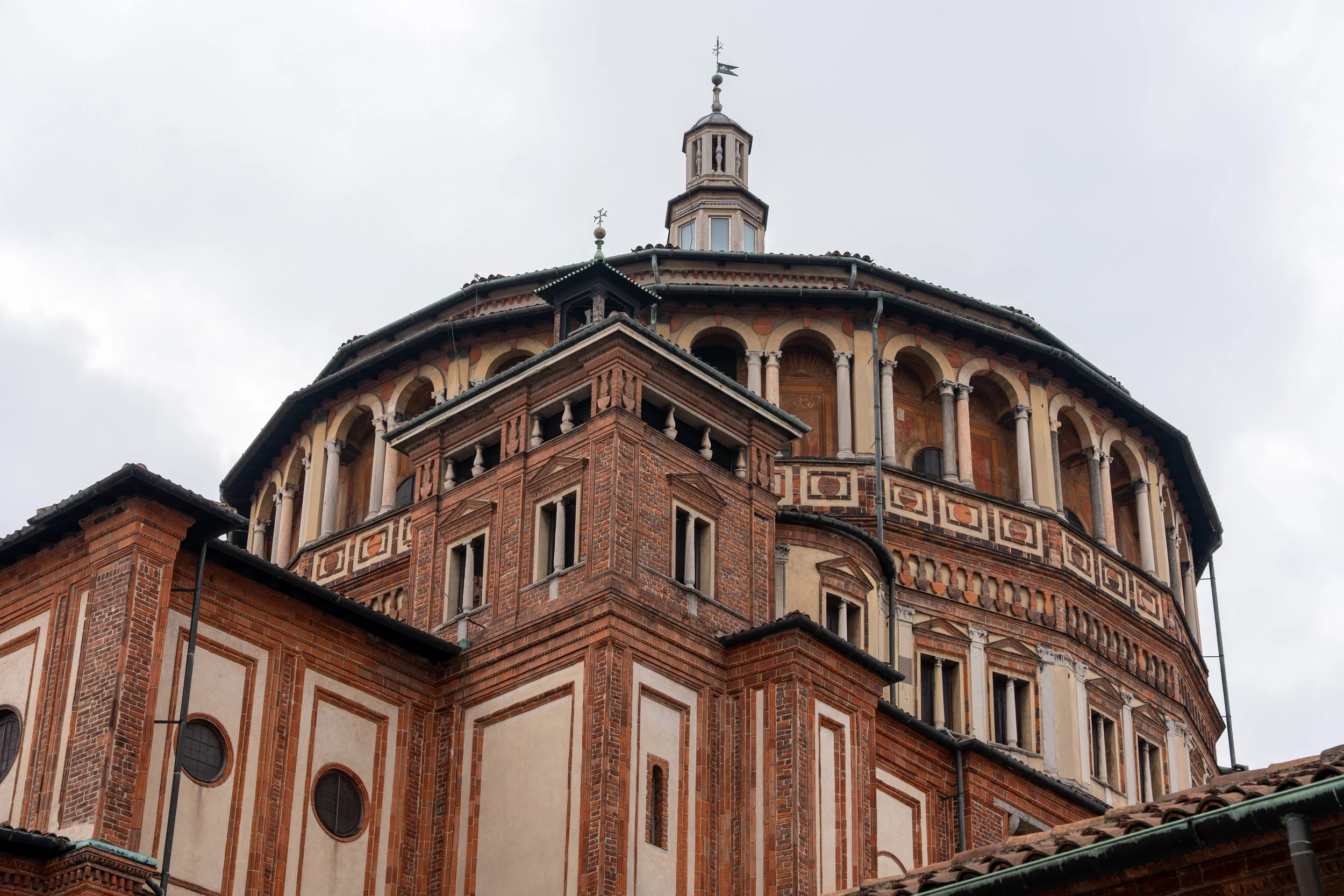
Angela: it is far more than a simple roof: this is a complex architectural structure, carefully designed to give the presbytery a monumental presence and make the church's new Renaissance identity unmistakable.
Piero: imagining this structure as it appeared at the end of the fifteenth century helps us understand just how innovative it was. Bramante, or at least the great Renaissance building project associated with him, introduced an architectural language based on geometry, proportion and clarity of form. While the nave retains the verticality and rhythm of Gothic architecture, the tribune opens up into a more spacious and carefully balanced setting. The tiburio conceals and protects the dome beneath it, while also enhancing its grandeur, creating a crowning feature that dominates the entire complex.
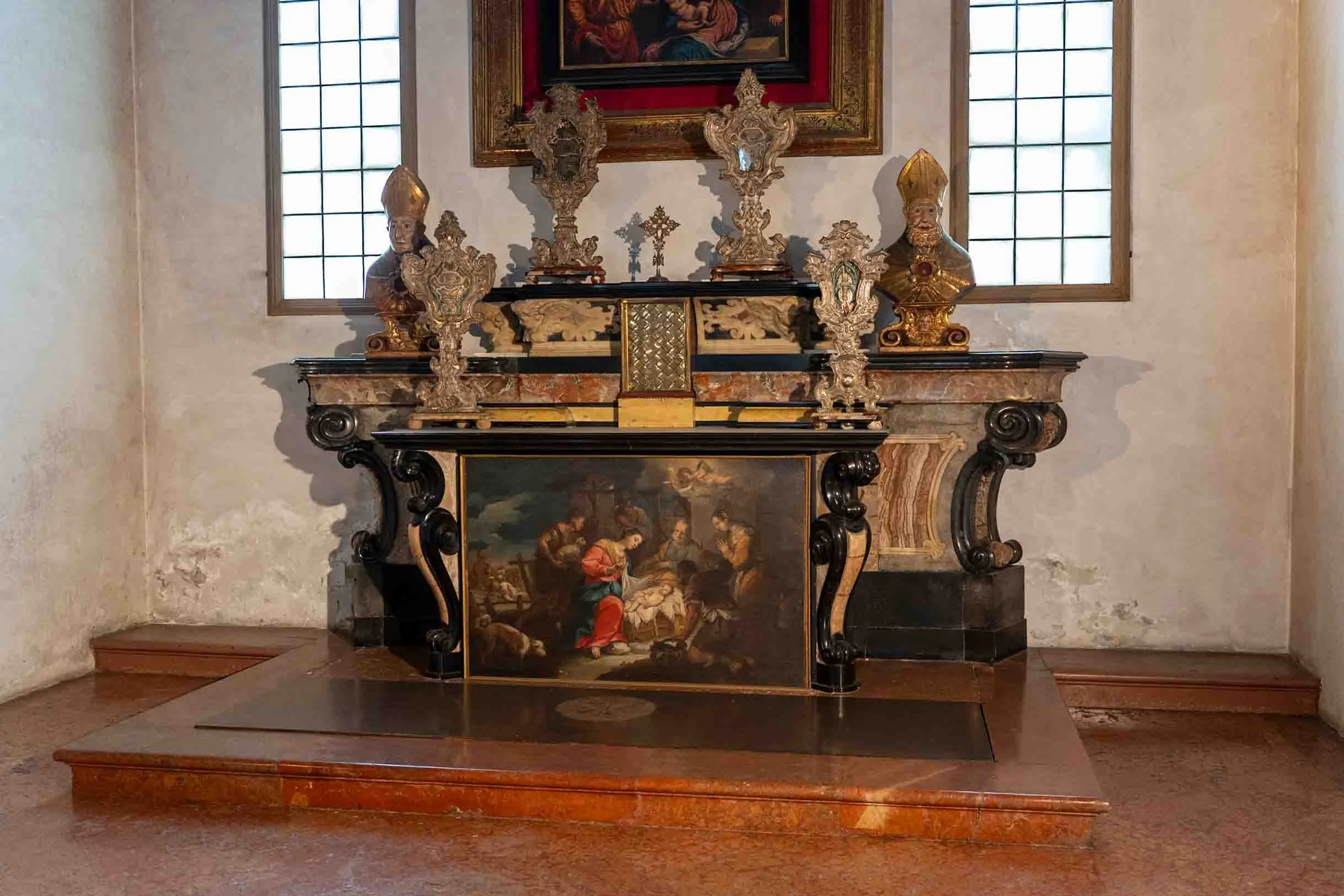
Angela: as we cross the threshold of the church, the atmosphere changes once again. The interior of Santa Maria delle Grazie reflects the meeting of two great artistic periods. The older section, associated with Guiniforte Solari's design, retains its Gothic layout: three naves, stone columns, ribbed vaults and pointed arches that guide our gaze towards the altar. Chapels open off the side aisles, bearing witness to the church's role in religious life and in the devotional practices of Milanese families. The overall impression is one of spaciousness and light, with an architectural structure that emphasises horizontal lines and a restrained yet richly detailed rhythm.
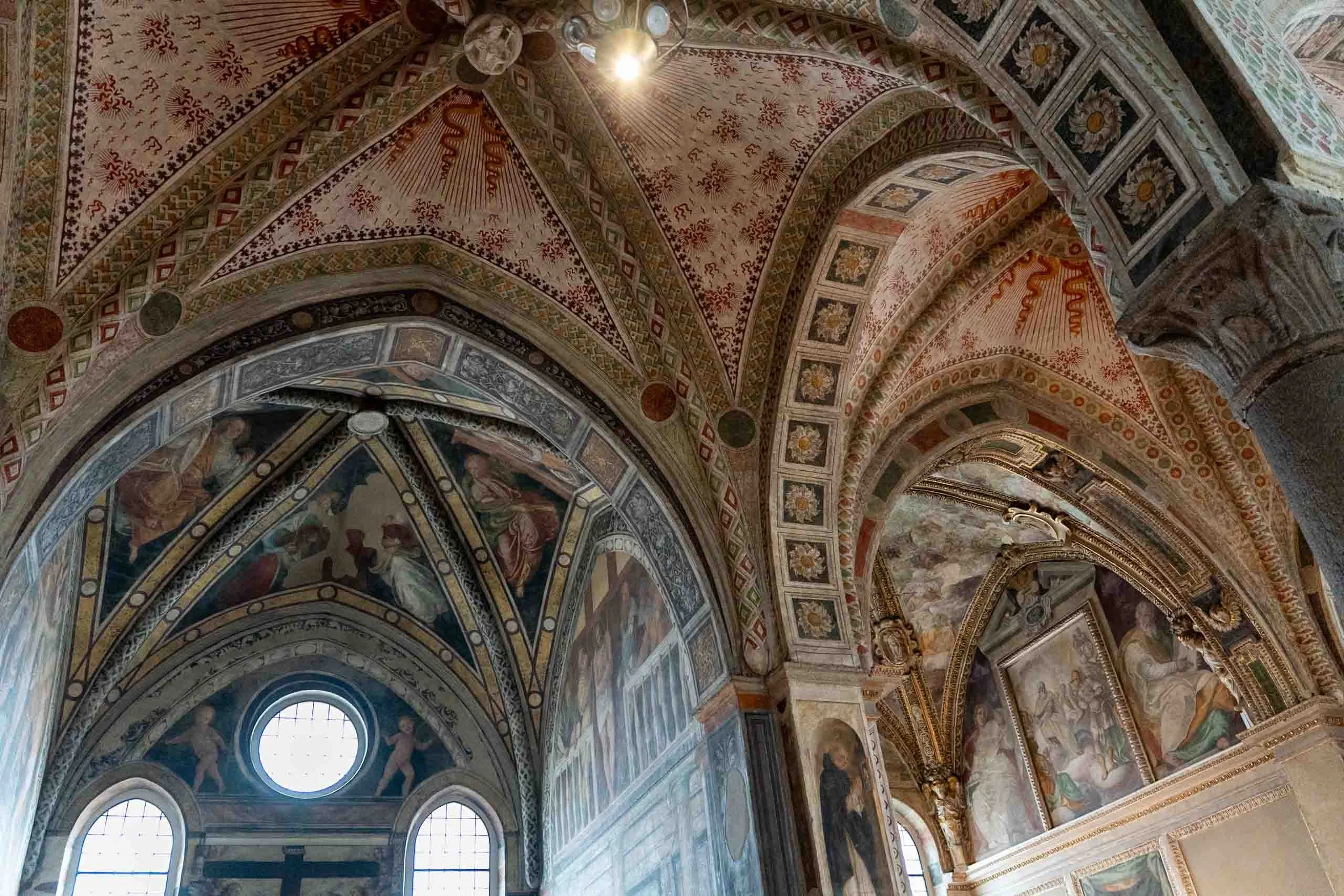
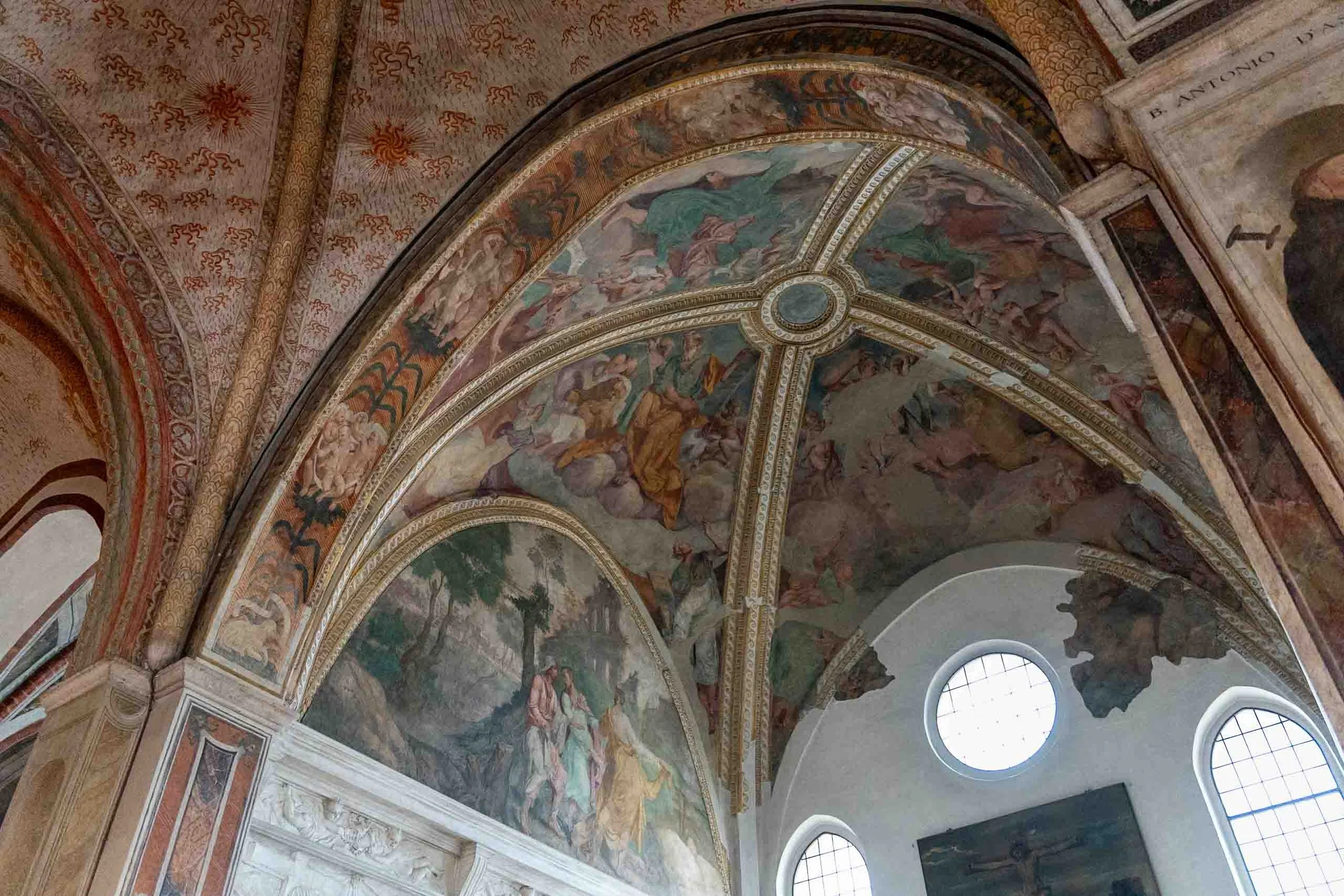
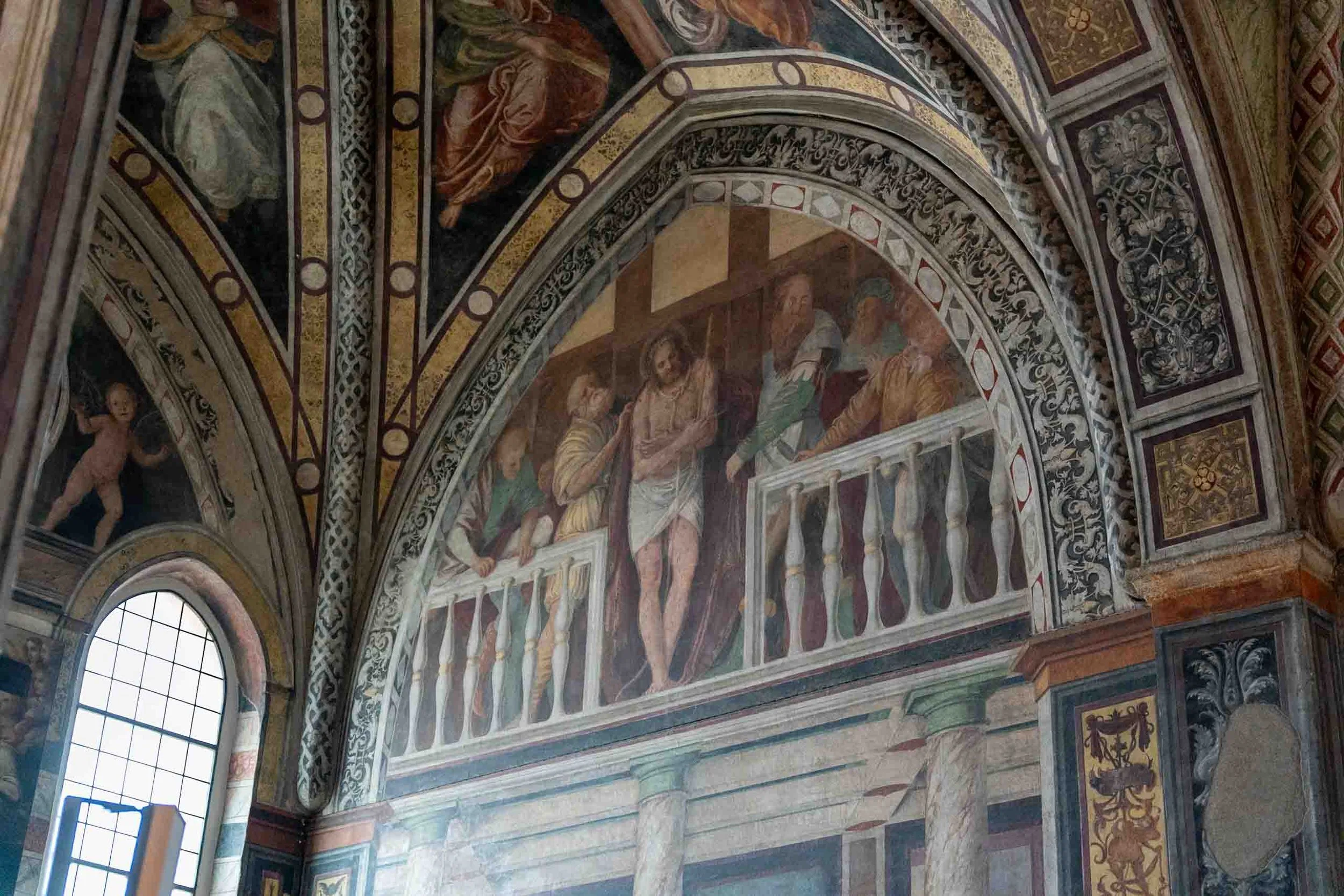
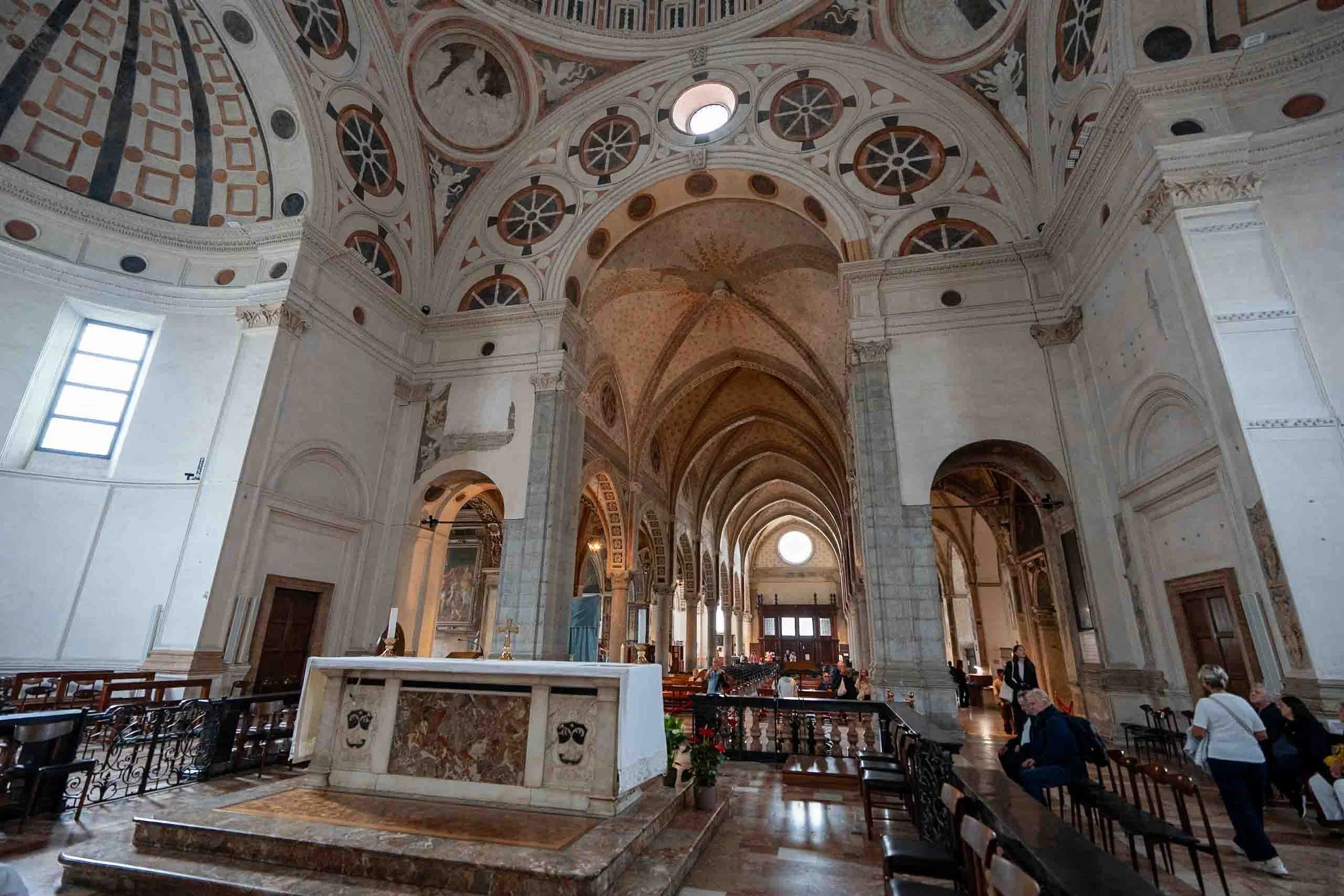
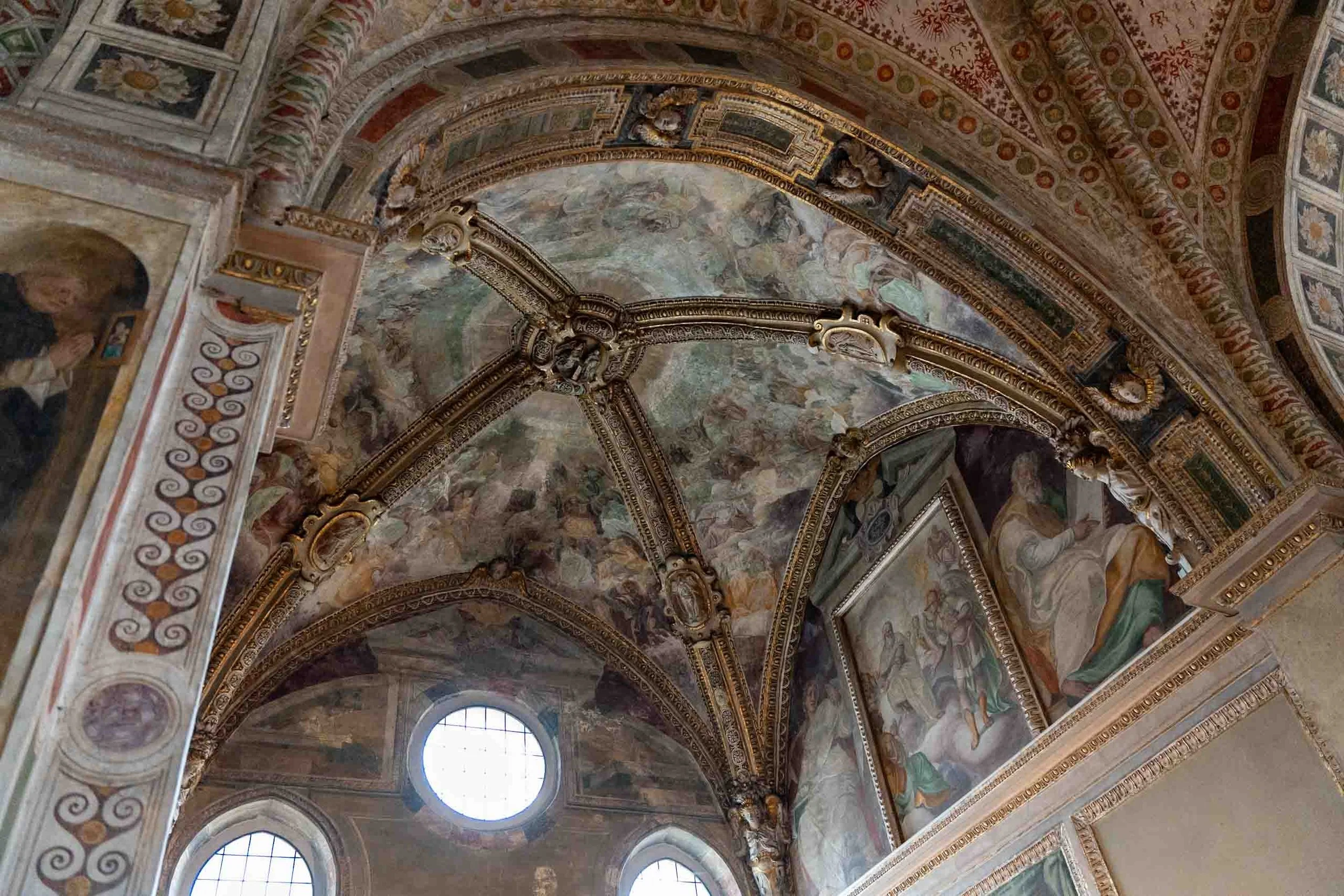
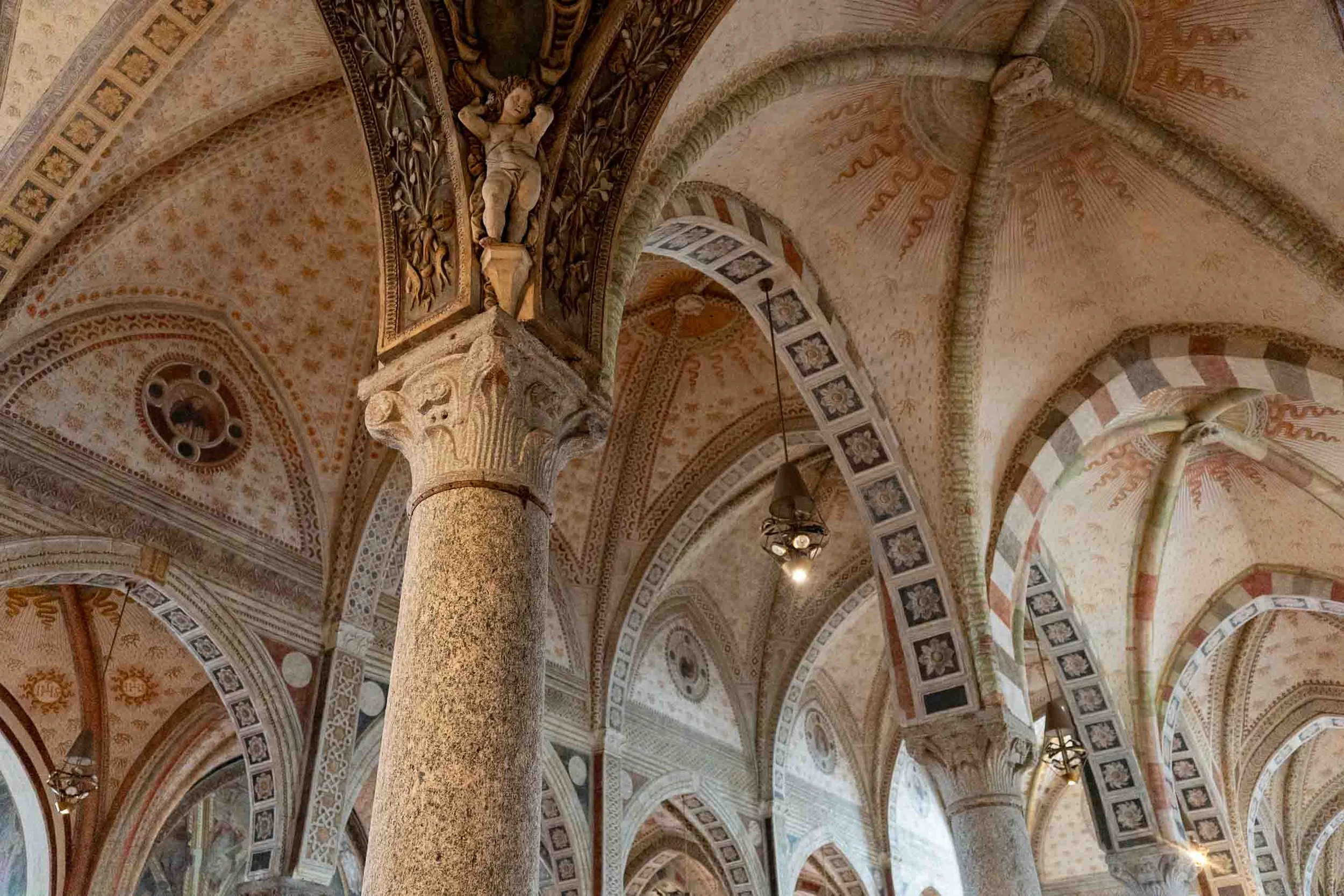
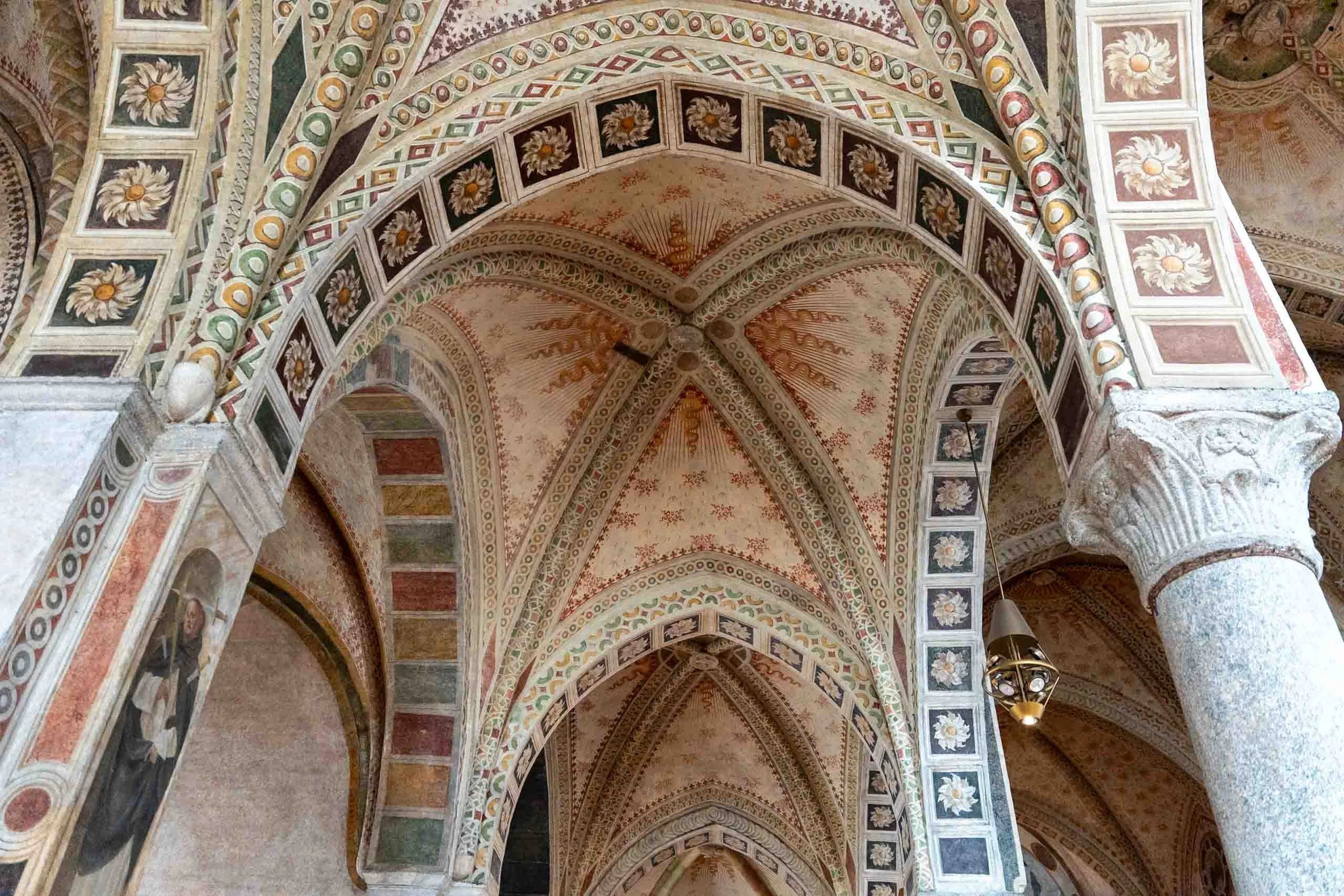
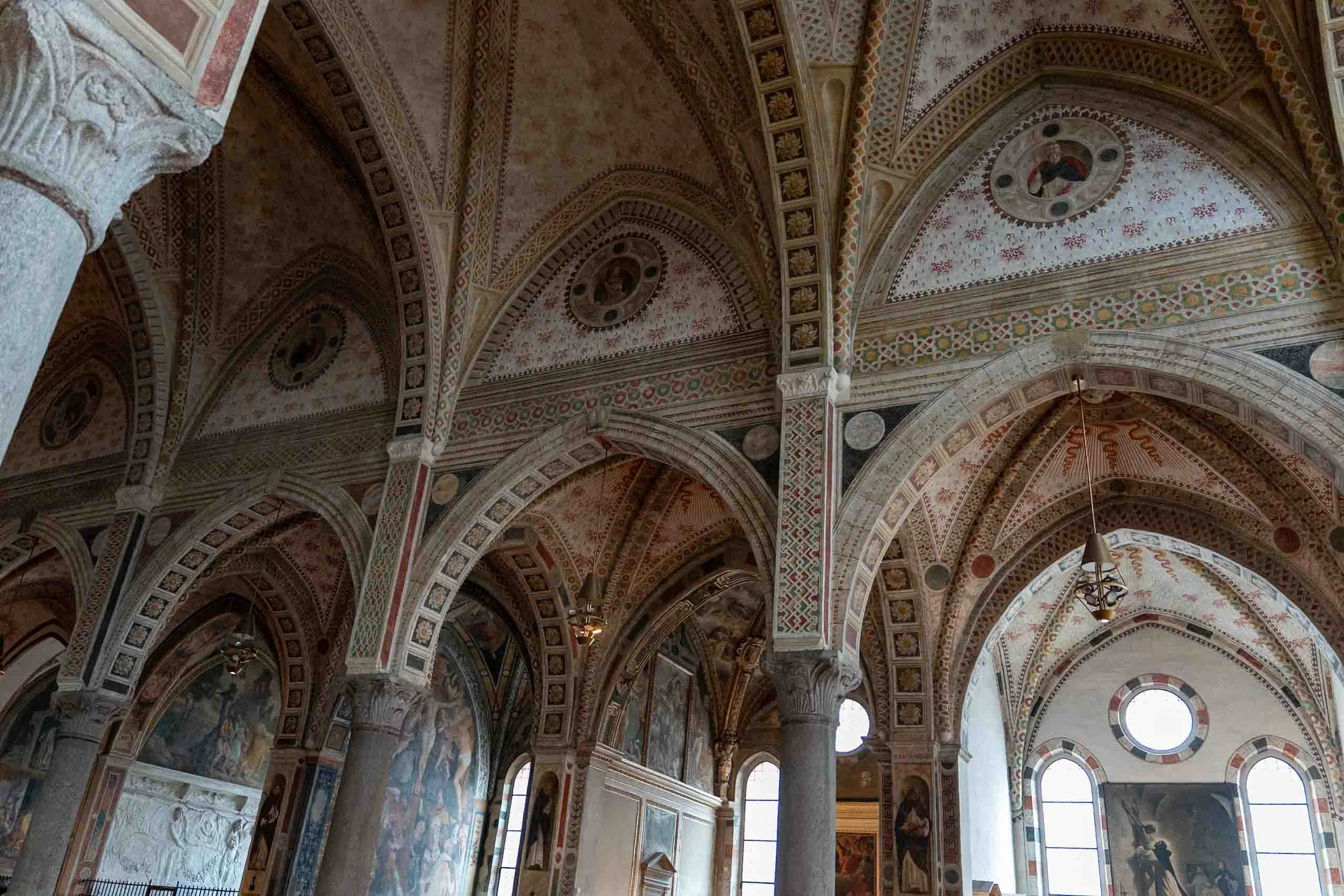
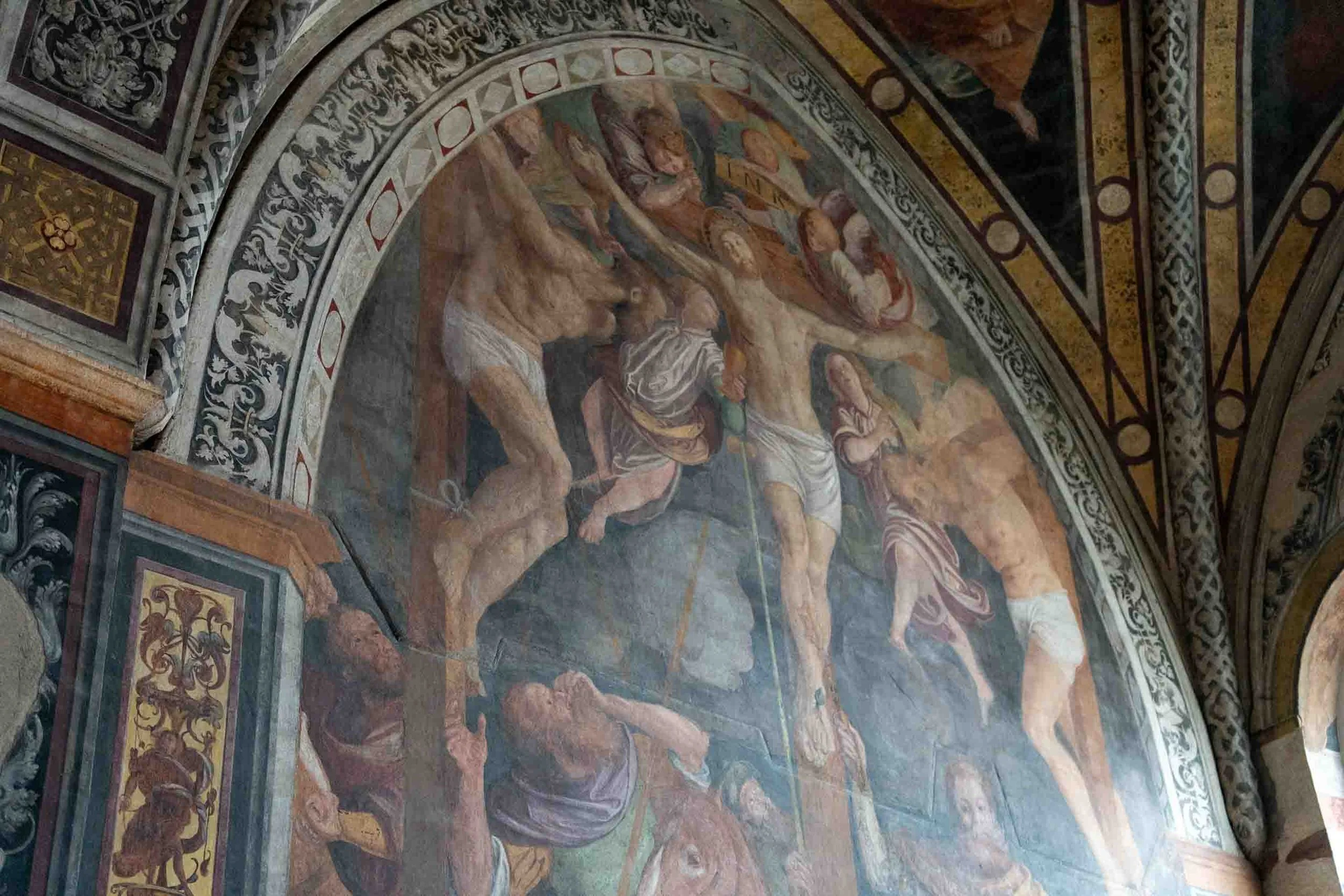
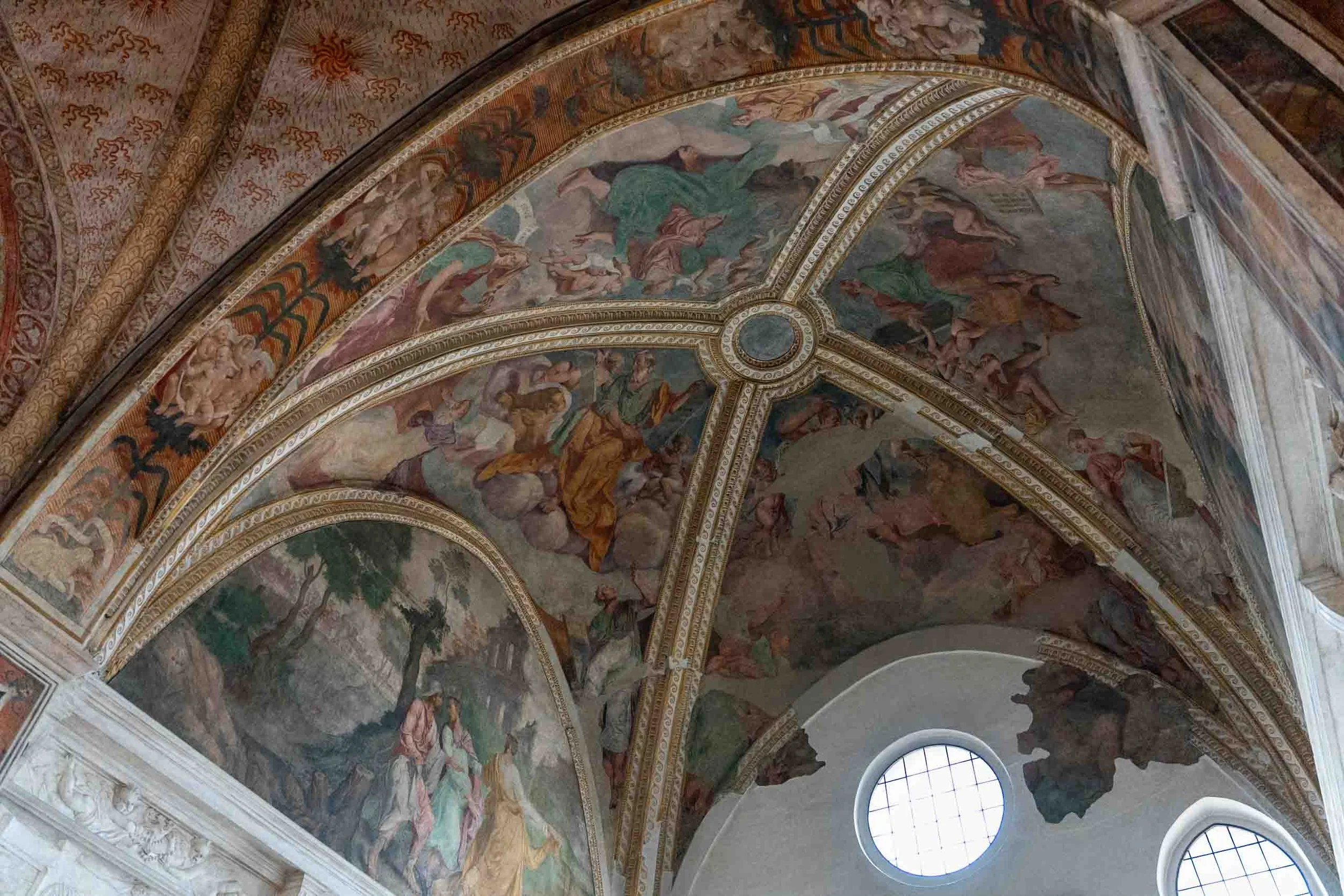
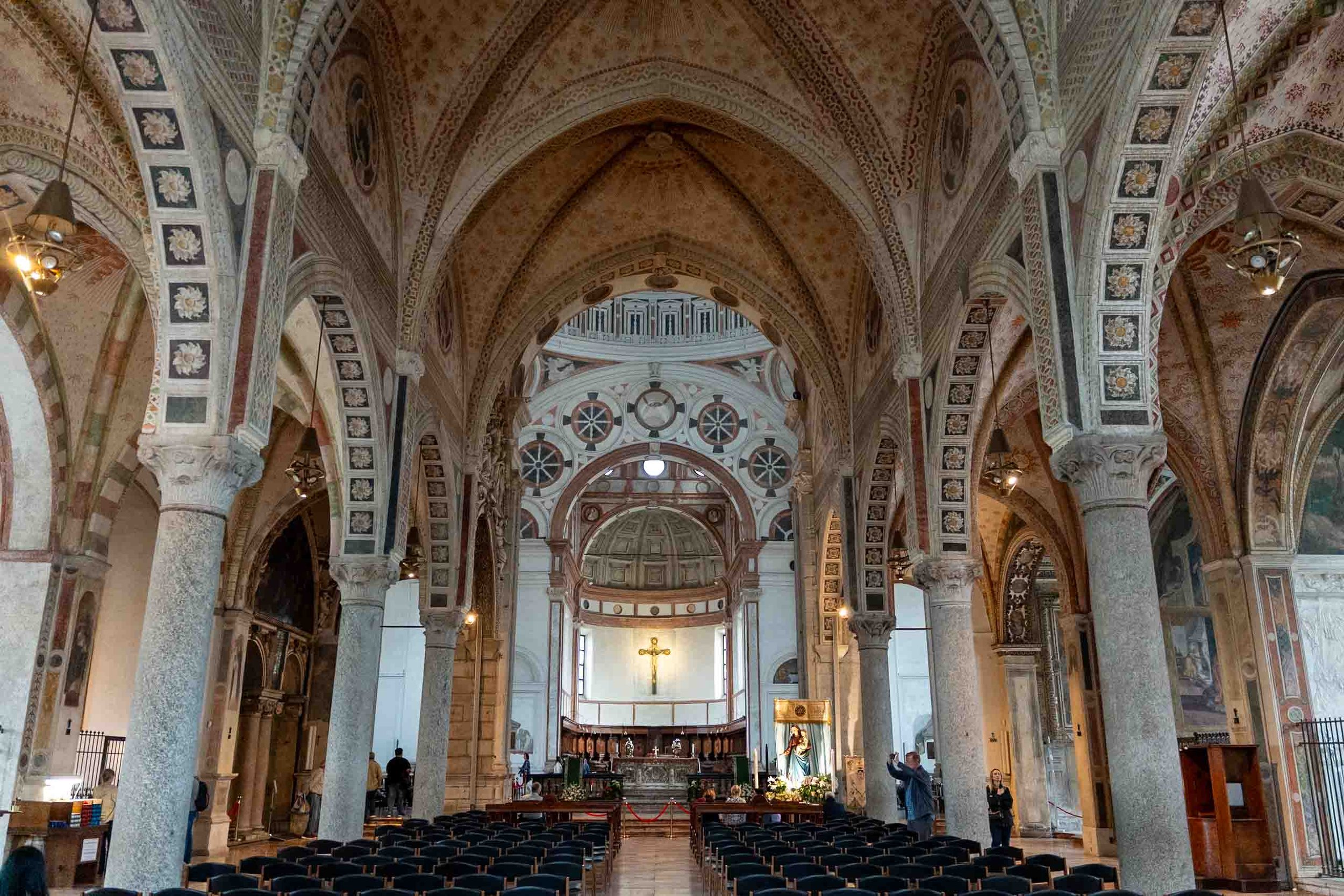
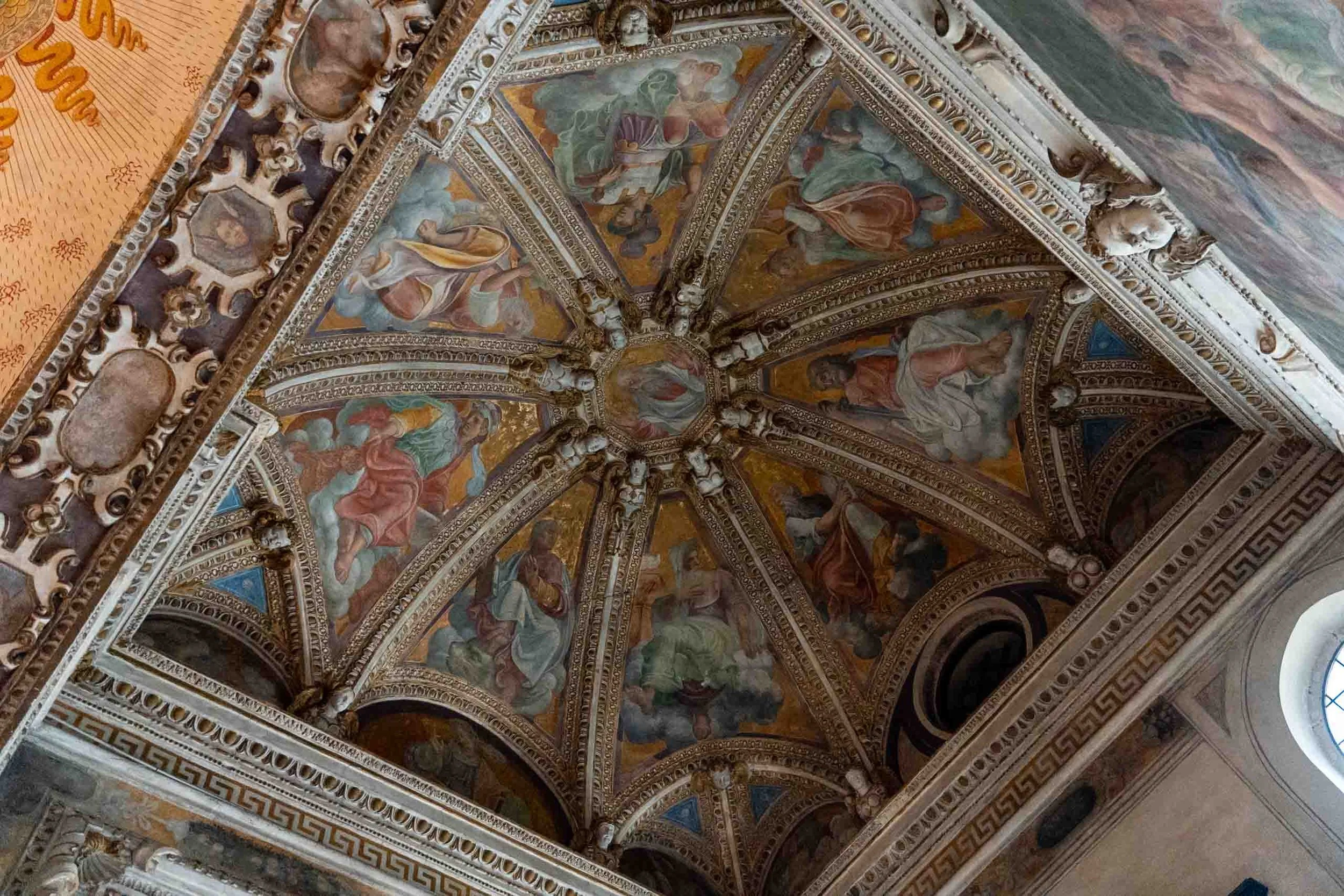
Piero: then, as we reach the far end of the church, we seem to step into another era. The Renaissance tribune emerges as a vast central space, crowned by a hemispherical dome and opening through monumental arches towards the apses and the choir. Inside, the sgraffito decoration and geometric patterns create a refined design, combining ornamental details, religious symbols and references to the Sforza family, who commissioned the work. Windows and circular openings allow light to filter in, highlighting the geometry of the space and enhancing its sense of balance. Its beauty differs from that of the Last Supper: perhaps less narrative, but captivating in its own way through space, proportion and light.
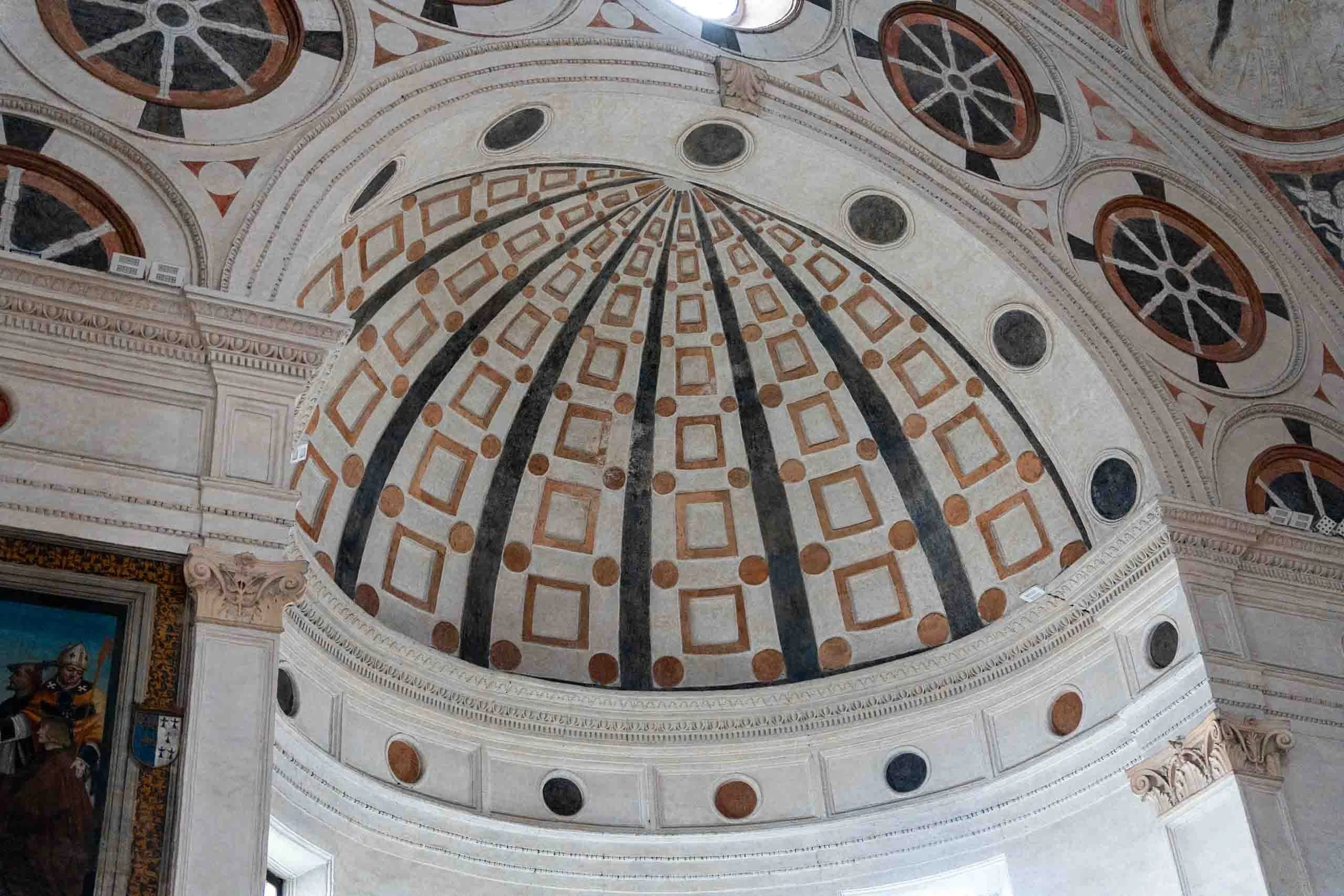
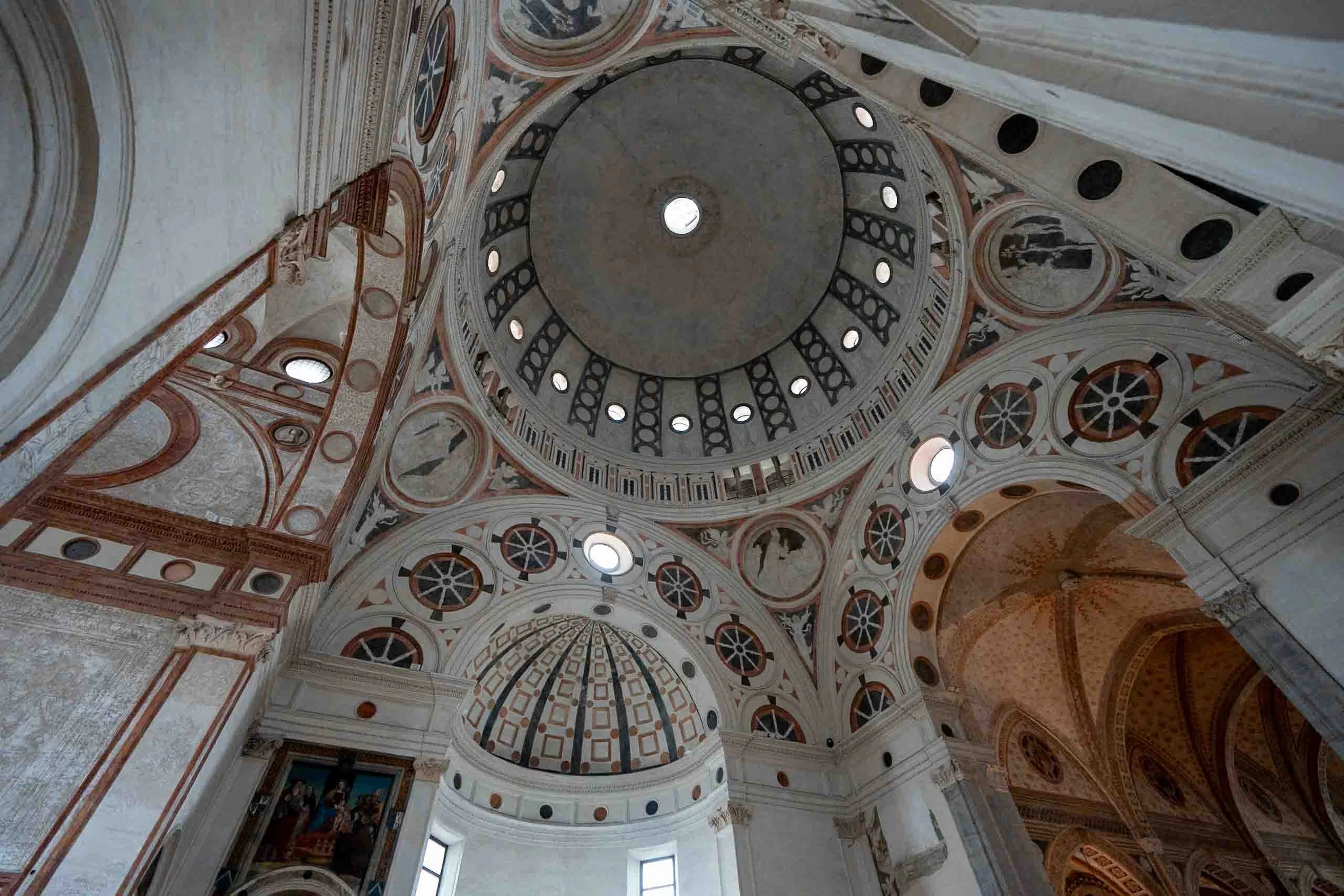
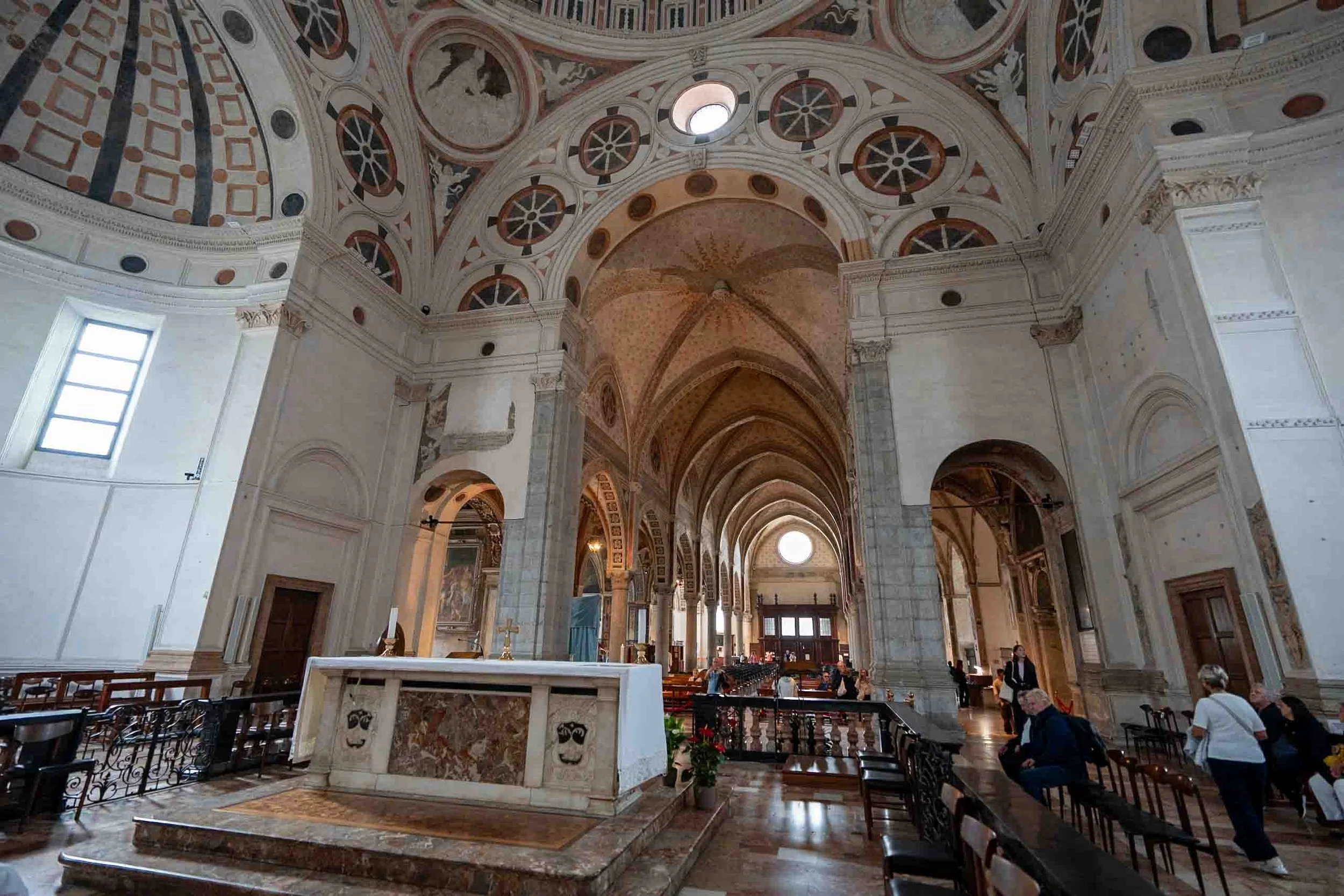
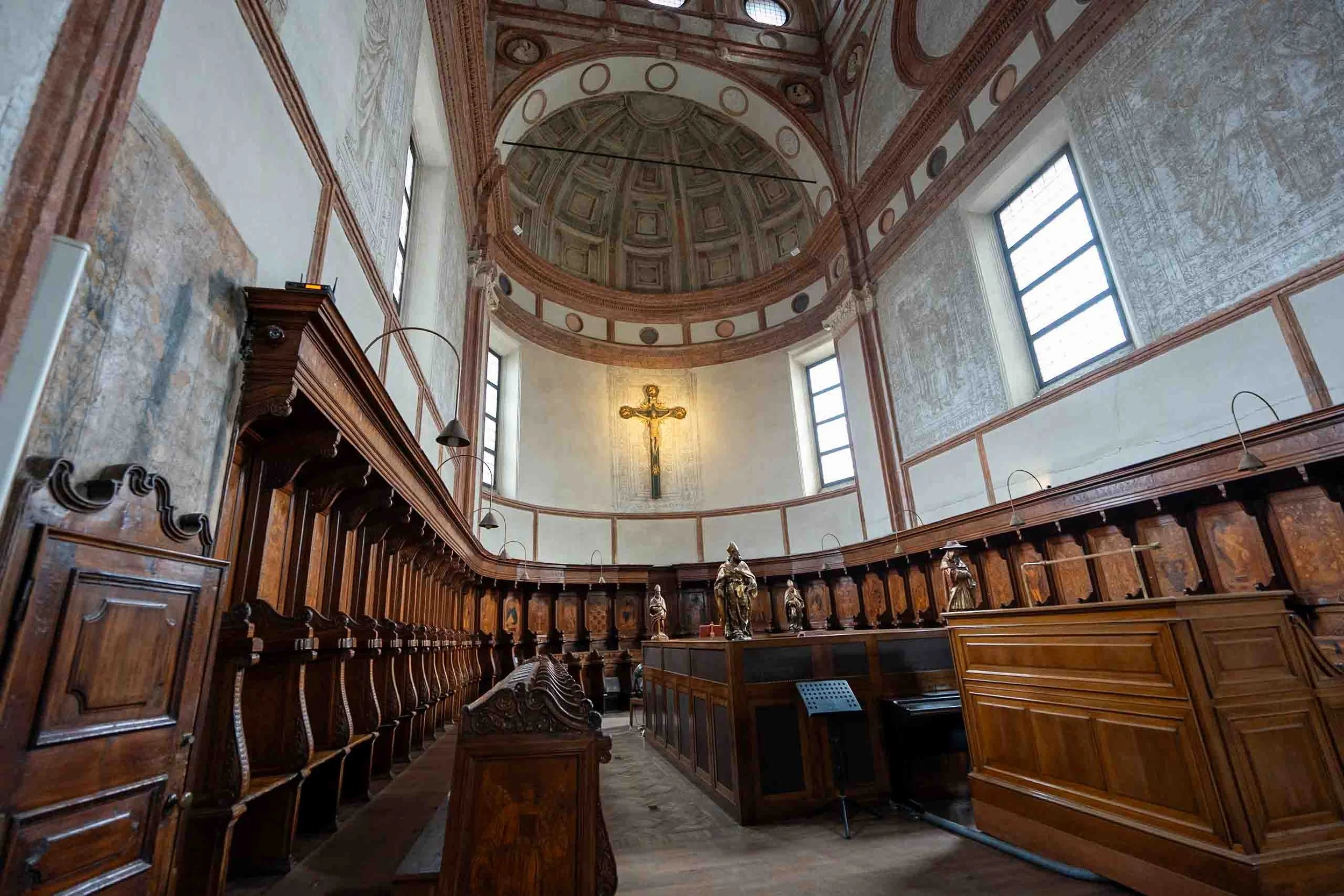
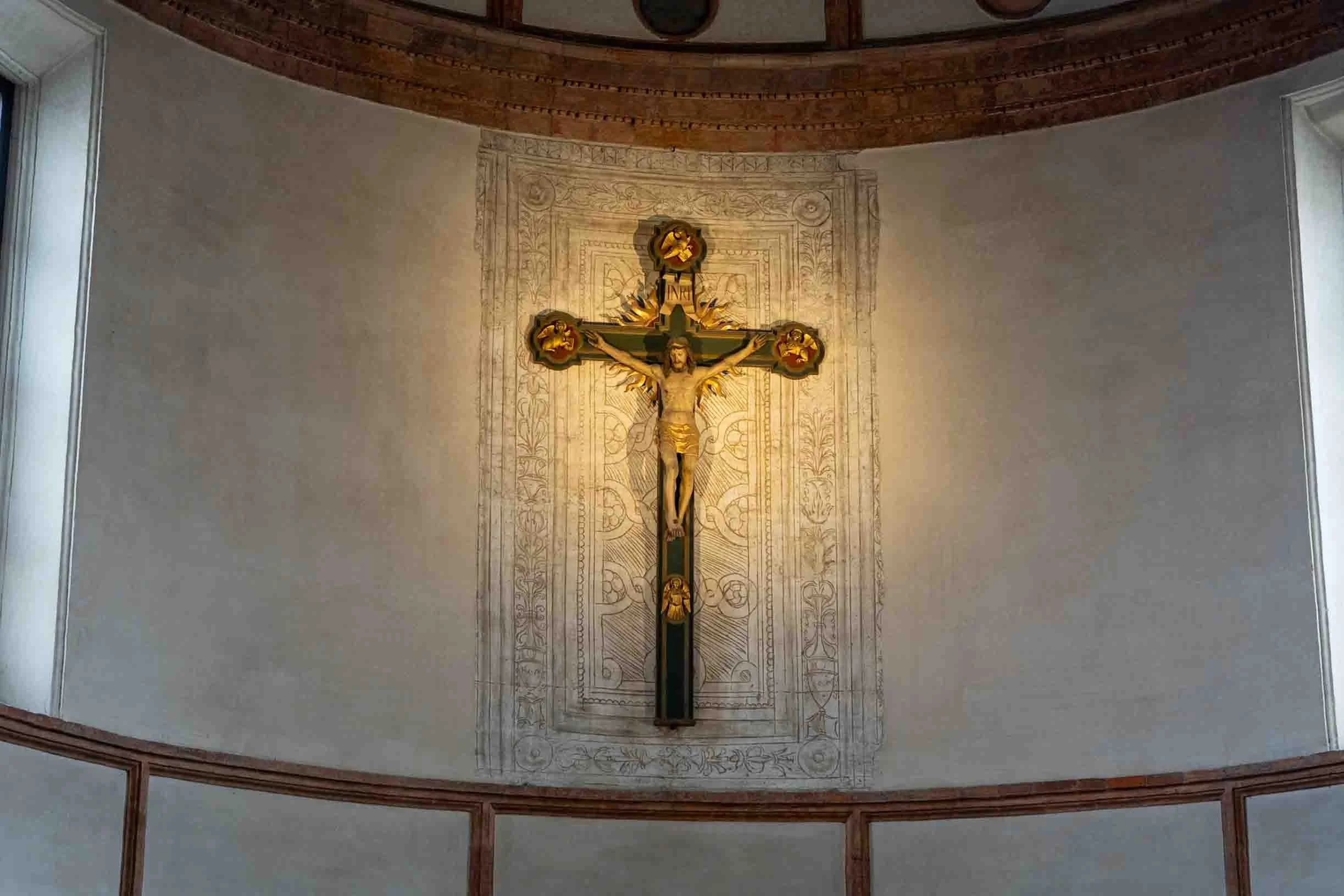
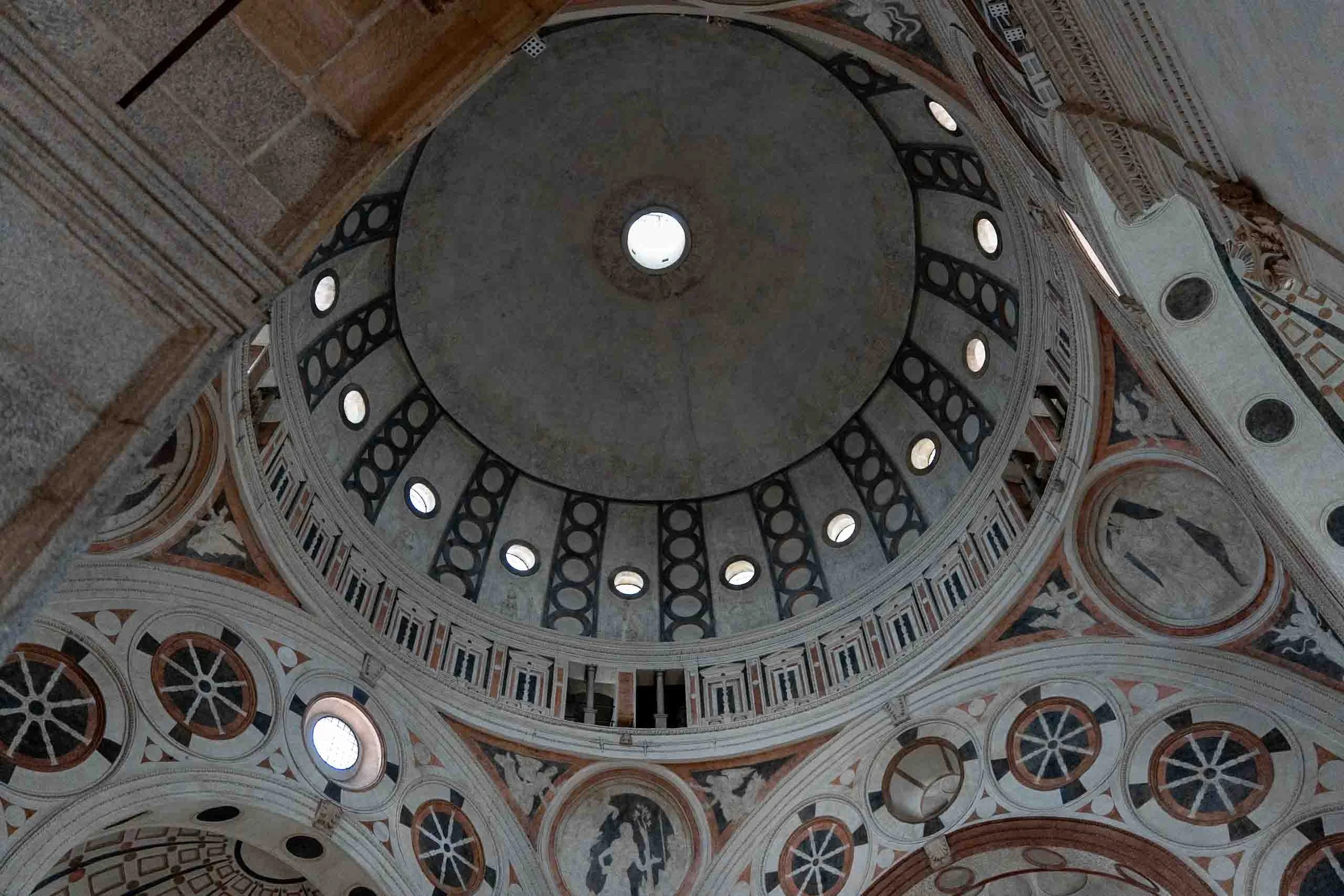
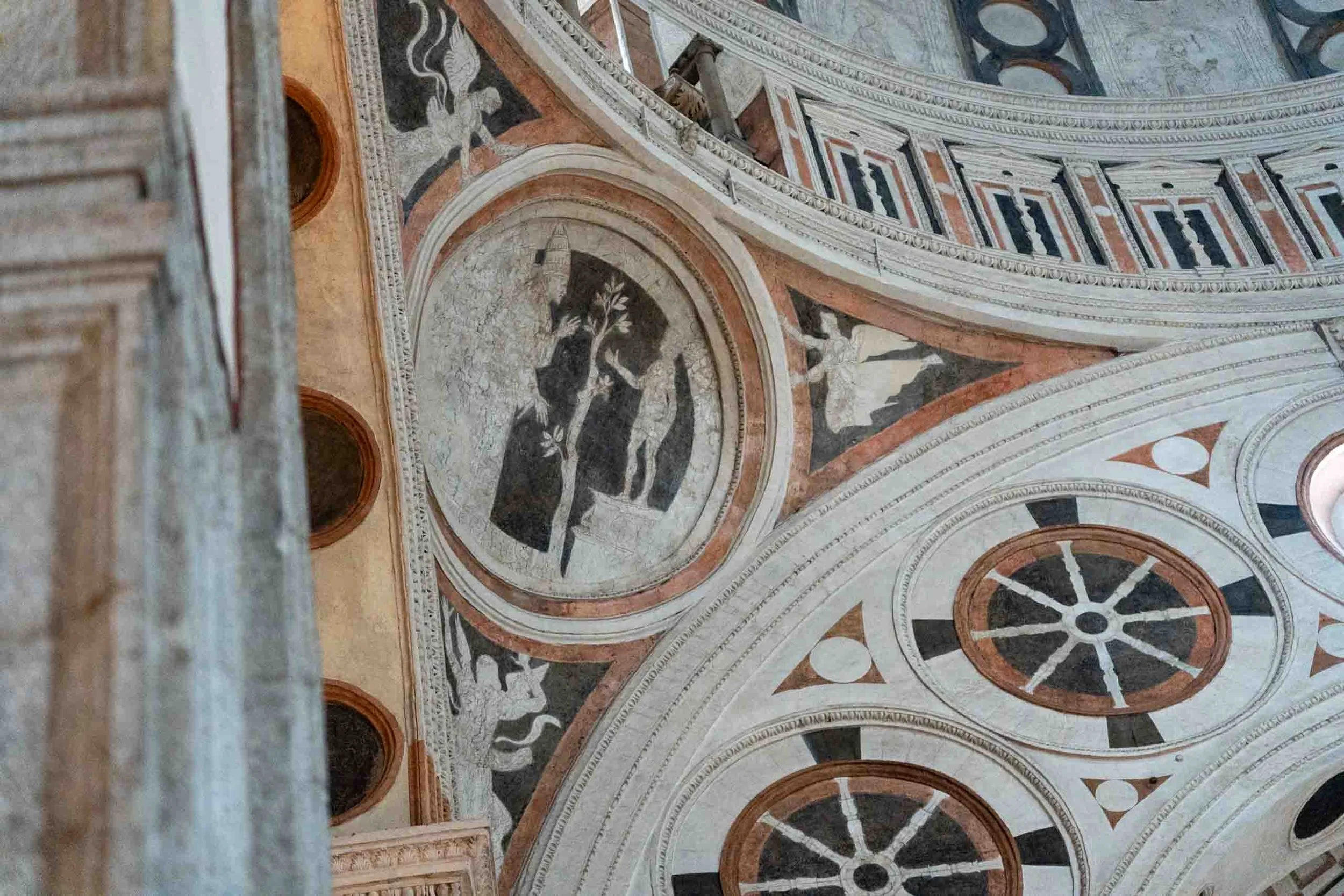
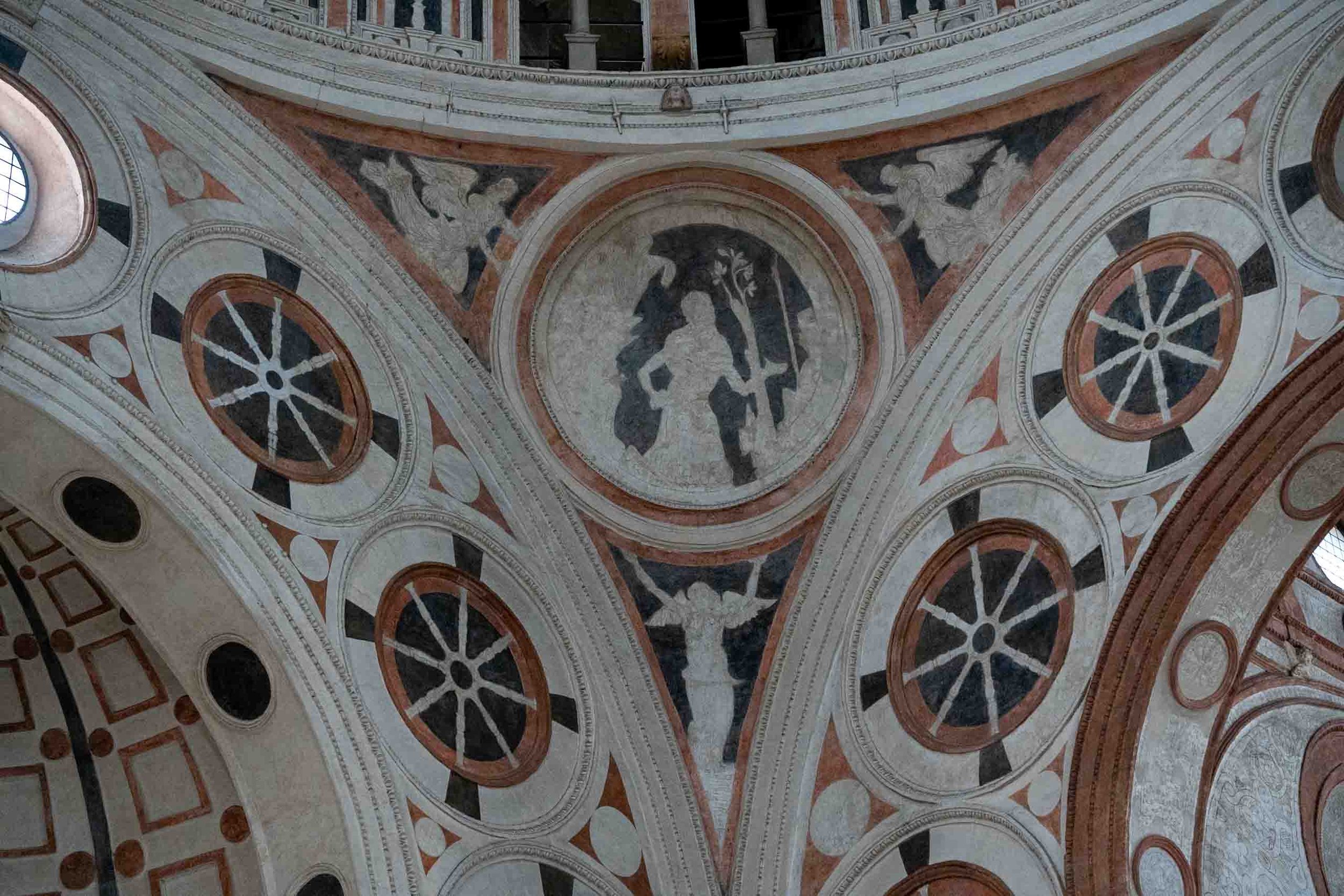
Angela: the dome is more than an architectural feature: it is the clearest symbol of Ludovico's vision. The church was intended to become the mausoleum of the Sforza family, a place where dynastic memory would be forever linked to artistic magnificence. The death of Beatrice d'Este in 1497 profoundly changed the duke's life. Deeply attached to her, Ludovico wished to be buried beside his wife and commissioned the sculptor Cristoforo Solari to create an exceptionally lavish funerary monument. The tribune and its architectural design thus became the centrepiece of a project that combined religious devotion with the celebration of his family.
Piero: but fate did not allow that dream to unfold as Ludovico had imagined. The Sforza dynasty's political fortunes came to an end with the arrival of the French and the duke's capture in 1500. Ludovico died a prisoner in France in 1508, far from Milan and from the church he had hoped to transform into an eternal memorial to his legacy. The funerary monument dedicated to him and Beatrice was dismantled in the following decades, and the sculptures depicting the couple lying on the sarcophagus were transferred to the Certosa di Pavia, where they can still be admired today. The monumental tomb Ludovico had envisioned no longer survives at Santa Maria delle Grazie.
Angela: this detail makes our visit even more moving. As we look at the tribune, we can almost imagine Ludovico's original vision in its entirety: a church designed to celebrate faith, but also to tell the story of a dynasty and its power.
Piero: and yet, beyond the ambitions of its patron, Santa Maria delle Grazie has endured through the centuries, architectural transformations and dramatic historical events. The Gothic and Renaissance sections do not contradict one another; they engage in a dialogue, showing how a building can embrace different styles and bring them together in a harmonious whole.
Angela: as we leave, we pause once more to admire the complex from the outside. The brick façade, more understated than the grandeur of the dome, retains a simplicity that invites us to look beyond appearances.
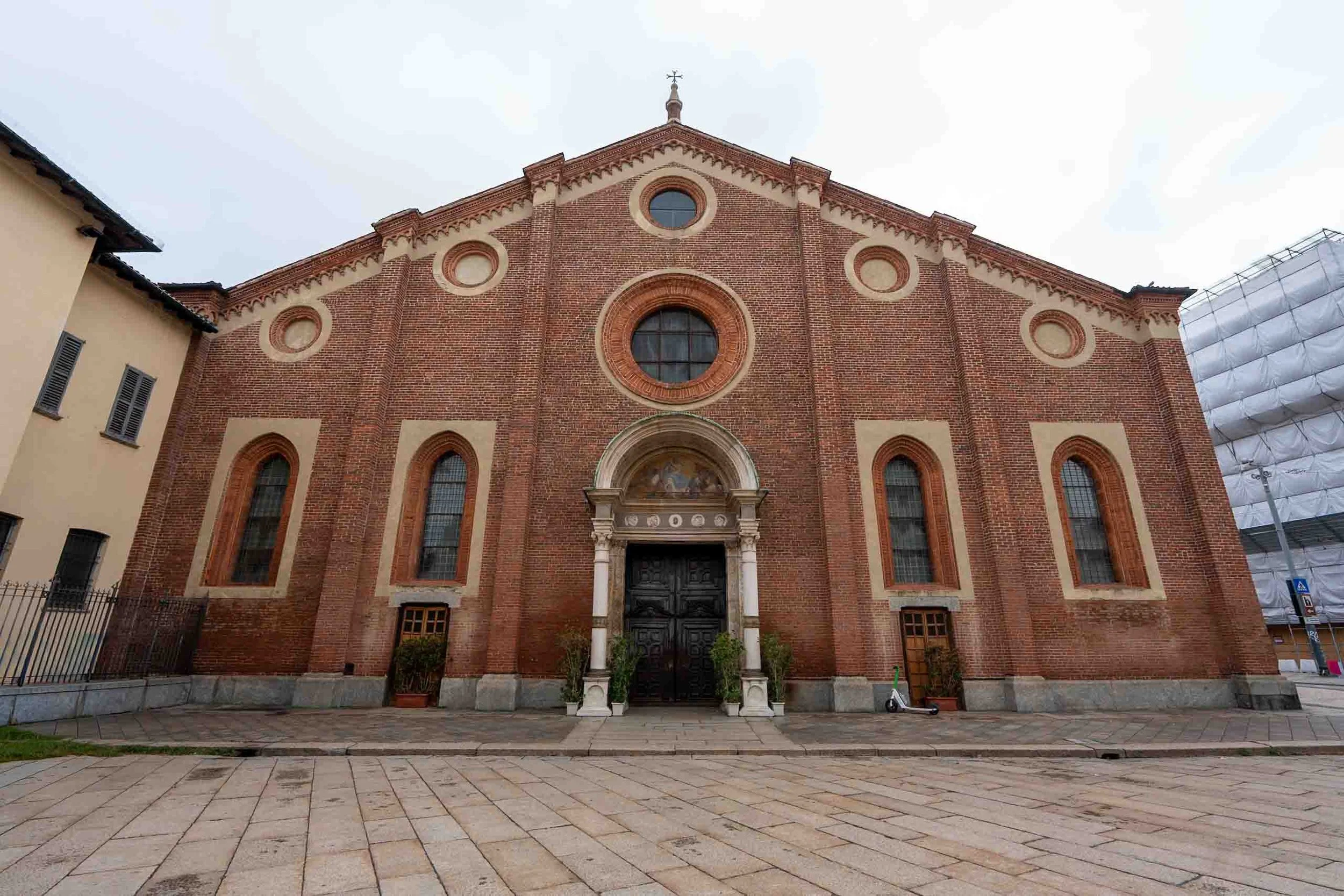
Piero: it's almost as though this place has one final lesson to teach us: beauty doesn't always announce itself with a flourish; sometimes it reveals itself gradually, to those willing to pause and look more closely. And after spending so much time with the Last Supper, I'm glad our visit has also led us to discover the history and architecture of the church that houses it.
A wonder just a few kilometres from home
Angela: our day trip comes to an end here, with the feeling that we've taken a journey far longer than the one shown on our satnav.
Piero: in just a few hours, we've travelled through the Renaissance, encountered Leonardo's genius and followed the ambitions of Ludovico il Moro, discovering how a single place can preserve so many different stories.
Angela: and, above all, you've finally been able to see up close a masterpiece you've dreamed of admiring for years.
Piero: fifteen minutes are hardly enough to fully understand the Last Supper, but they are enough to understand why it continues to fascinate millions of people. Sometimes, we don't need to travel far to feel that we're on a journey. All we need to do is pause before beauty and give it time to speak to us.
Angela: more than ever, we hope this video can convey some of the beauty we were fortunate enough to experience.