Gargano
Piero: I have prepared the van, are the bags ready?
Angela: where are we going this time?
Piero: we are staying in Italy this time, in a truly wonderful land that is not exactly at the centre of the most famous tourist routes: do you know the “spur” of the boot?
Angela: I think you are referring to Gargano; from Milan to Vieste by van, another eight hundred kilometres for us, and we hope we can make it in 8 hours…
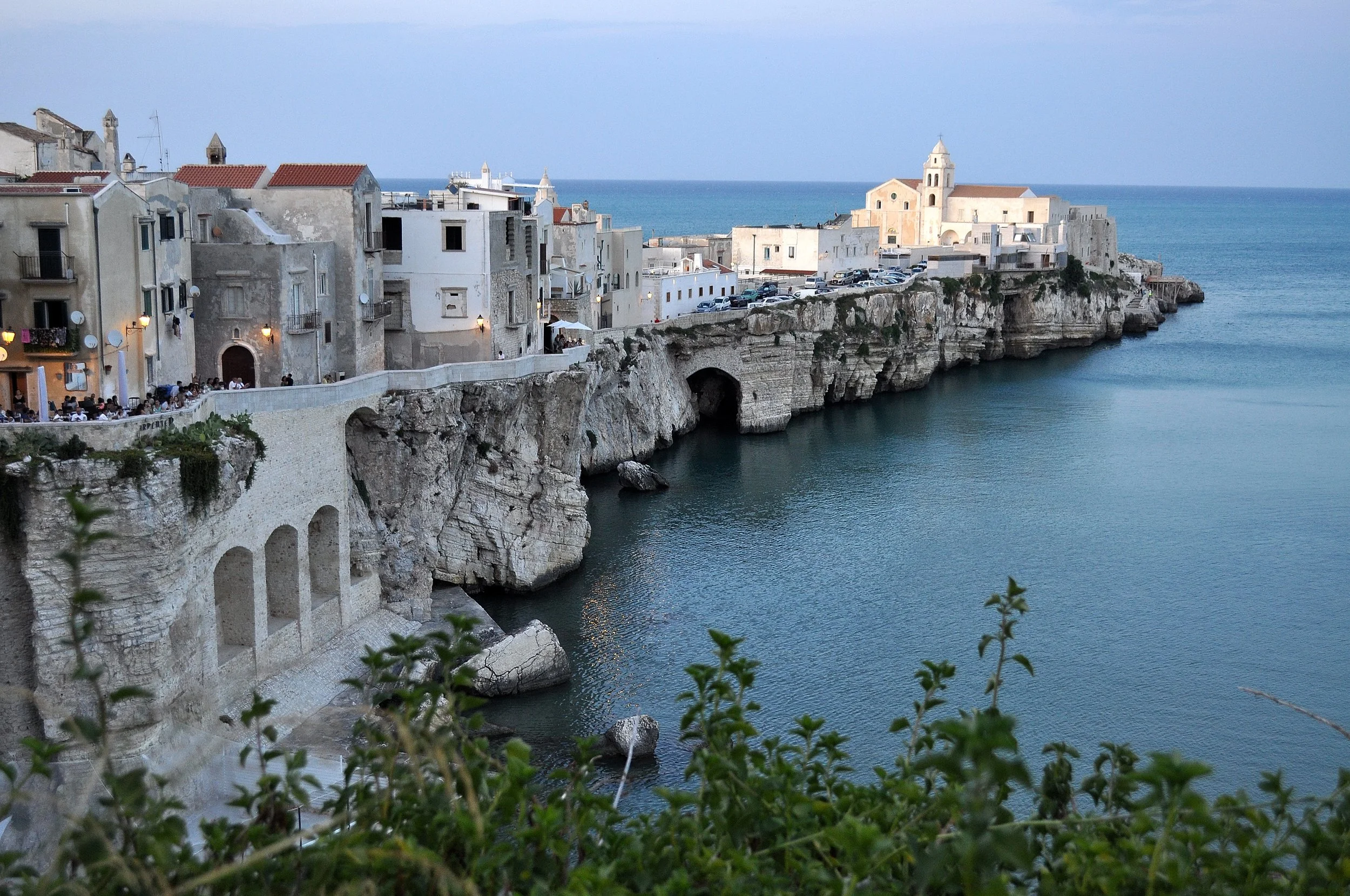
Piero: don’t worry, no intermediate stops, but it will absolutely be worth it! We will spend a wonderful week…
Angela: it seems to me that everything is already organized, let’s start the engine and… we’re off!
“The most varied mountain one can imagine.”
Piero: this is how Ungaretti described Gargano: the variety of the landscape is one of the most distinctive features of this territory. In this corner of the Mediterranean, nature is the absolute protagonist, with the colours and scents of its wonderful landscapes. Traditions, beautiful beaches and delicious food then complete the recipe for a special holiday.
Angela: Gargano is a promontory surrounded on three sides by the Adriatic Sea and rich in naturalistic, historical and archaeological treasures. The term “Gargano” probably derives from the ancient Greek Gargaros, meaning “stone mountain”. The entire territory is located in the province of Foggia and, together with the whole province, this area is also known as Capitanata, from the title of the Catapani, the officials of the Byzantine Empire. In ancient times, the province of Foggia was also called Daunia, from the name of the people who inhabited northern Apulia, the Dauni.
Piero: Gargano has been inhabited since the Neolithic period, and has always represented one of the most important places for research into early human history. An example is Grotta Paglicci, in Rignano Garganico, a cornerstone for the study of Palaeolithic civilisation in Europe, both for the variety of its archaeological layers and for the presence of the oldest cave paintings ever discovered in Italy.
Angela: there are also clear traces of the passage of the Dauni, of course the Romans, and later the Byzantines, Saracens, Slavs and Normans. The Swabian period was one of the most important for this land: many of the castles built in Gargano are due to Frederick II and his son Manfred. The Angevins and Aragonese then preceded the Bourbon period.
Piero: only recently has this land partially abandoned its agricultural tradition, mostly poor and underdeveloped, in favour of a strong tourism development which, starting from the 1960s, became the driving force behind the economy of the entire region.
Angela: Gargano, while preserving many of the characteristics of the Apulian landscapes, is particularly different from the Itria Valley and Salento. The main difference is that this territory combines, on one side, a coastline rich in limestone cliffs, sea caves, sandy beaches and villages overlooking the sea, and on the other side, enchanting almost mountain landscapes, with wooded areas, forests and pine forests.
Gargano, here we are!
Piero: so let’s set off to discover this wonderful variety. We will make our base in Vieste, perhaps the most famous and fascinating village in Gargano.
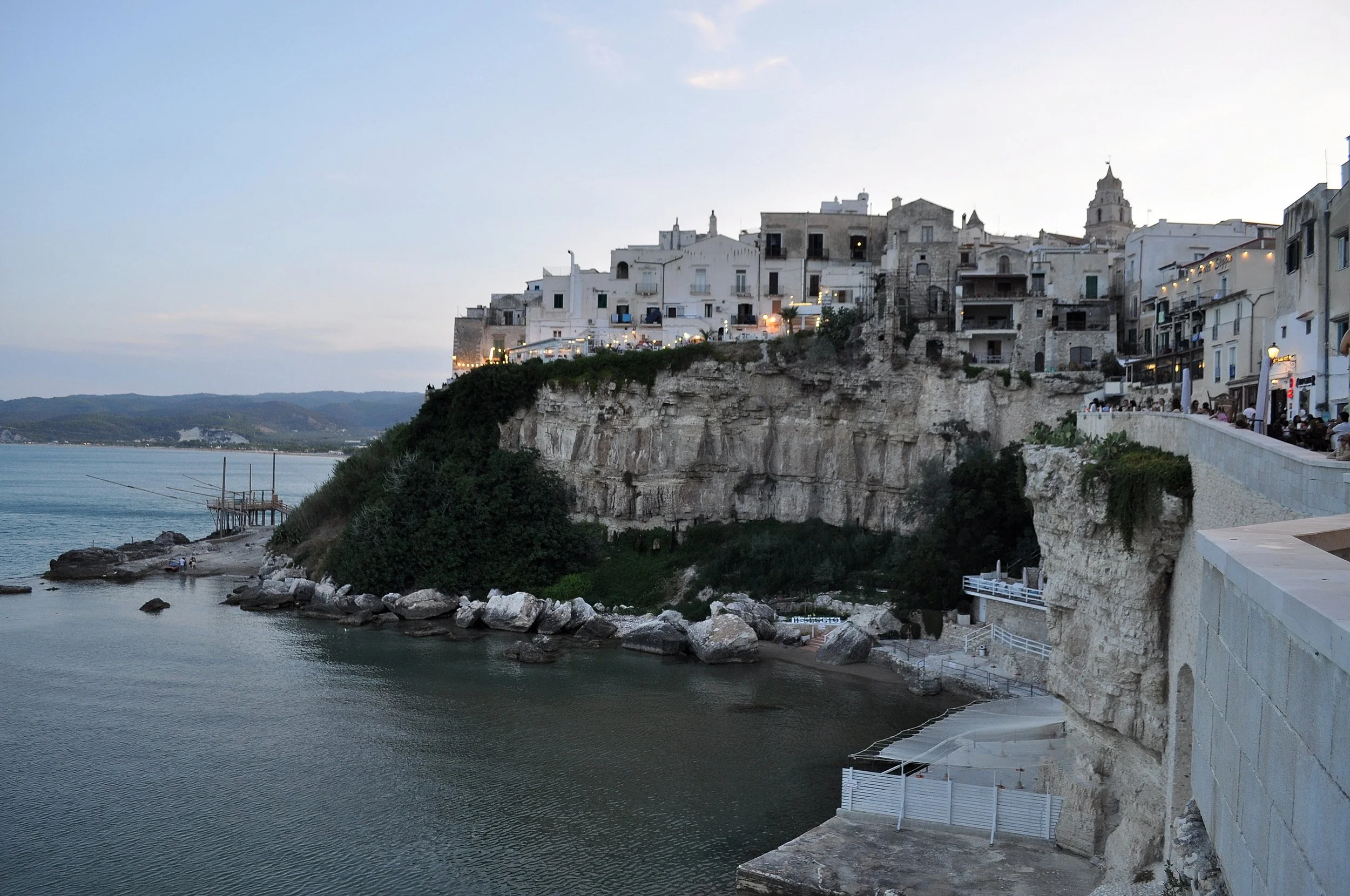
Angela: it is the pearl of Gargano and represents its easternmost point. This wonderful village, made of stairs and winding alleys, white houses and arches, stands on a rocky promontory with an unforgettable sea as its backdrop; on either side, two long stretches of white sandy beaches.
Piero: like all the other villages we will visit, the historic centre of Vieste has medieval origins and stands right on the rocky promontory known as Punta di San Francesco. The waterfront area, on the other hand, is known as Punta di Santa Croce and developed more recently together with the town’s tourist vocation.
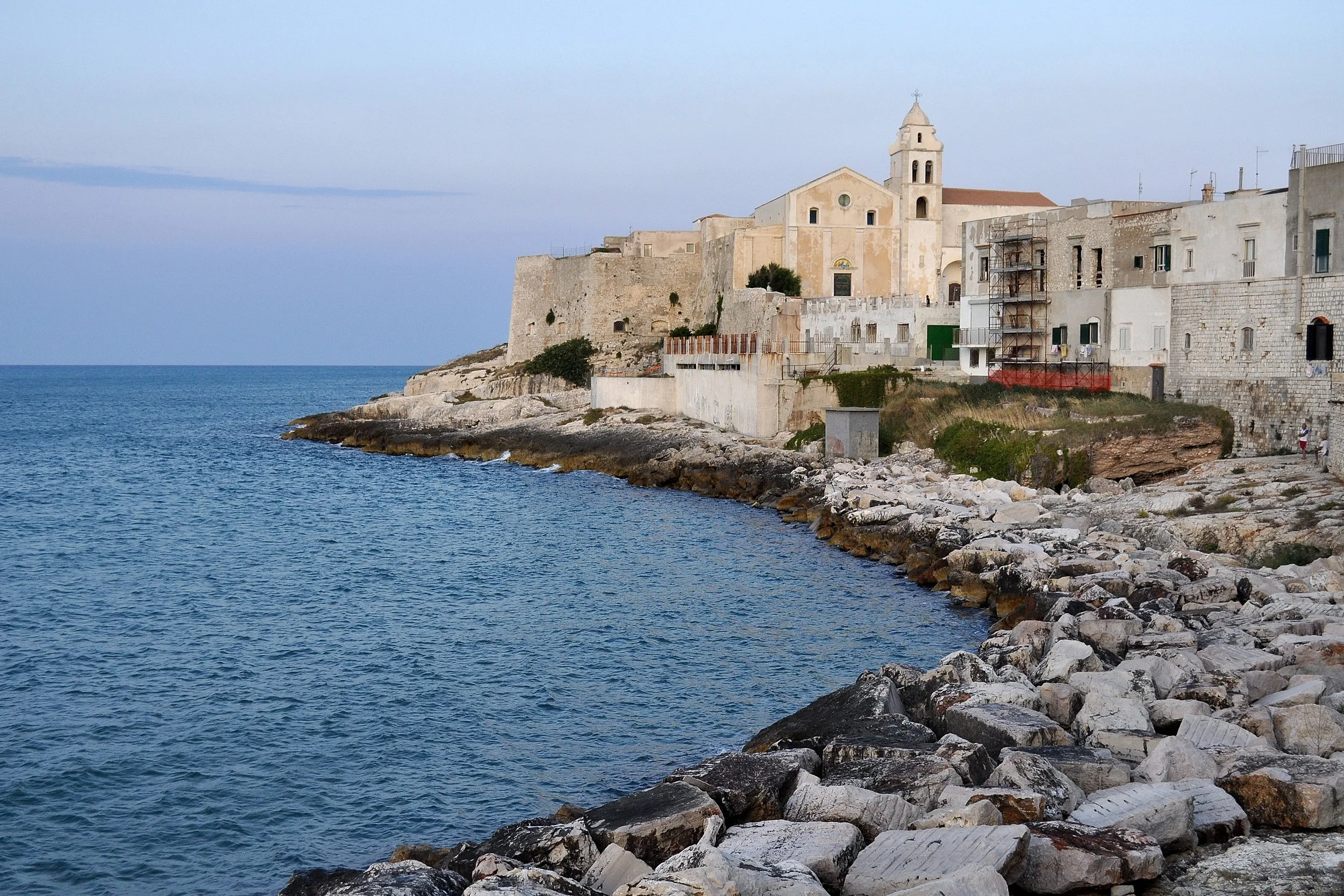
Angela: the beauty and popularity of Vieste come not only from its beautiful beaches, but also from its historical heritage and its culinary traditions, which attract tourists throughout the year. Let’s obviously start with the beaches.
Piero: the main one is Scialara Beach, also known as Castle Beach, three kilometres of sand at the foot of the rocky promontory where the historic centre stands.
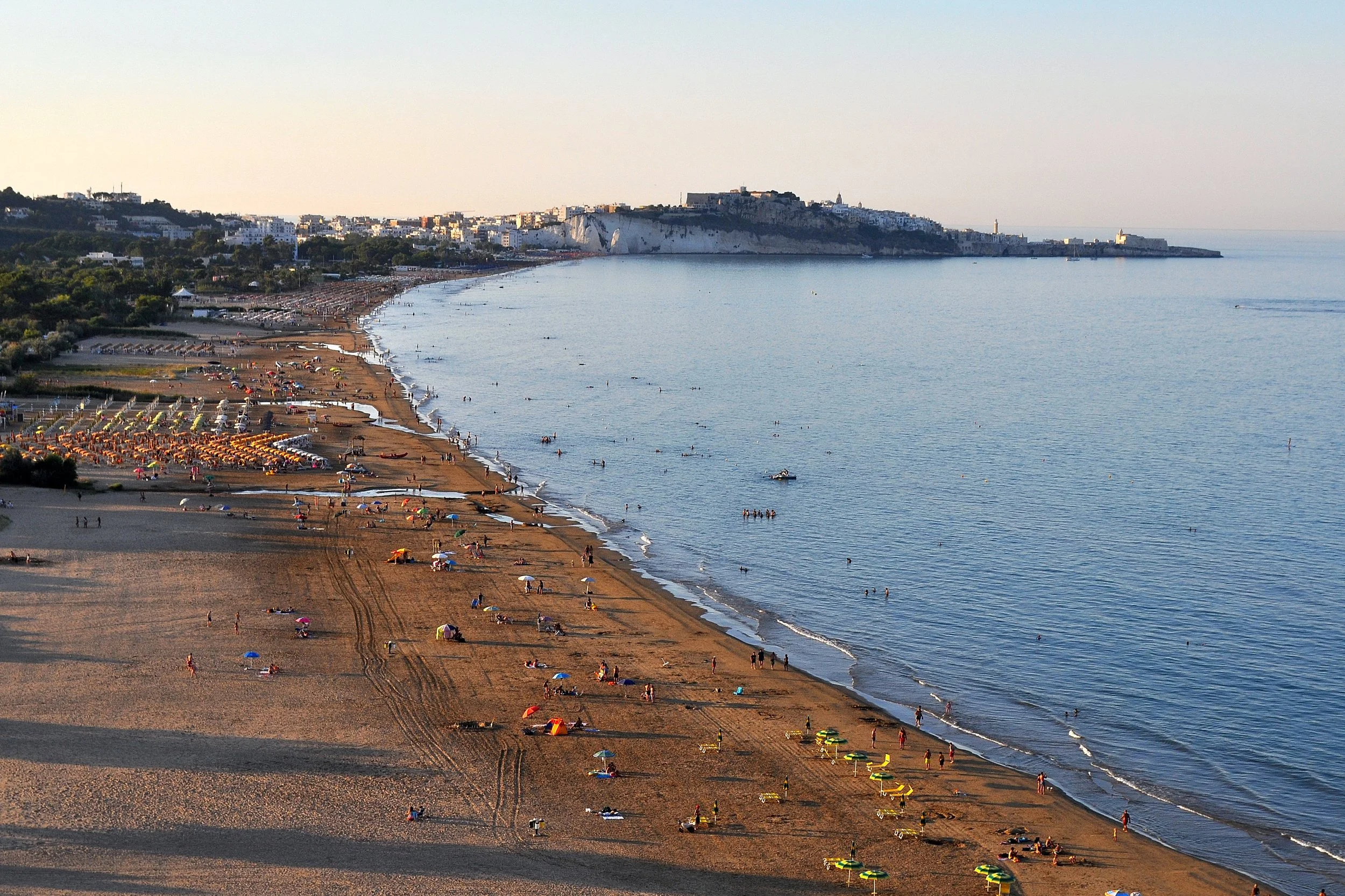
Angela: right near the promontory there is also the symbol of the city, the “Pizzomunno”, a very white limestone rock about twenty-five metres high. According to legend, Pizzomunno was a young and handsome fisherman who had fallen in love with the beautiful Cristalda. Every night, Pizzomunno would go out to sea with his boat to fish, and, regularly, the sirens, enchanted by his beauty, would emerge from the waves and sing in his honour, offering him immortality if he joined them. However, Pizzomunno, faithful to Cristalda, never gave in to their offers. Out of jealousy and anger at his repeated refusals, the sirens kidnapped Cristalda, chaining her and dragging her down to the bottom of the sea. Pizzomunno desperately followed the voice of his beloved, until, overwhelmed by anger and grief, he turned to stone, becoming the rock formation that we can still see today. According to the legend, every one hundred years, on the night of 15 August, Cristalda rises again from the depths of the sea and Pizzomunno returns to human form: the two lovers can once again live, for just one night, their ancient love.
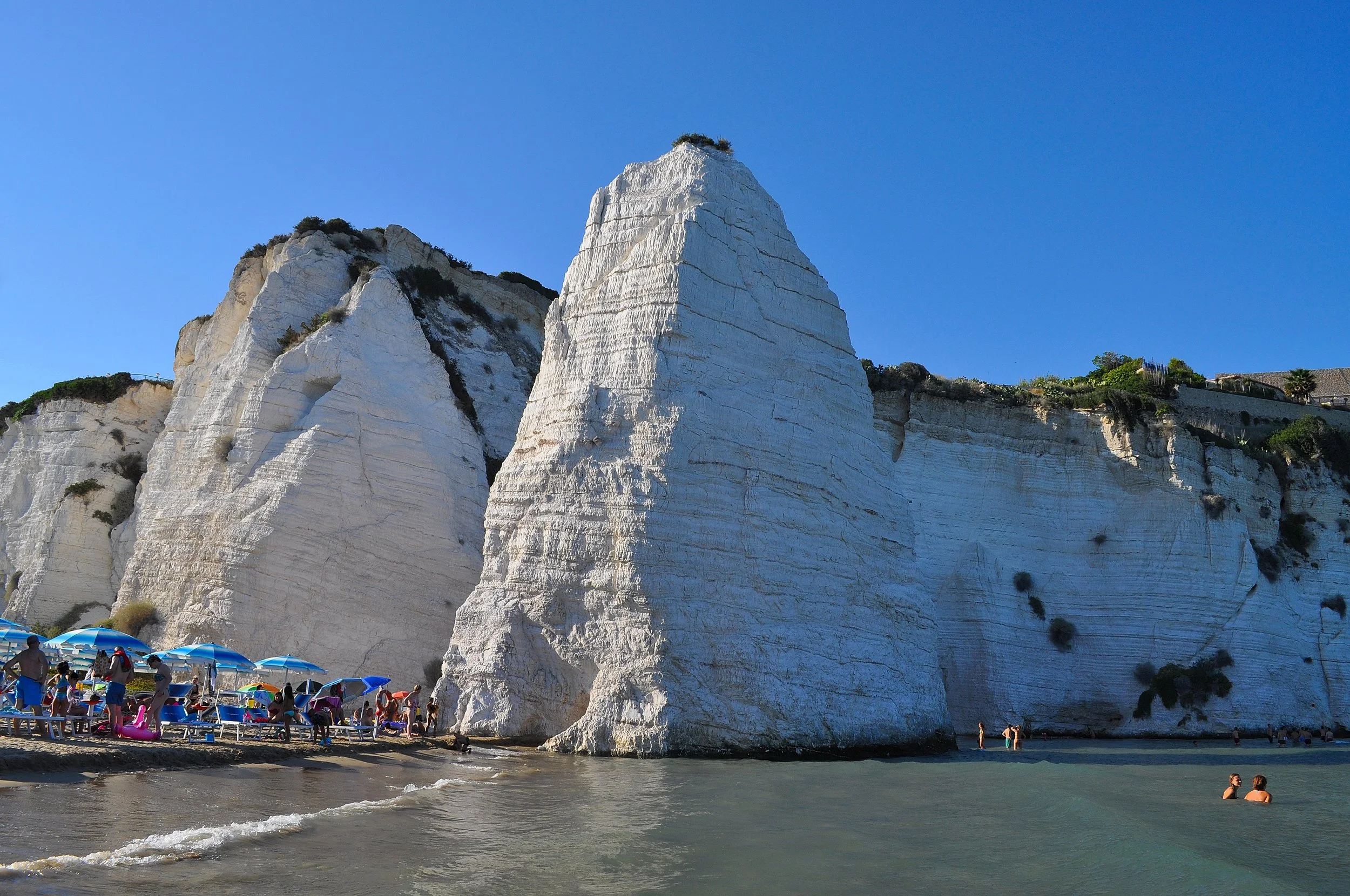
Piero: the view of the monolith is absolutely unmissable, both from the sea and from the village of Vieste.
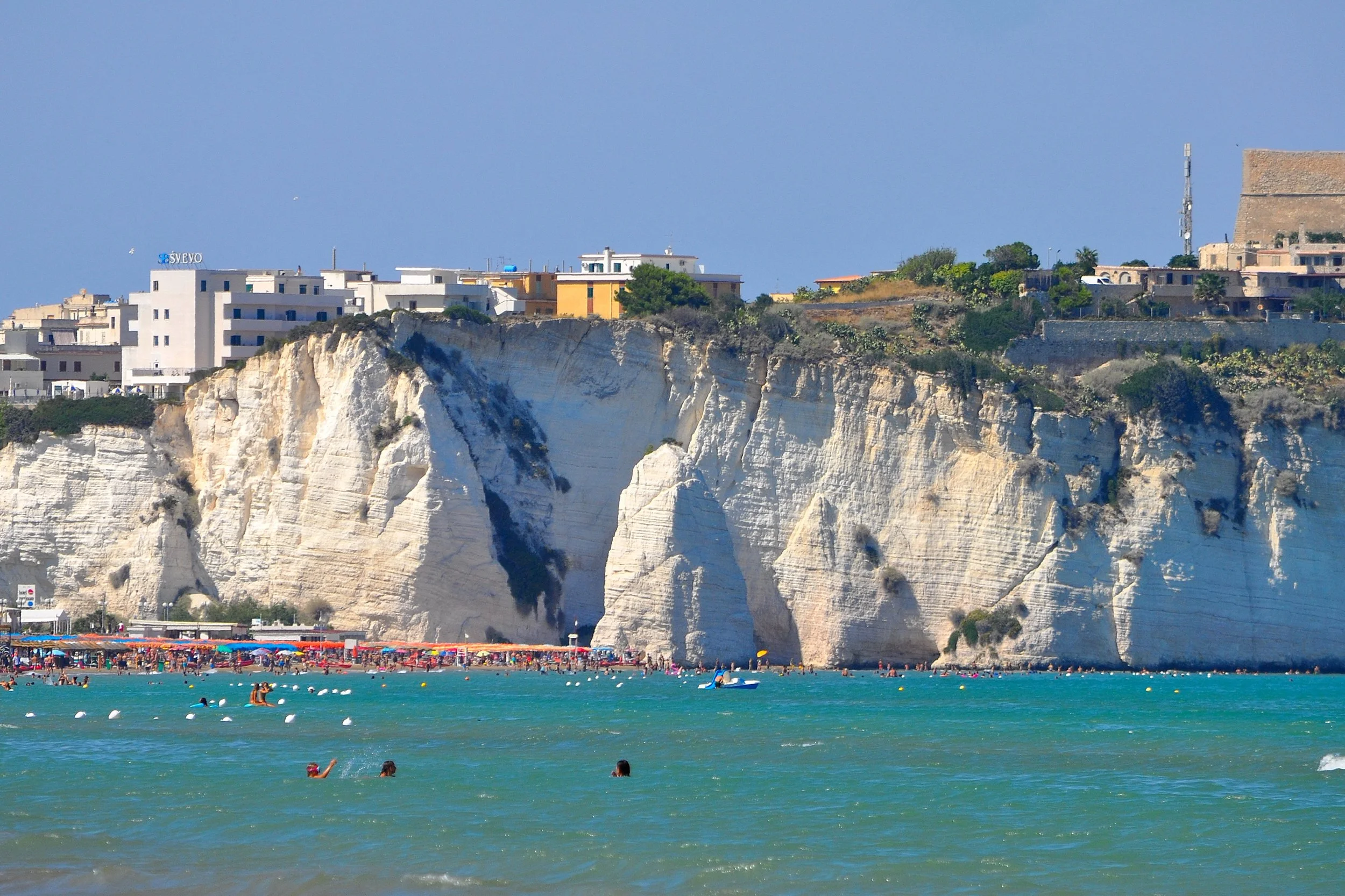

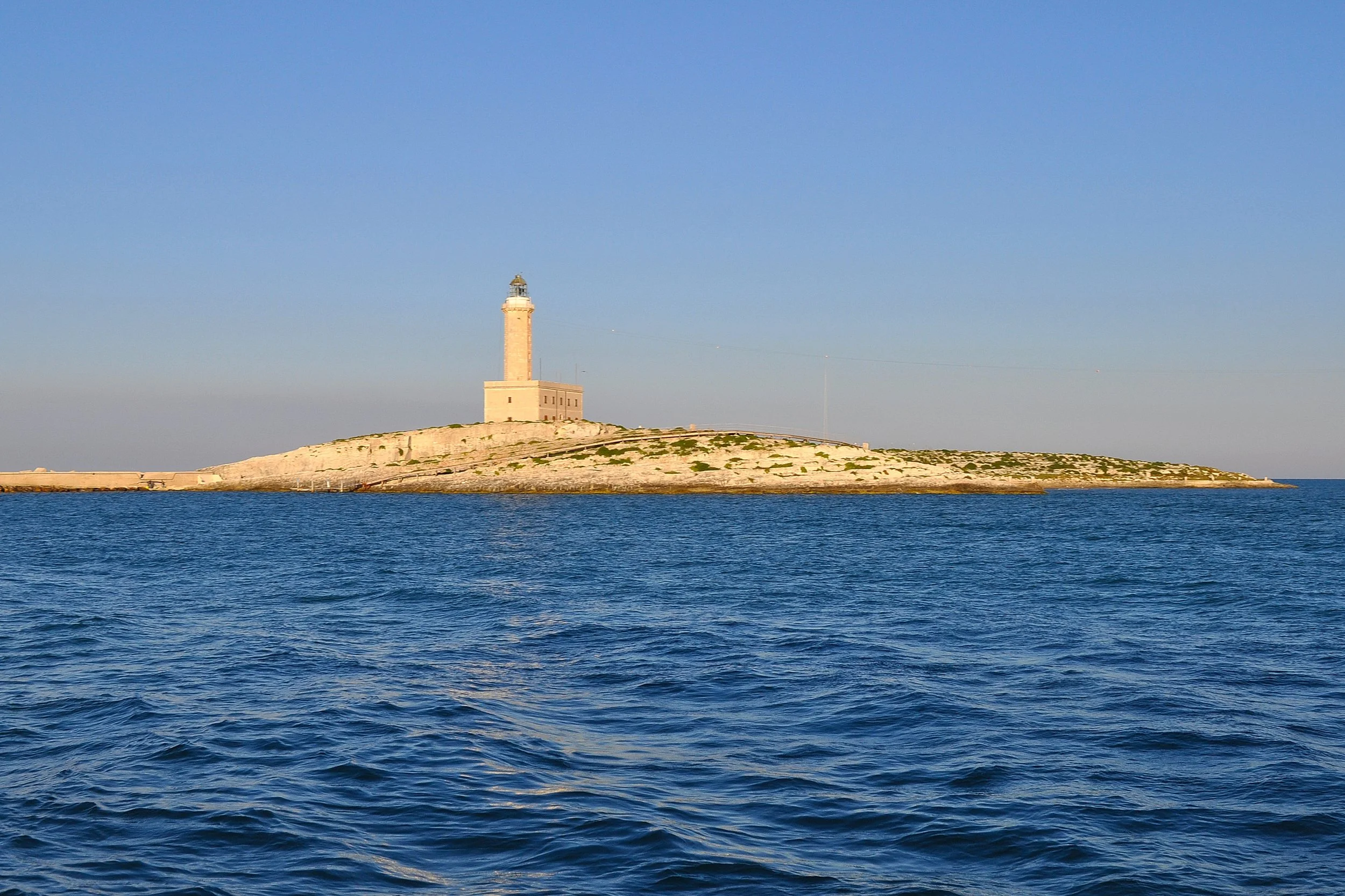
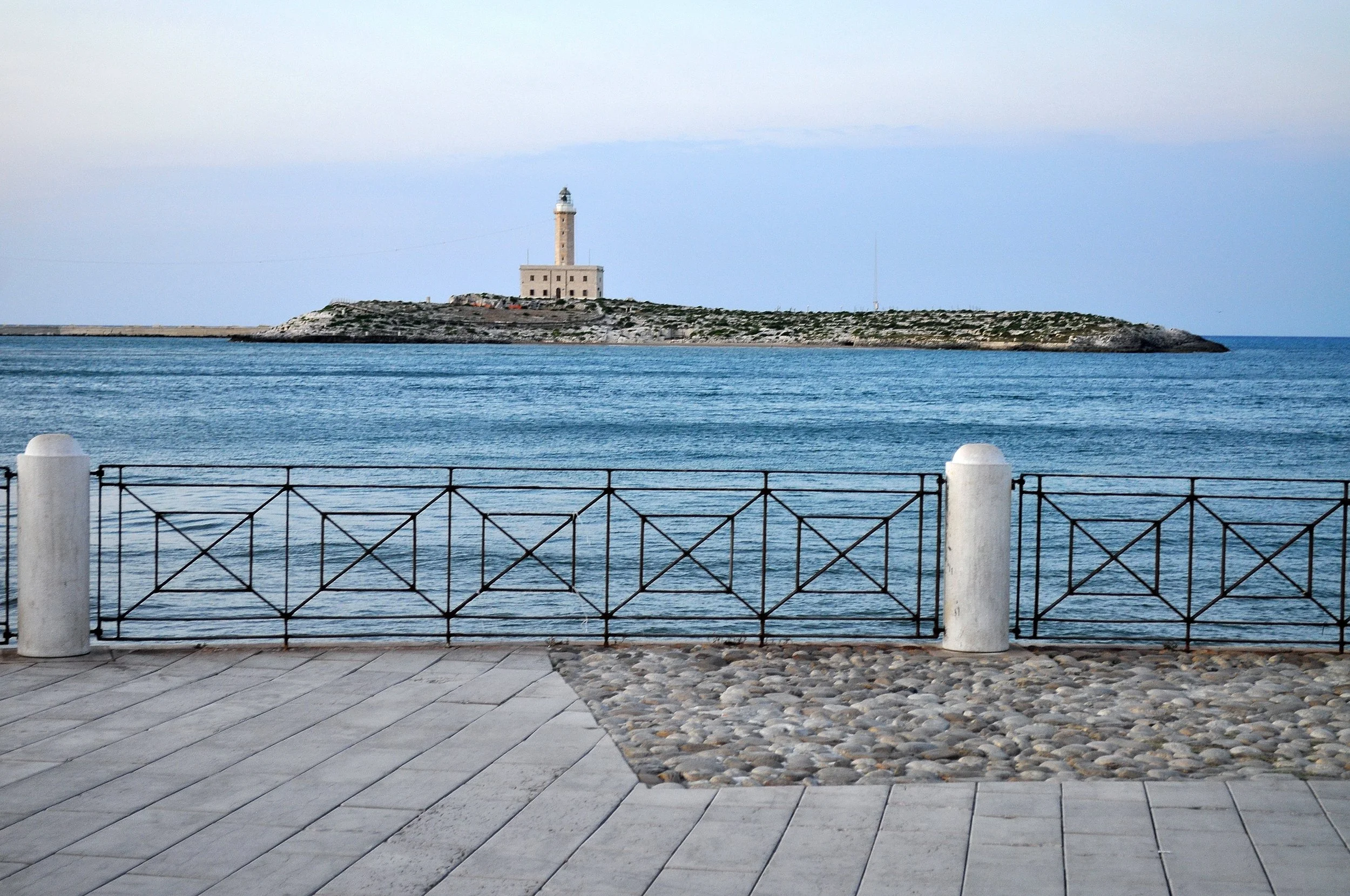
Angela: another beautiful beach in Vieste is the one at Marina Piccola Bay, as the beach resort is located right next to the historic centre. Soft sand and crystal-clear water have as their backdrop the Santa Eufemia rock, which is home to the lighthouse.
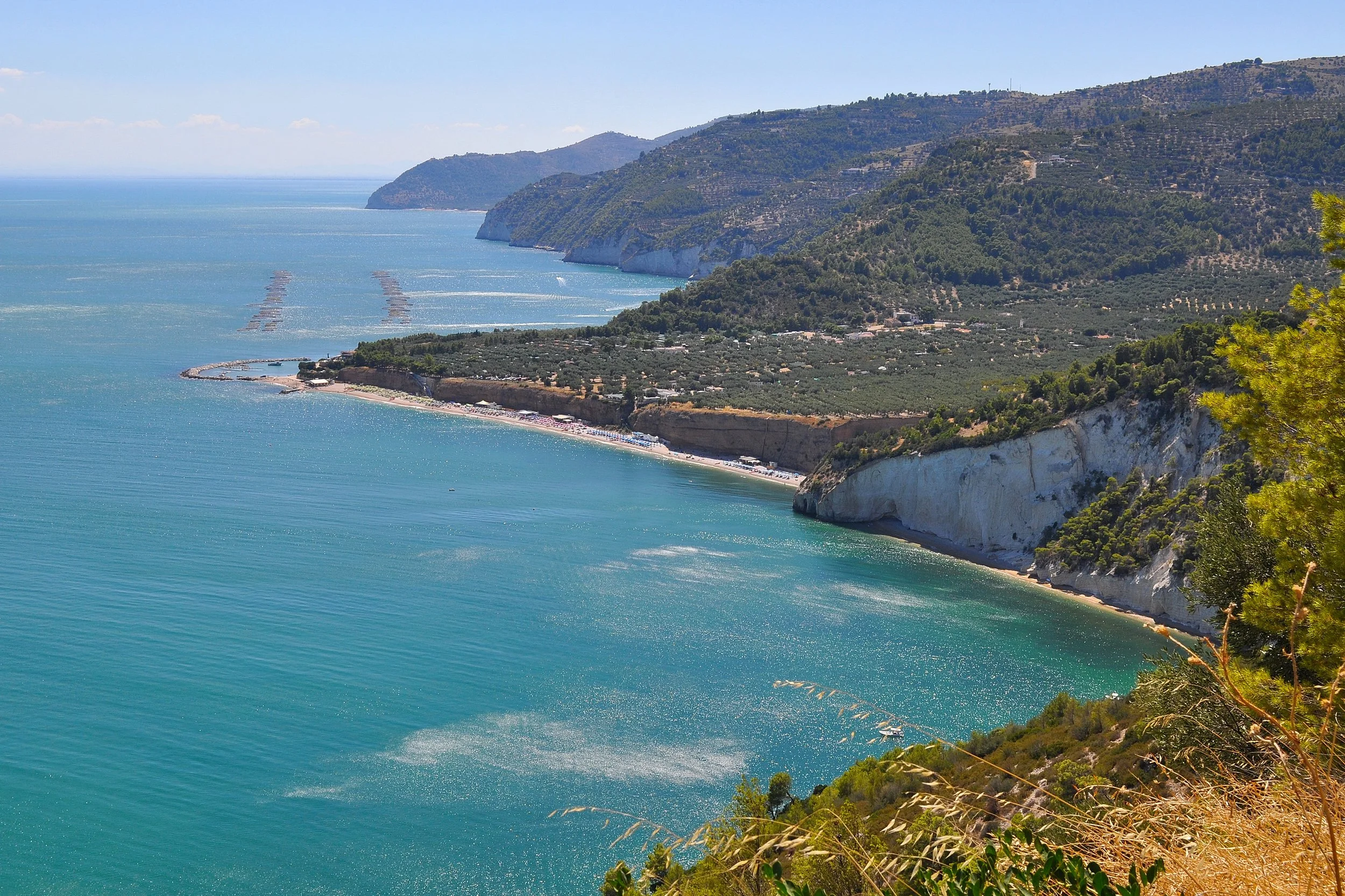
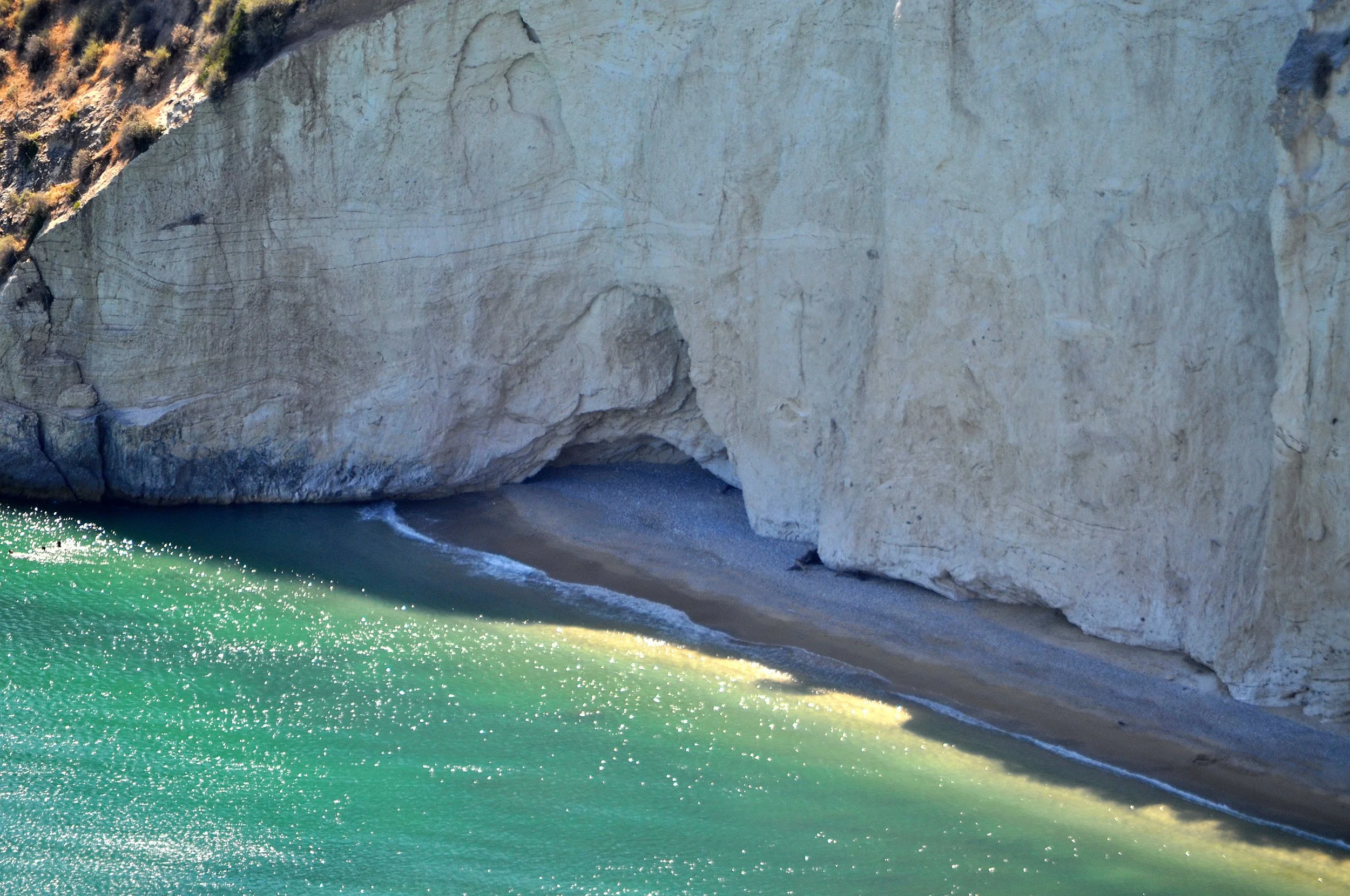
Piero: not far from Vieste, heading north, there are many other beaches, starting from San Lorenzo and reaching Scialmarino, often windy and therefore popular with kitesurfing enthusiasts, all the way to La Chianca and Crovatico. While the beaches north of Vieste are more touristic, well-equipped, and sandy, with gently sloping seabeds, south of Vieste you can find more wild coves and bays, such as Baia delle Zagare, Baia di San Felice, Cala della Pergola and Pugnochiuso.


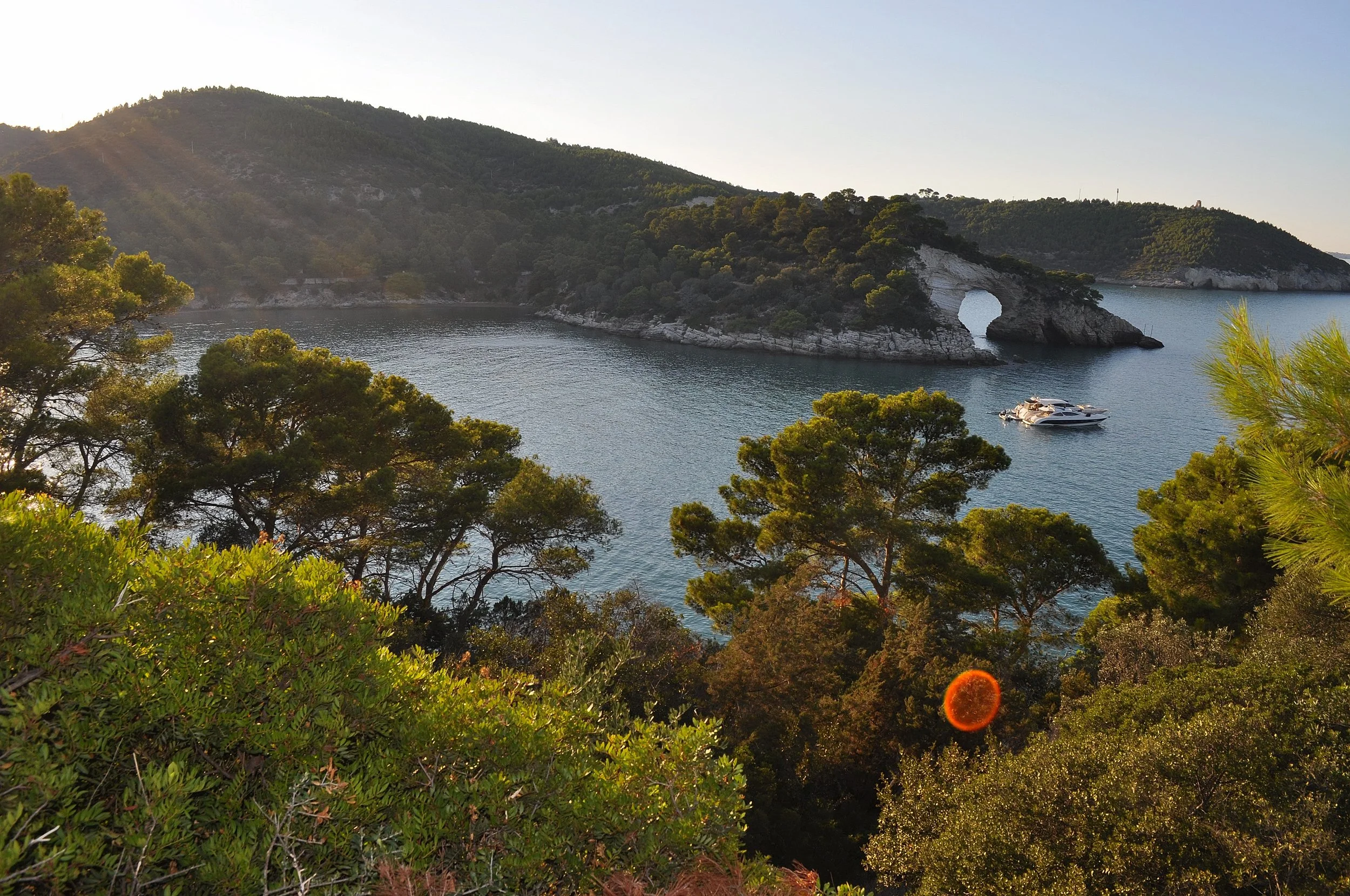





Angela: but as we said, Vieste is not only about the sea. In the evening, the city is very lively and it is a pleasure to take a walk through its narrow streets. However, it truly shows its best side at sunset: getting lost among the alleys leads to the discovery of one fantastic view after another.

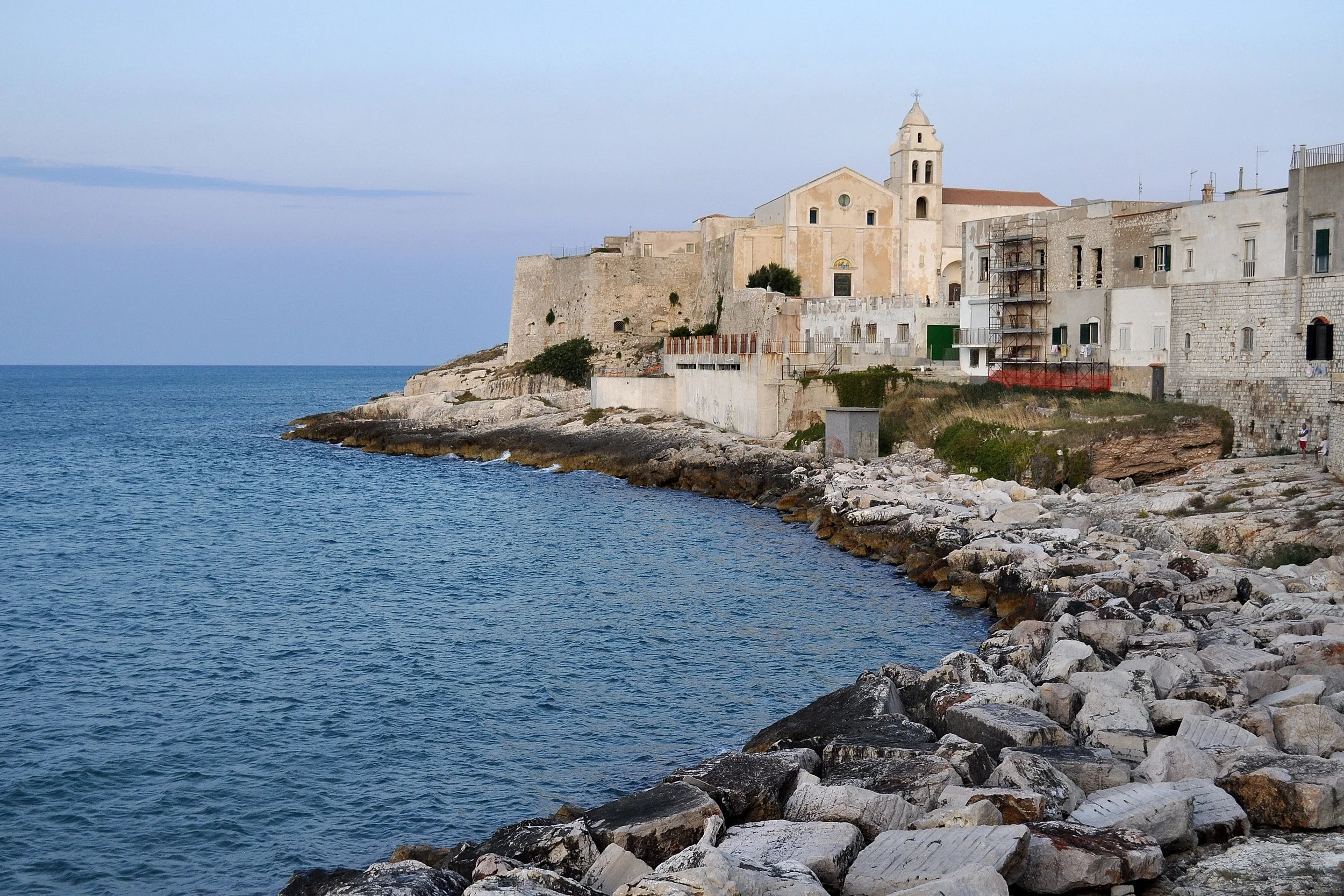
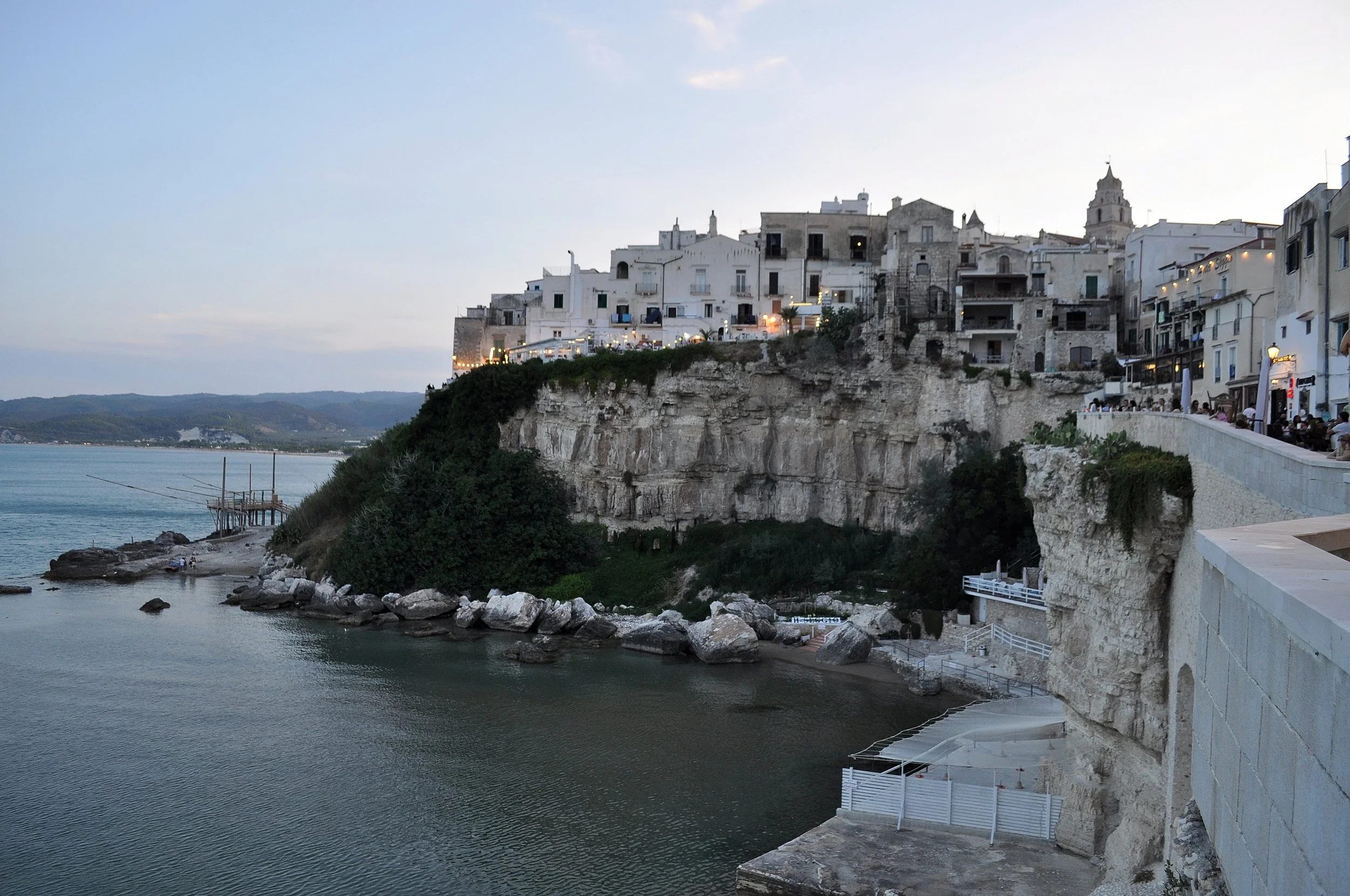
Piero: if the character of the village is medieval, its origins are truly ancient. Vieste was in fact a Greek colony, a Roman municipality and, during the Byzantine period, an episcopal see, with the construction of the beautiful Cathedral. In 1065, it was conquered by the Normans, and in 1240 Frederick II had the castle built on the top of the small promontory.


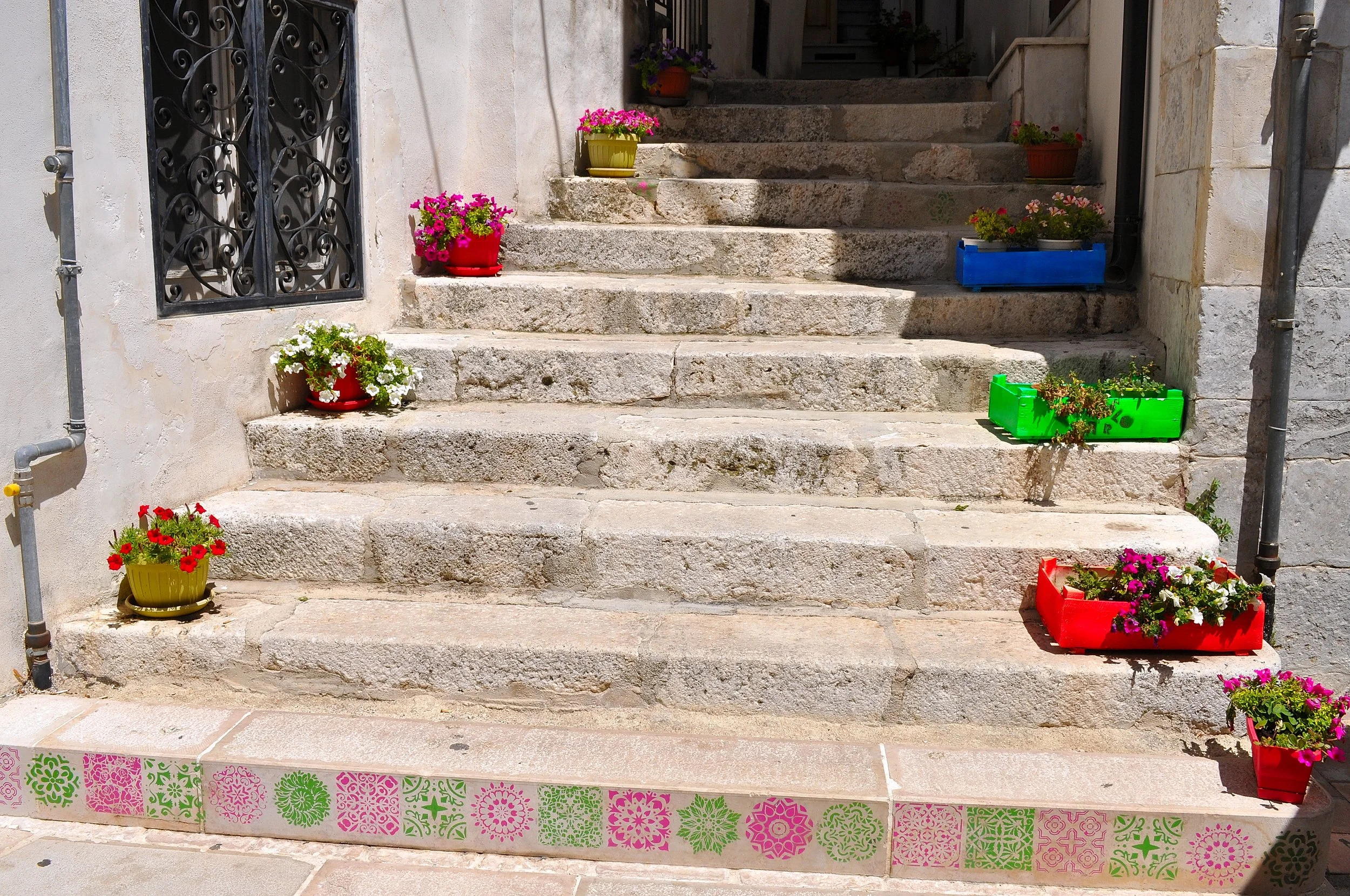
Angela: from the legend of Pizzomunno we can understand that Vieste is also a romantic city, indeed the “city of love”, with a festival called “Vieste in Love” that takes place every year. On the occasion of the first edition, the staircase connecting the upper gate of the old town with Corso Fazzini was painted with symbols of love and with the lyrics of the song by Max Gazzè, which celebrates the love between Pizzomunno and Cristalda.
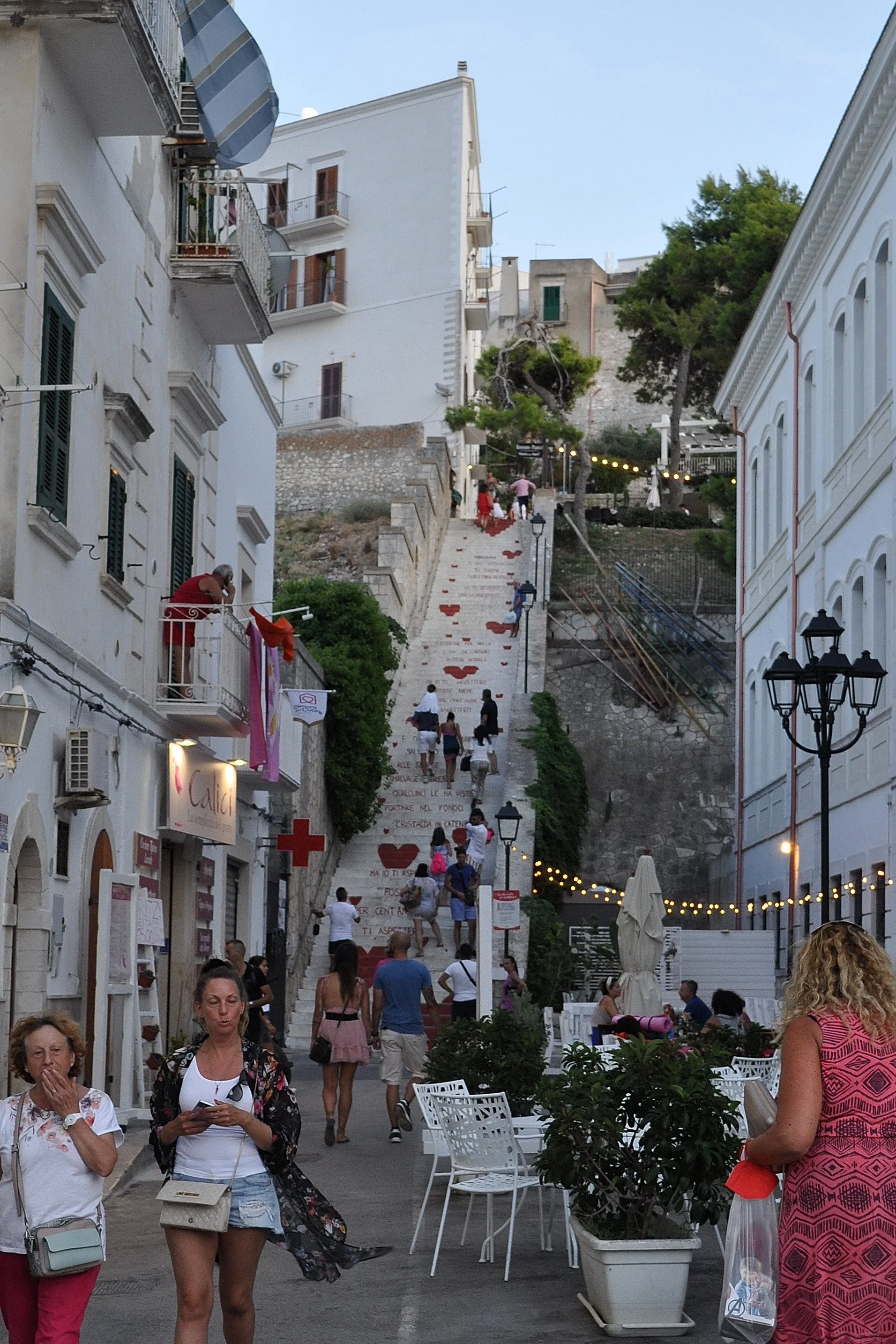
Piero: since then, the staircase has taken on a symbolic value: it is said that walking up it together with the person you love will keep you united forever.
Angela: from Vieste, we move just twenty kilometres to another of the symbolic villages of Gargano, Peschici.
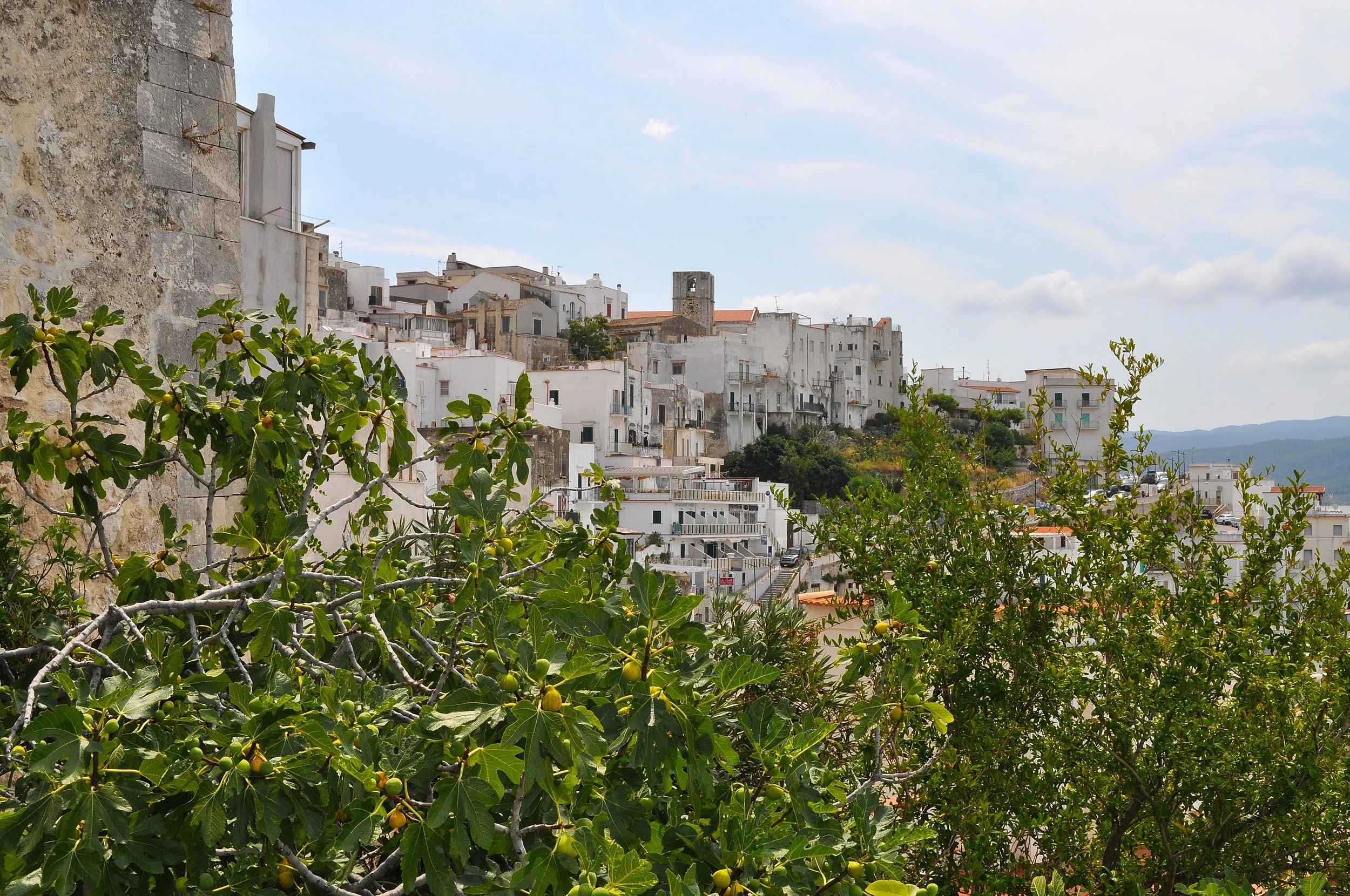
Piero: it is a wonderful postcard of Gargano and of the entire Mediterranean, with its little houses clinging to the cliff, the harbour with the beach below, and the castle at the top overlooking and dominating them all.
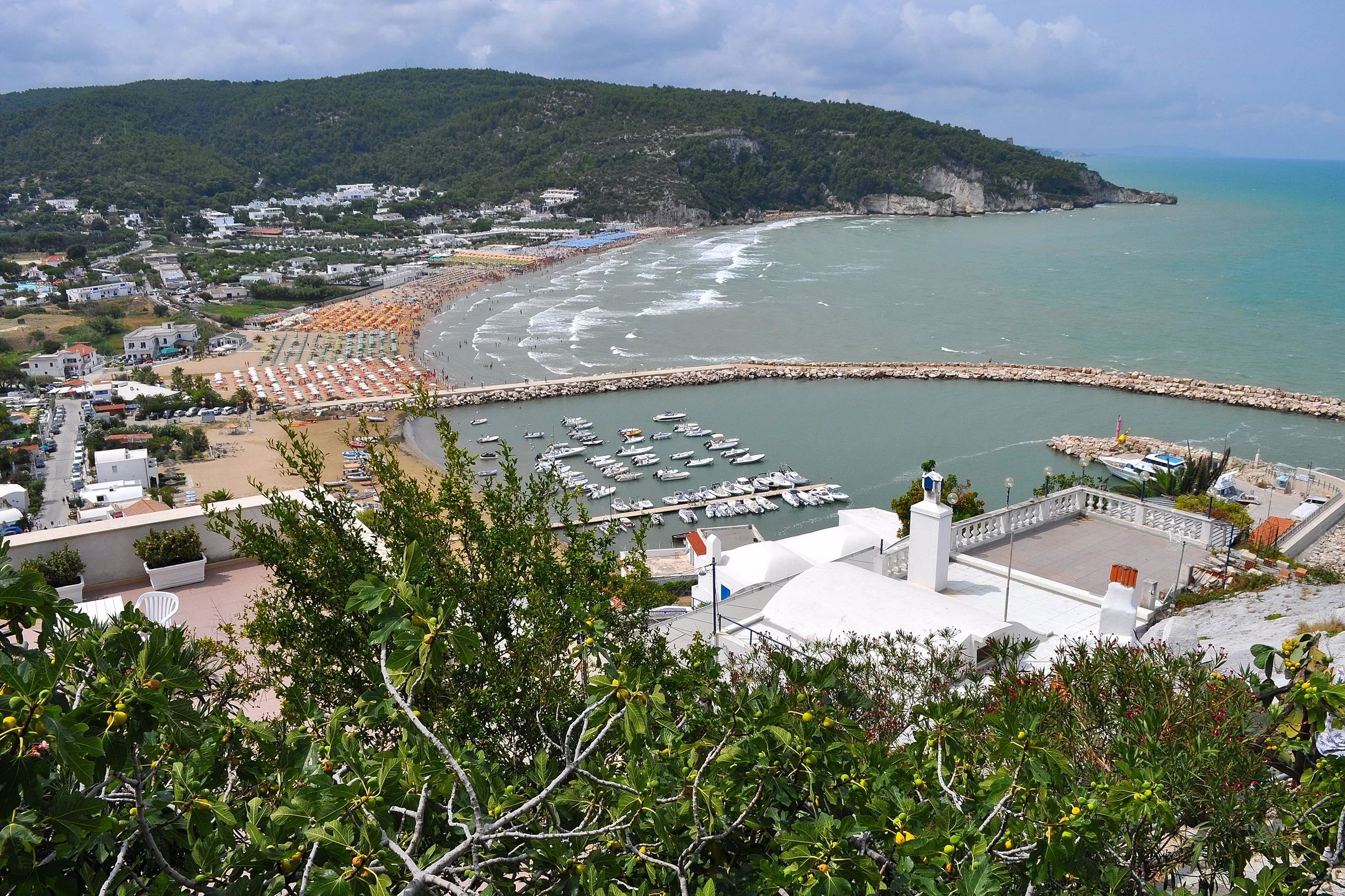
Angela: the historic centre is located within the medieval walls, interspersed with still perfectly preserved towers. It can be accessed through an arch next to a tower that the people of Peschici call “Porta del Ponte”, in memory of the drawbridge that once closed off the village.
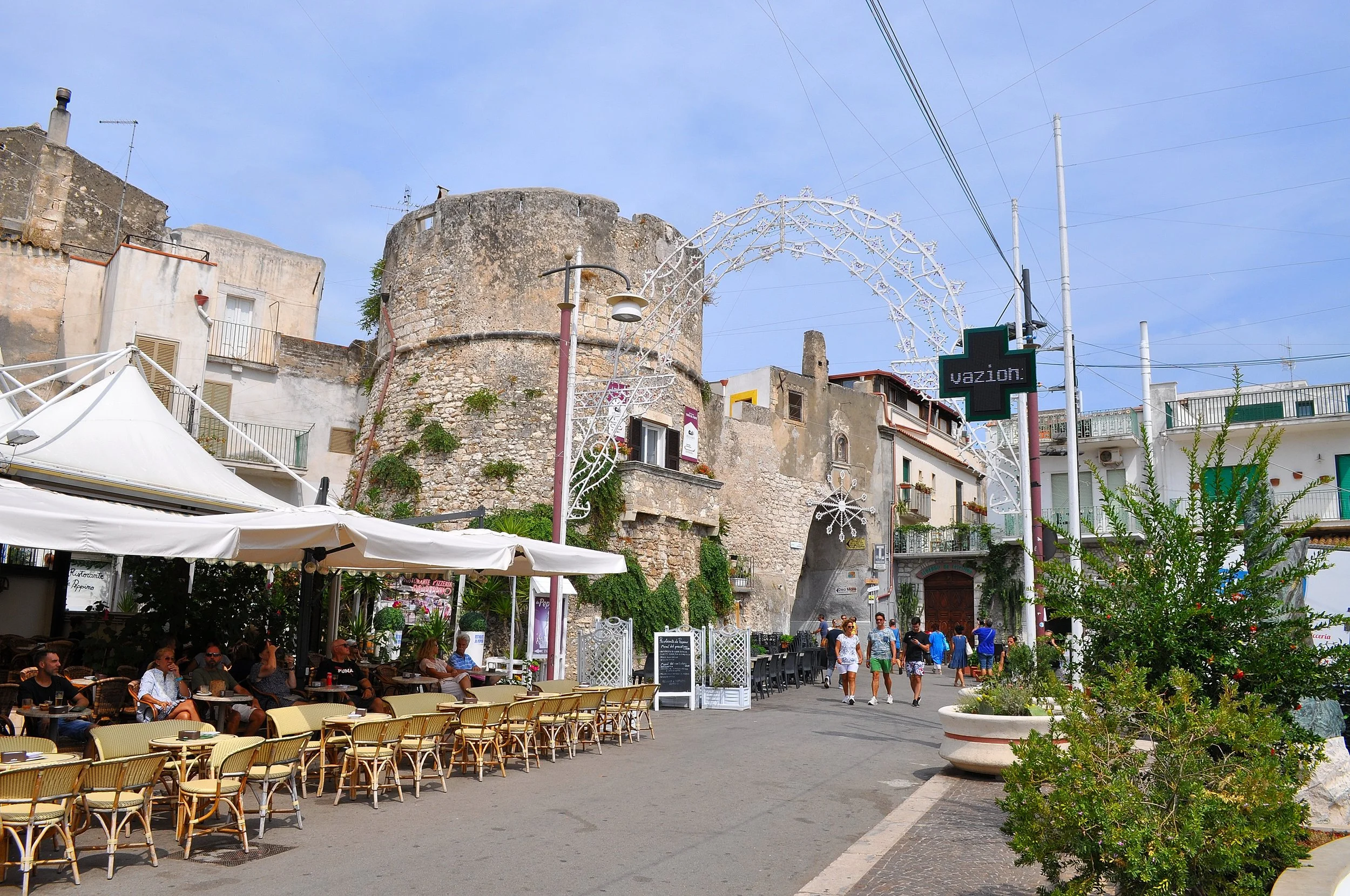
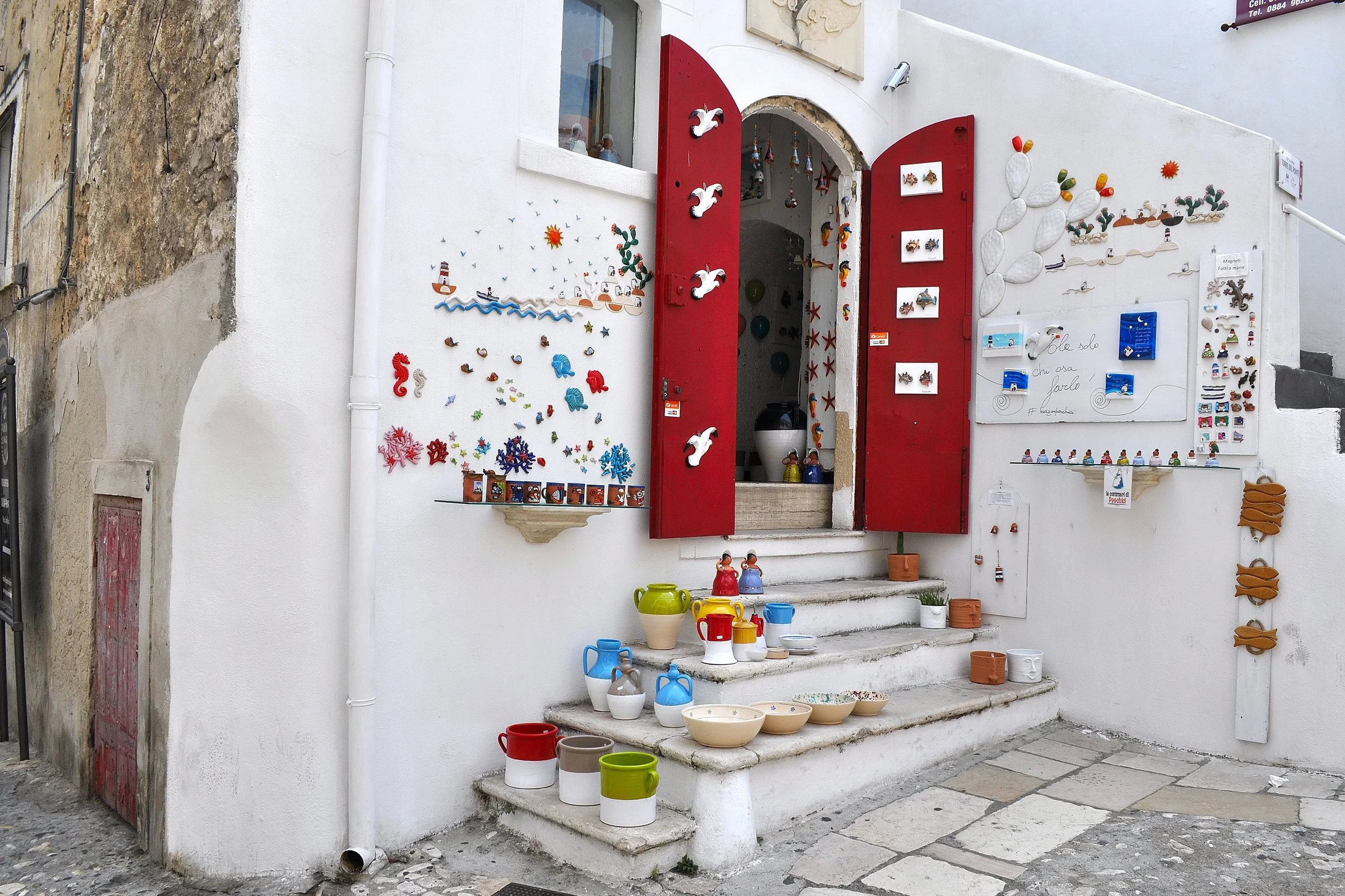
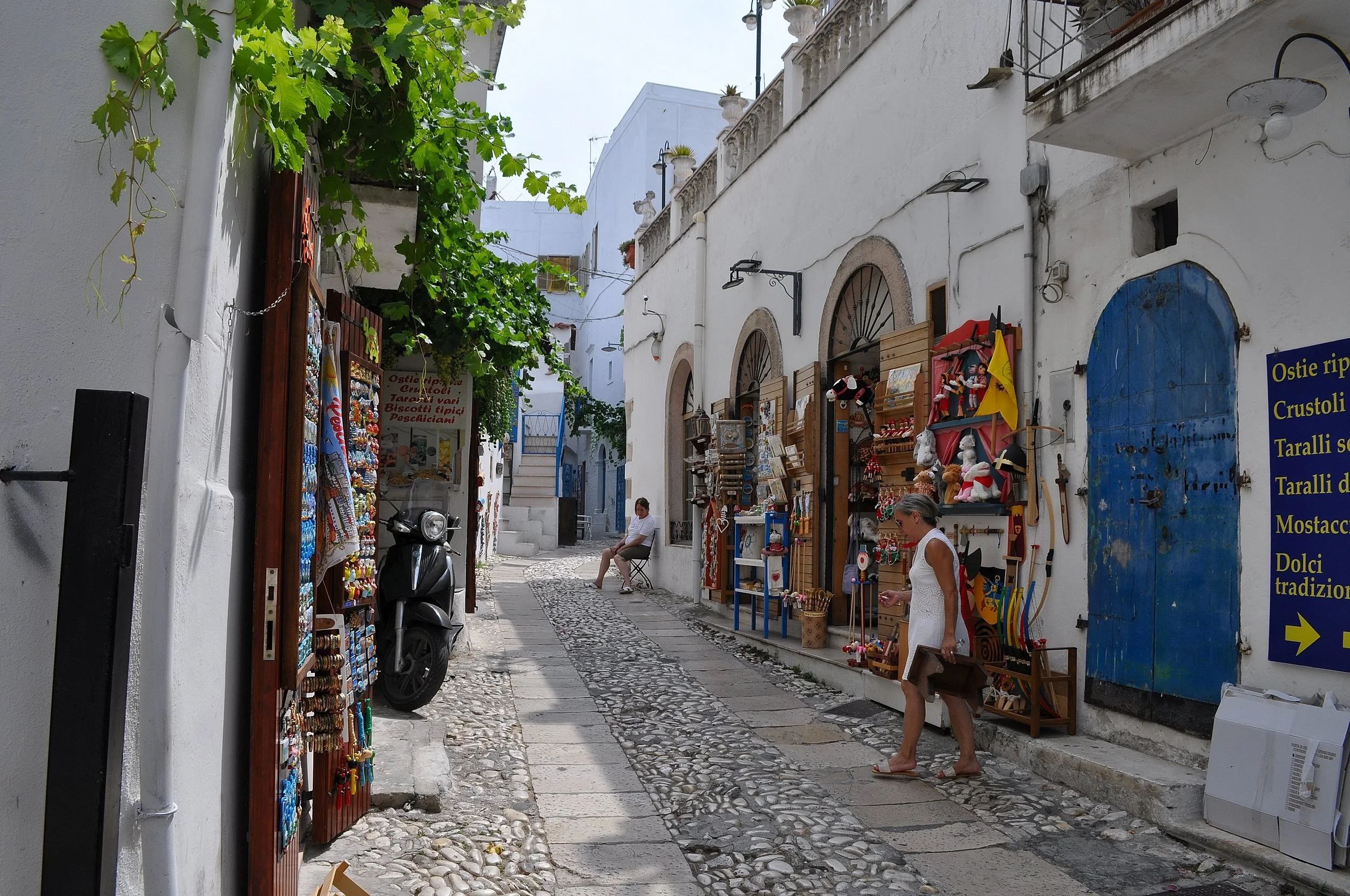
Piero: Peschici has a typically Mediterranean character, with its narrow streets, sea-view terraces and white houses with domed roofs and sloping roofs: practically a delightful mix of different historical periods and the various rulers who succeeded one another.



Angela: to further appreciate the variety of the Gargano landscape, we move to Monte Sant’Angelo, crossing the Umbra Forest.
Piero: let’s start with the name: it is called Umbra not because it has anything to do with the Umbria region, but because the term “umbra” comes from Latin and means “dense, shady”. Its vegetation provides moments of coolness, especially during the scorching summer heat. The entire nature reserve extends for over ten thousand hectares and rises above eight hundred metres above sea level.
Angela: it is an enormous biodiversity heritage which, despite its relatively small size, hosts 40% of Italian flora and 70% of the bird species found in Italy. Furthermore, several studies have shown that here plants generally develop a larger size than normal: this makes it possible to encounter monumental specimens of Aleppo pines, beeches, holm oaks and yew trees.
Piero: precisely because of these unique characteristics, since 2017 the Umbra Forest has been recognised as a UNESCO World Heritage Site for its ancient beech forests.
Angela: the forest hosts as many as fifteen marked trails, some suitable for beginners, others designed for trekking and mountain bike experts. It is absolutely worth discovering the forest through one of these trails; however, be aware that there are many areas where mobile phone coverage is unavailable.
Piero: after crossing the forest, we arrive at Monte Sant’Angelo, the highest inhabited centre of Gargano. It is another wonderful medieval village, with the classic white houses and an unforgettable view of the sea from above.

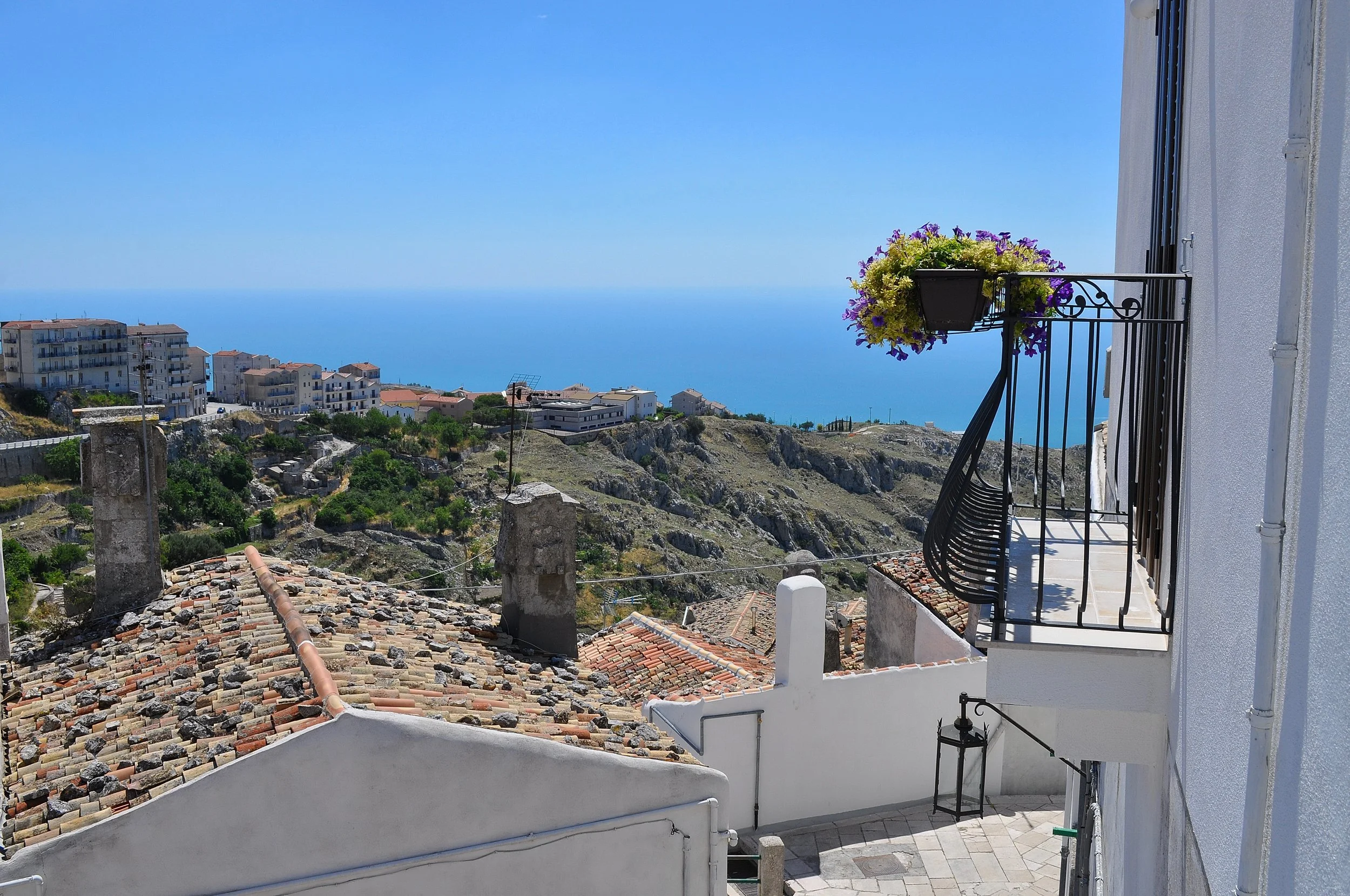
Angela: the wonderful historic centre, the Rione Junno, is more than one thousand years old and houses the second UNESCO World Heritage Site of Gargano, the Basilica of Saint Michael.
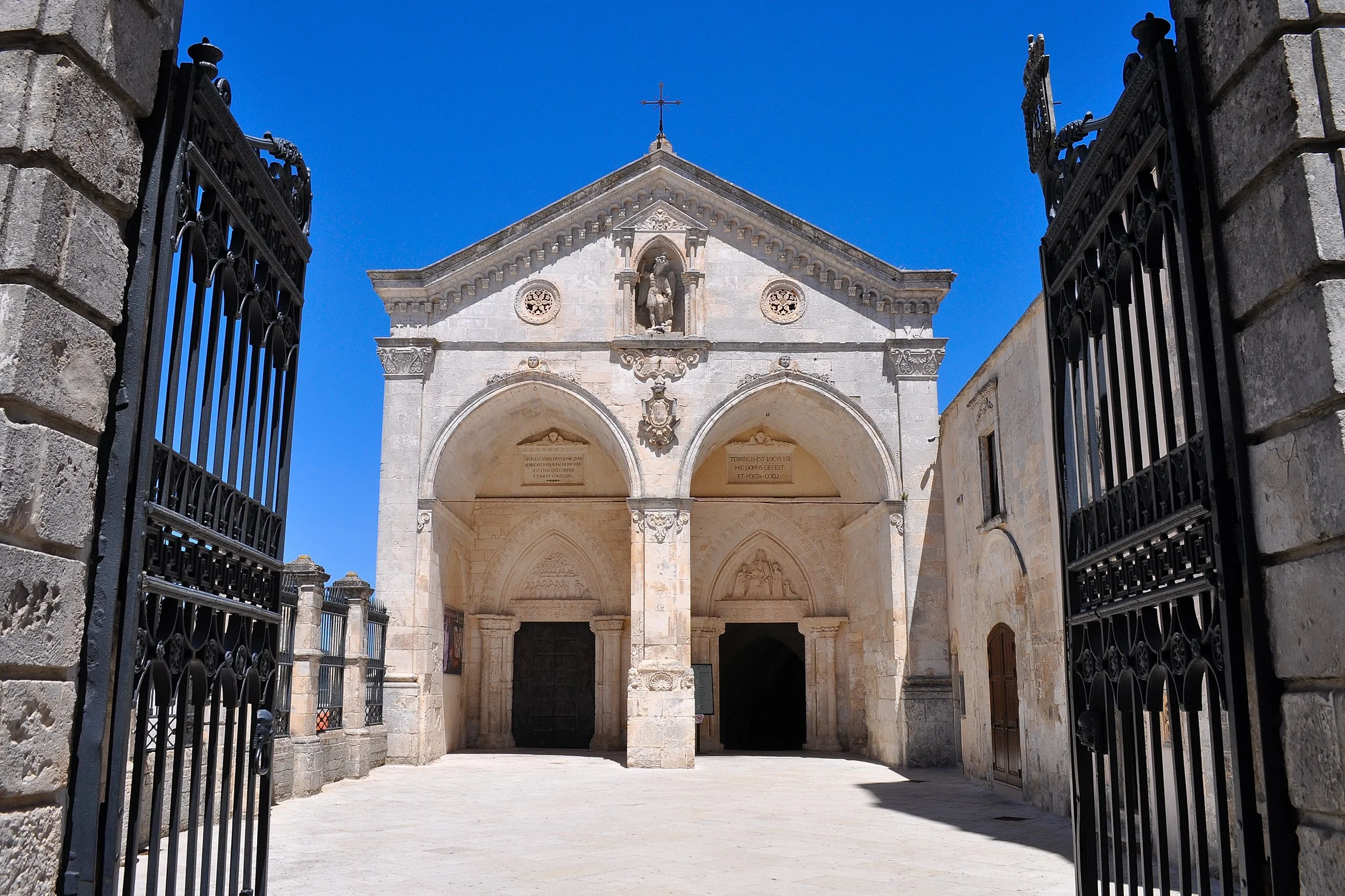
Piero: clearly, the basilica is the symbol of Monte Sant’Angelo, and it seems to have been built exactly on the spot where the Archangel Michael first appeared, inside a cave. The cave itself is the heart of the basilica, and it can be reached by walking down the descending staircase.

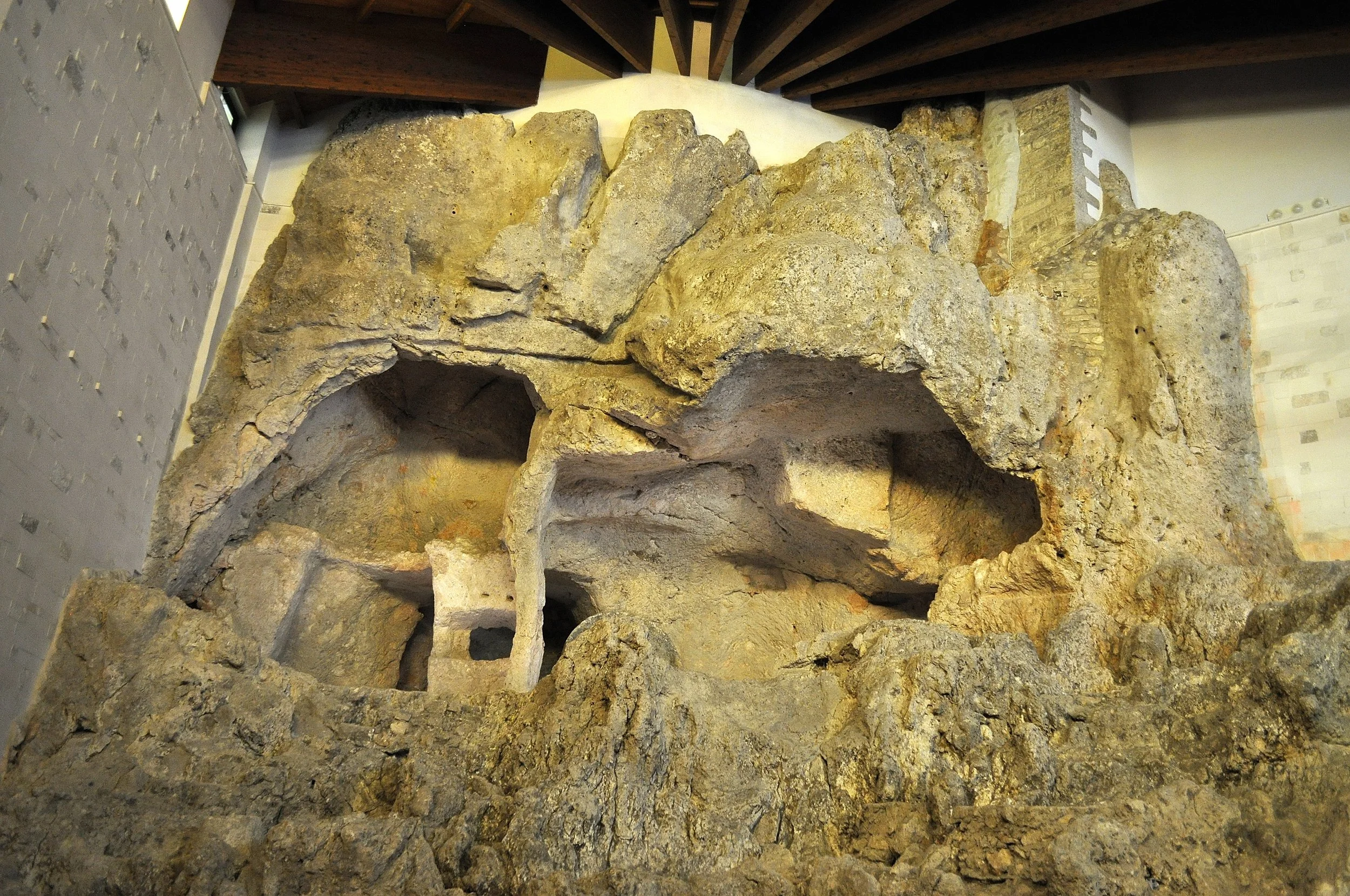
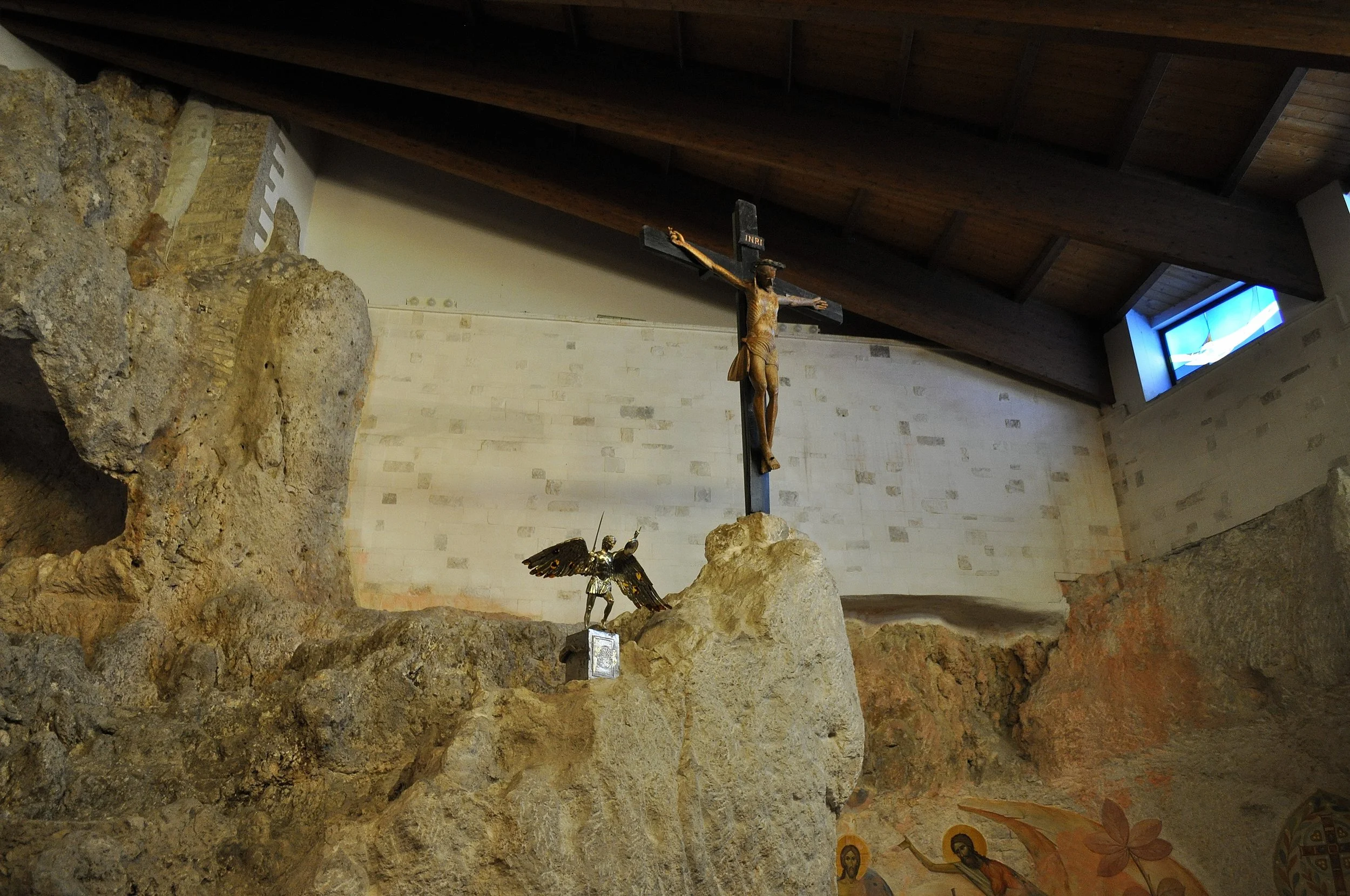

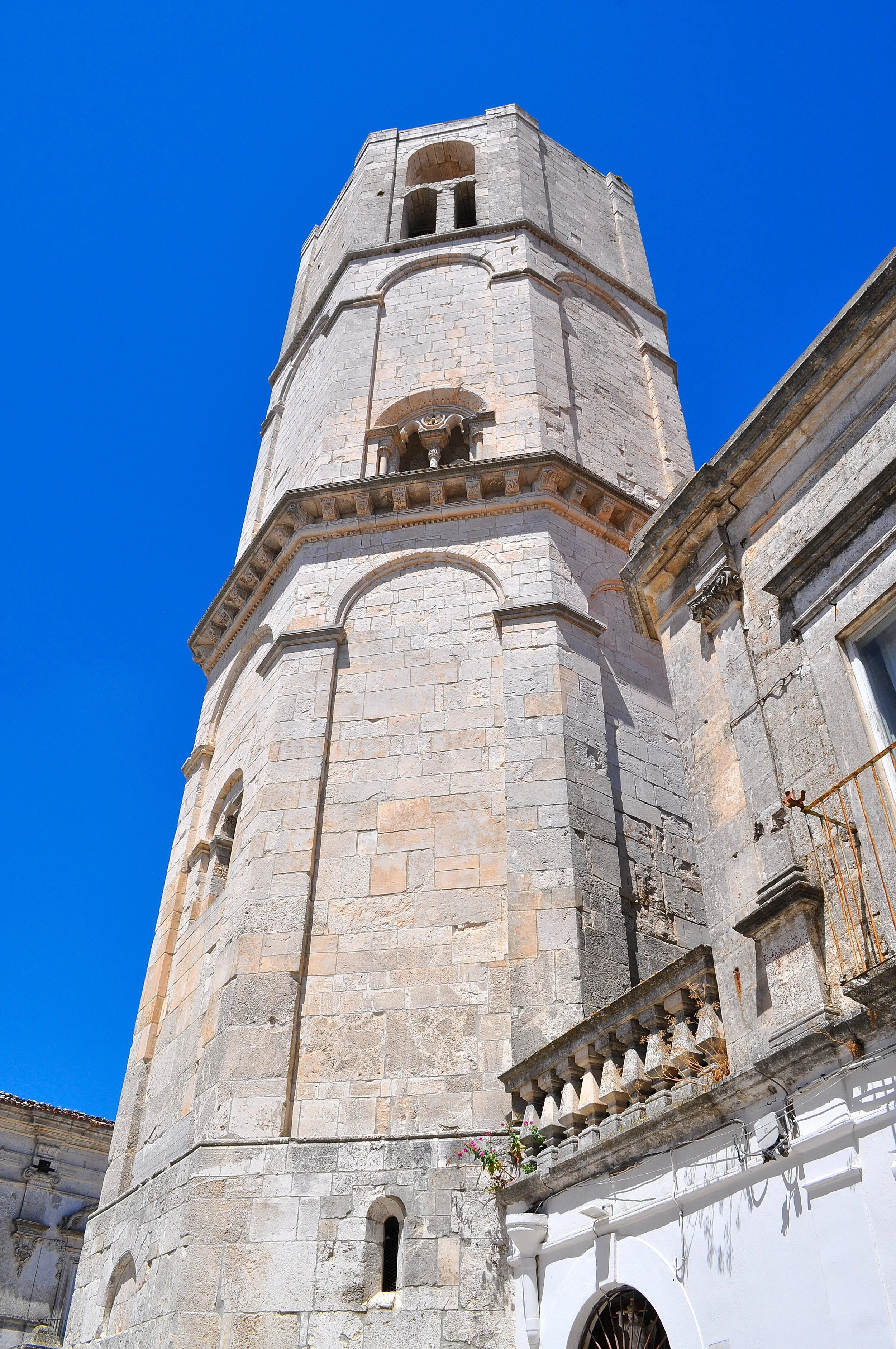
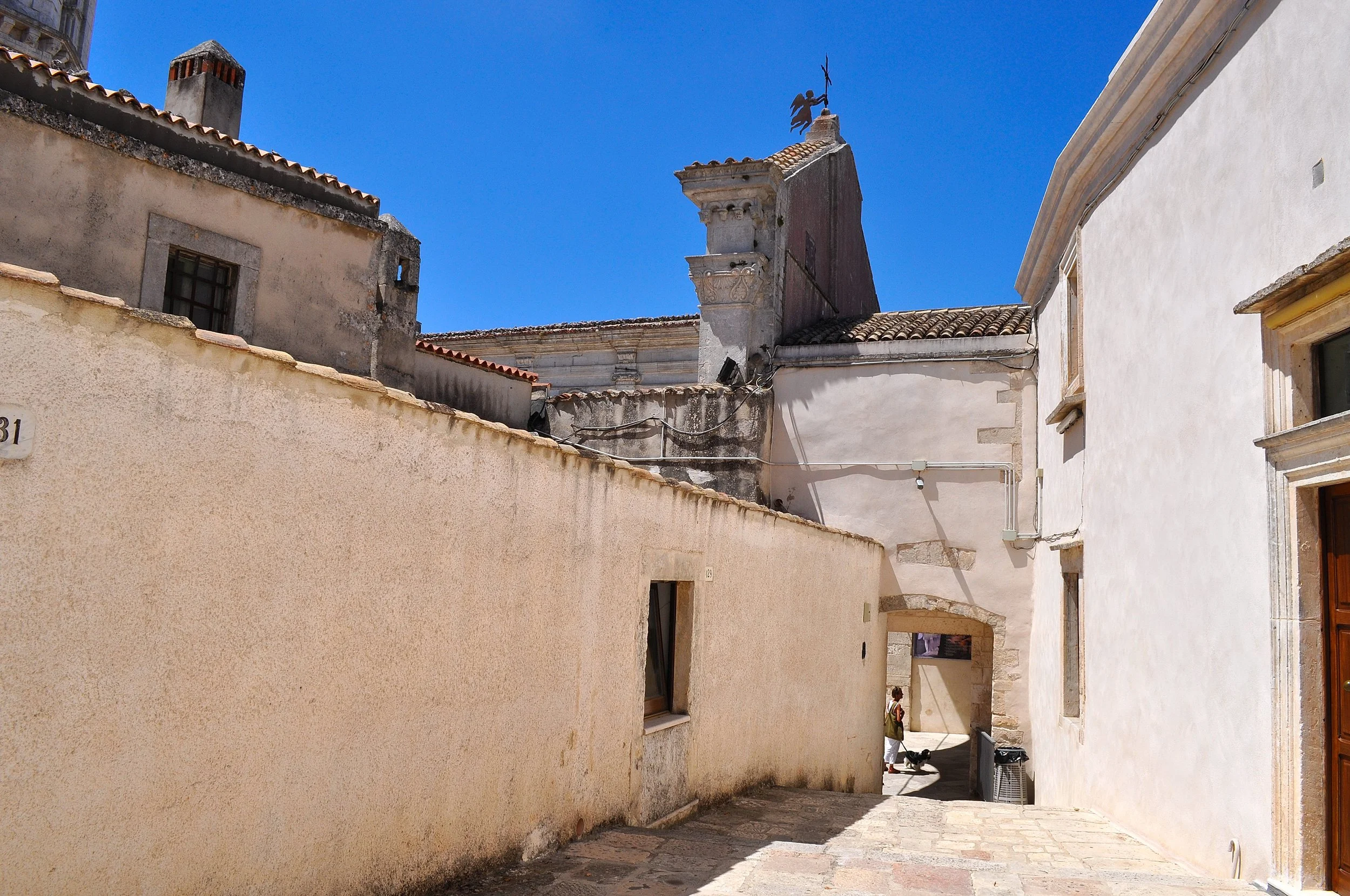
Angela: after leaving the cave, we go back to strolling through the Rione Junno. As mentioned, it is the oldest and most characteristic neighbourhood of Monte Sant’Angelo, thanks to its small white houses that seem to create a nativity scene. In the past, these little houses were home to large families living in very confined spaces, often shared with animals as well. Today, many of these houses have been transformed into accommodations for tourists.


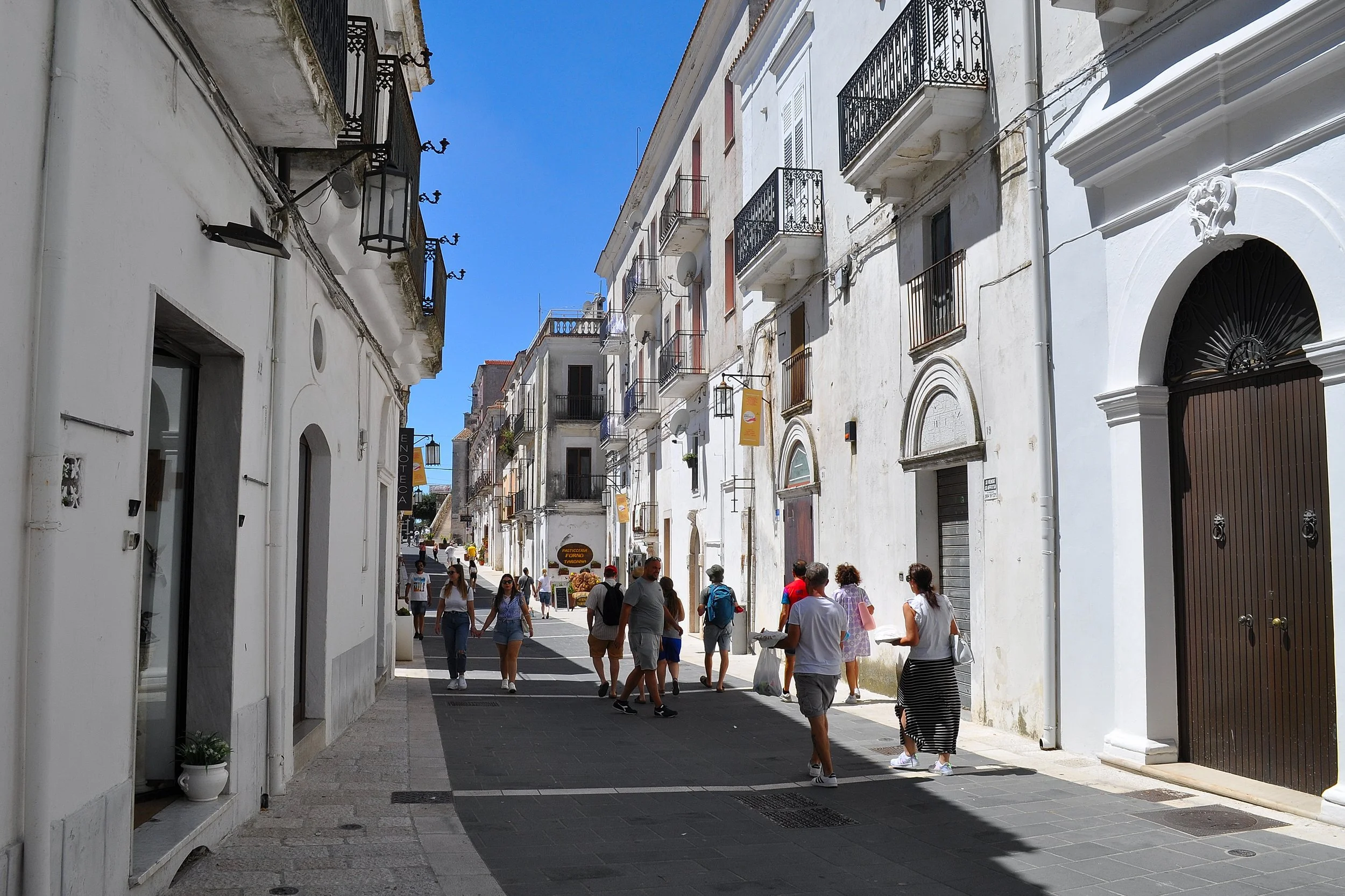
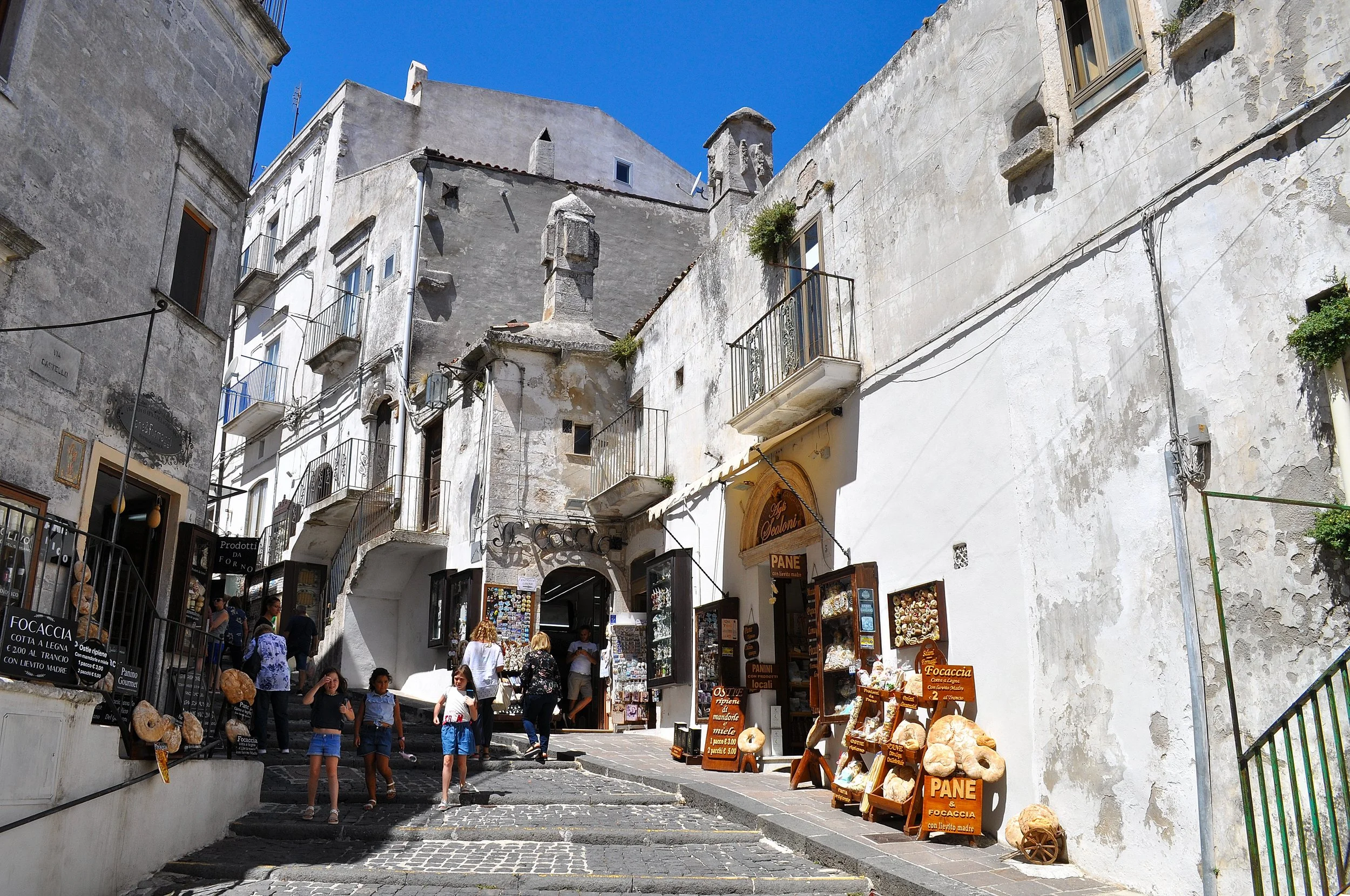



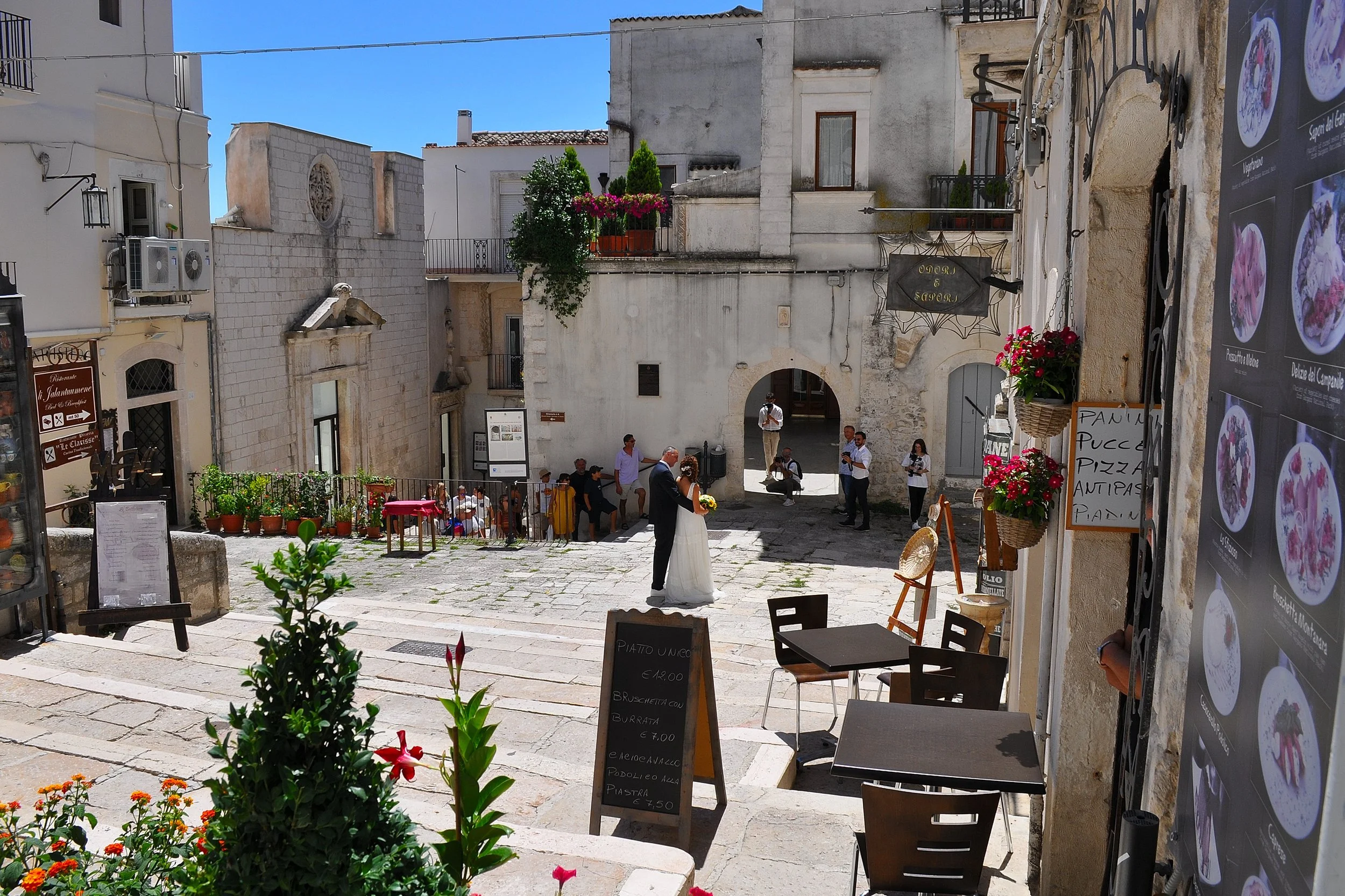
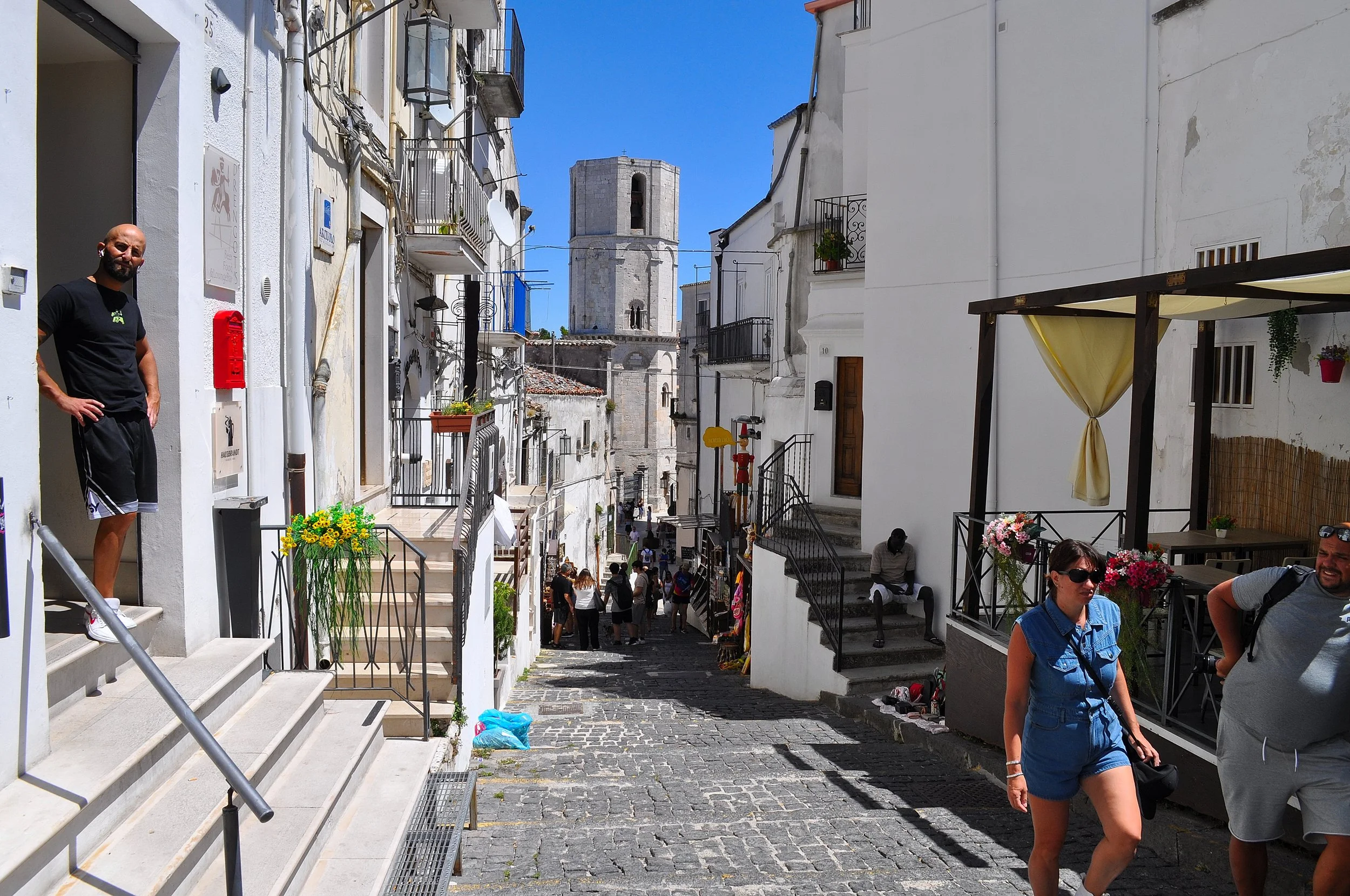
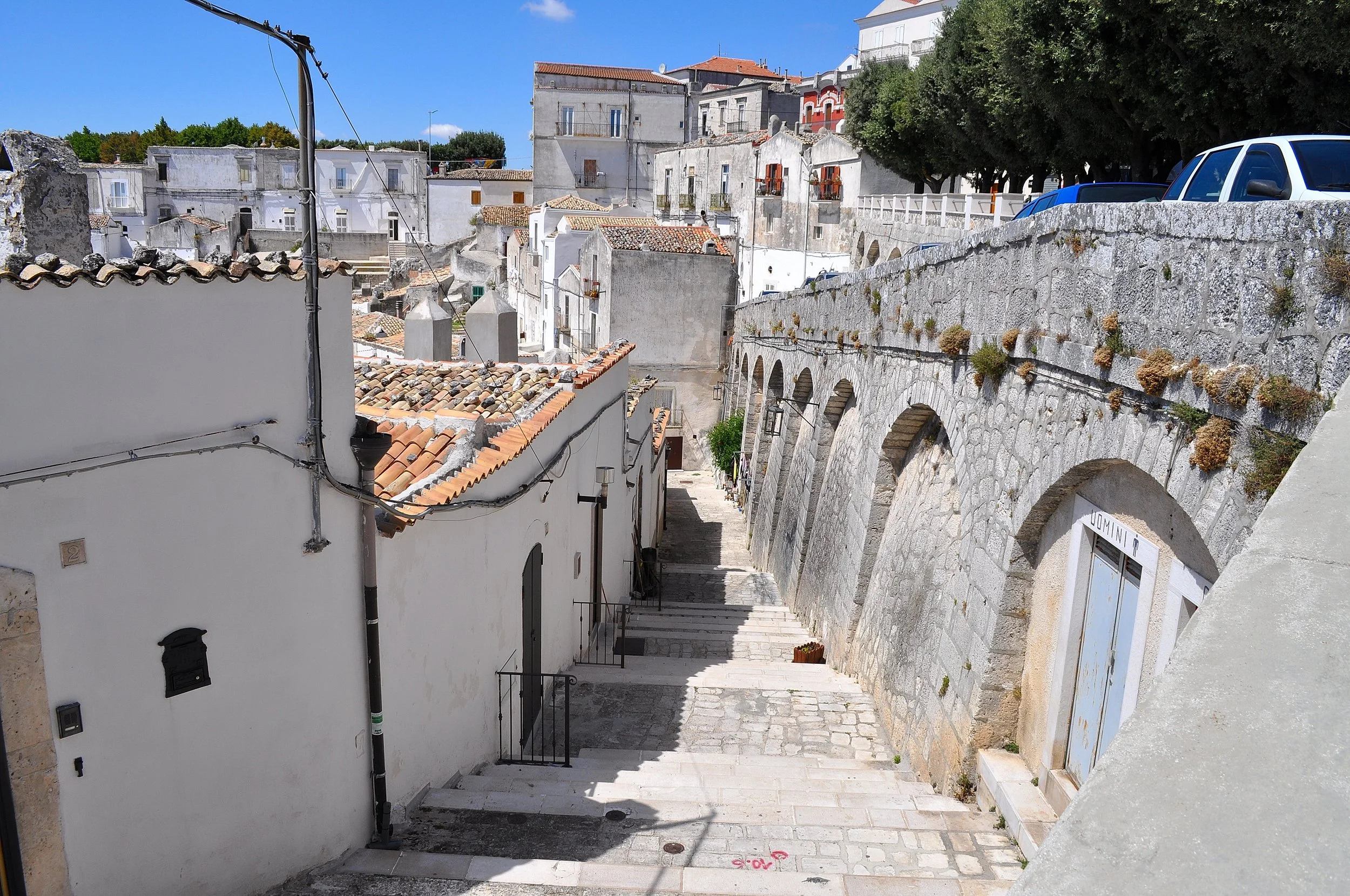
Piero: during our walk, we simply cannot miss stopping at one of the many little shops to taste the typical sweet of Monte Sant’Angelo, the ostia ripiena, filled with almonds and honey.
Angela: the last stop before lunch is the castle of Monte Sant’Angelo, with its Norman, Swabian influences under Frederick II, as well as Angevin and Aragonese influences.
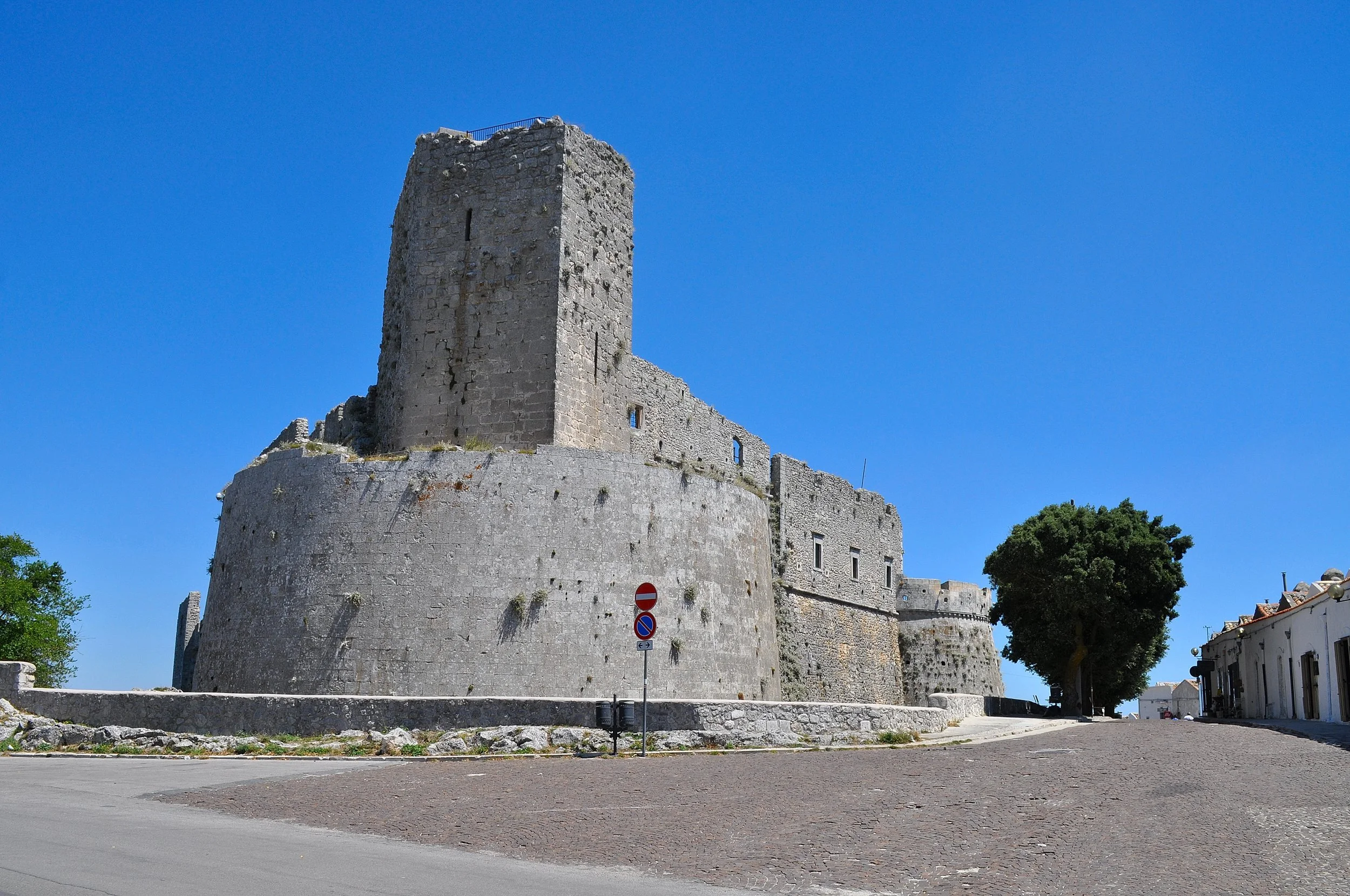
Piero: from here, you can enjoy a beautiful panorama over the entire city, the forest and the Gulf of Manfredonia.
Angela: after lunch, we head precisely to Manfredonia.
Piero: the name of the city comes from Manfredi, King of Sicily and natural son of Frederick II, who founded it in the 13th century to relocate the inhabitants of nearby Sipontum, destroyed by Saracen raids and by an earthquake.
Angela: the construction of the castle, still the symbol of the city today, is also due to Manfredi.
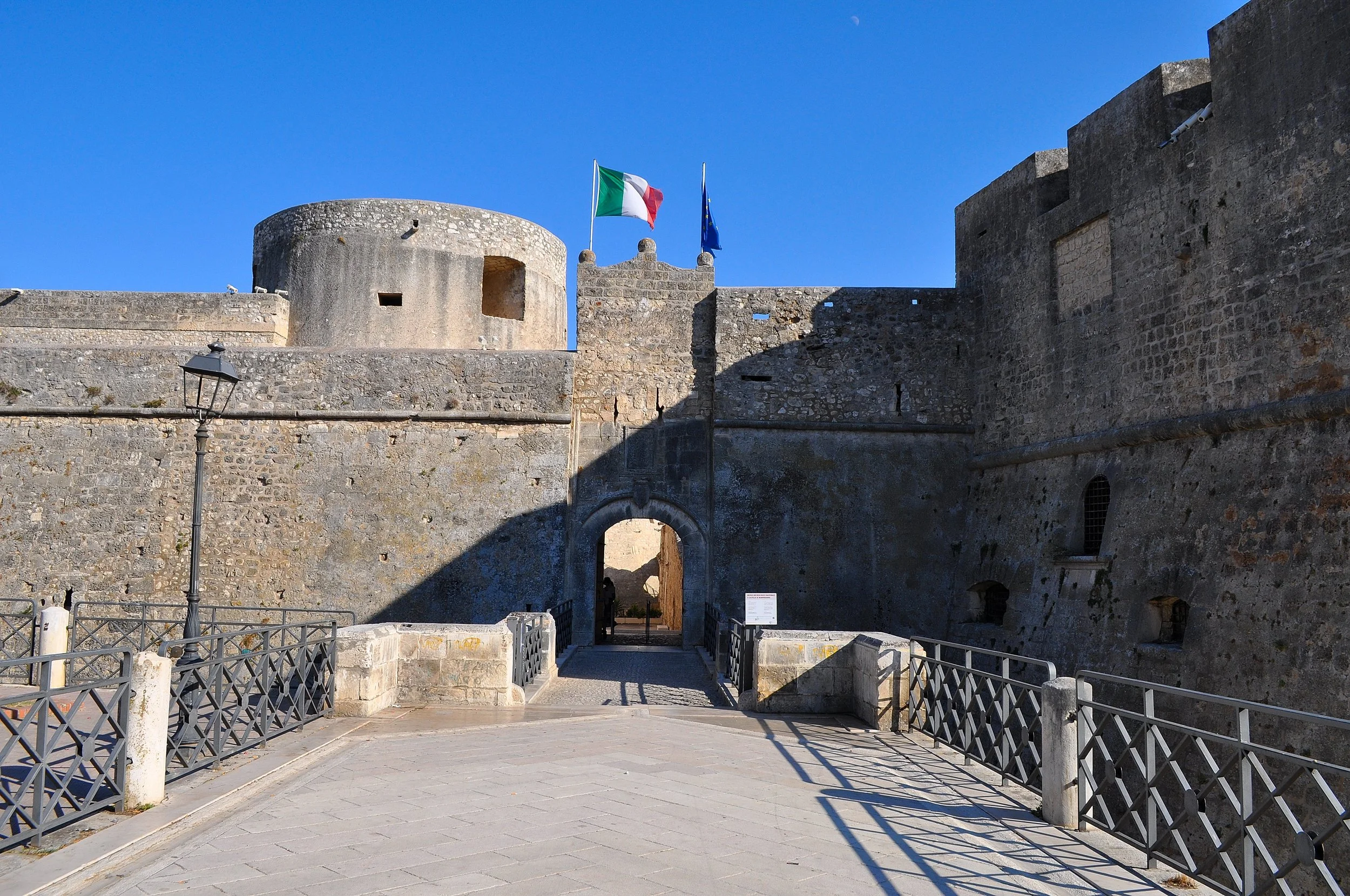
Piero: after the visit to the castle and a walk through the town centre and along the waterfront, it is time to head back.
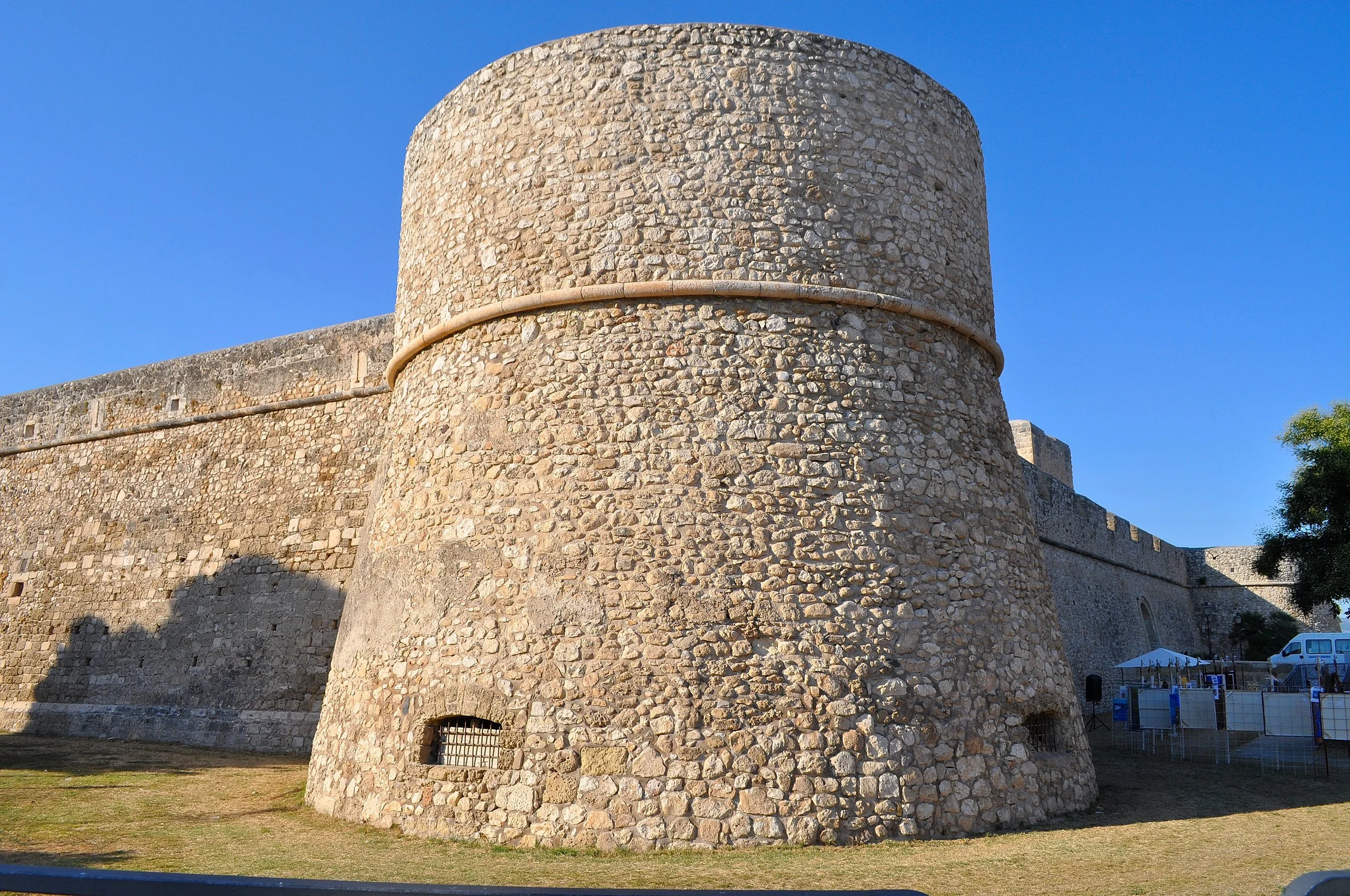


Goodbye Gargano!
Piero: with Manfredonia, our one-week tour through this wonderful land comes to an end.
Angela: actually, we have not talked about two other wonderful stops: from Vieste or Peschici, ferries depart for the Tremiti Islands, a true corner of paradise that we will tell you about later though…
Piero: as we followed in the footsteps of Frederick II, we left Gargano for one day to visit Trani and Castel del Monte; but we will talk about this experience another time as well.
Angela: for now, it is worth enjoying this wonderful journey in this short video!