Easter in Kraków: history, emotions, and a special birthday
Piero: this year Easter has a different meaning than usual.
Angela: I would also say special… you don’t get to celebrate 50 years every day!
Piero: and in fact for the occasion we also chose something different in the way of traveling. This time no van, no endless hours driving, and no timetable to follow. At least to get to the destination I mean…
Angela: how wonderful, just a comfortable flight from Milan to Kraków. The return flight we will do from Katowice: it is not exactly the same thing (one hour and a half by car or bus) but the saving was significant. Less than two hours and we find ourselves catapulted into one of the most beautiful and fascinating cities of Central Europe.
Piero: you must admit… it almost seems strange for us to leave so light. No desperate search for parking, no navigator on all day, no rush from one stop to another.
Angela: and in the end this is exactly the beauty of Kraków: here the car is not really needed. The city is compact, very easy to walk around and very well connected with very punctual trams that cross every district.
Piero: one of those cities that invites you to slow down. You walk without a precise destination, turn into an alley and you find yourself in front of a Gothic church, an elegant building or a square full of life.
Angela: and then we arrive in the perfect period. Easter is really felt here: markets, decorations, smell of traditional sweets and an atmosphere lively but at the same time elegant.
Piero: maybe because Kraków manages to be many things together. Monumental but welcoming, historical but young, melancholic and full of energy at the same time.
Angela: in short, the right place to celebrate an important milestone. A journey without hurry, to be lived walking, observing and letting yourself be surprised.
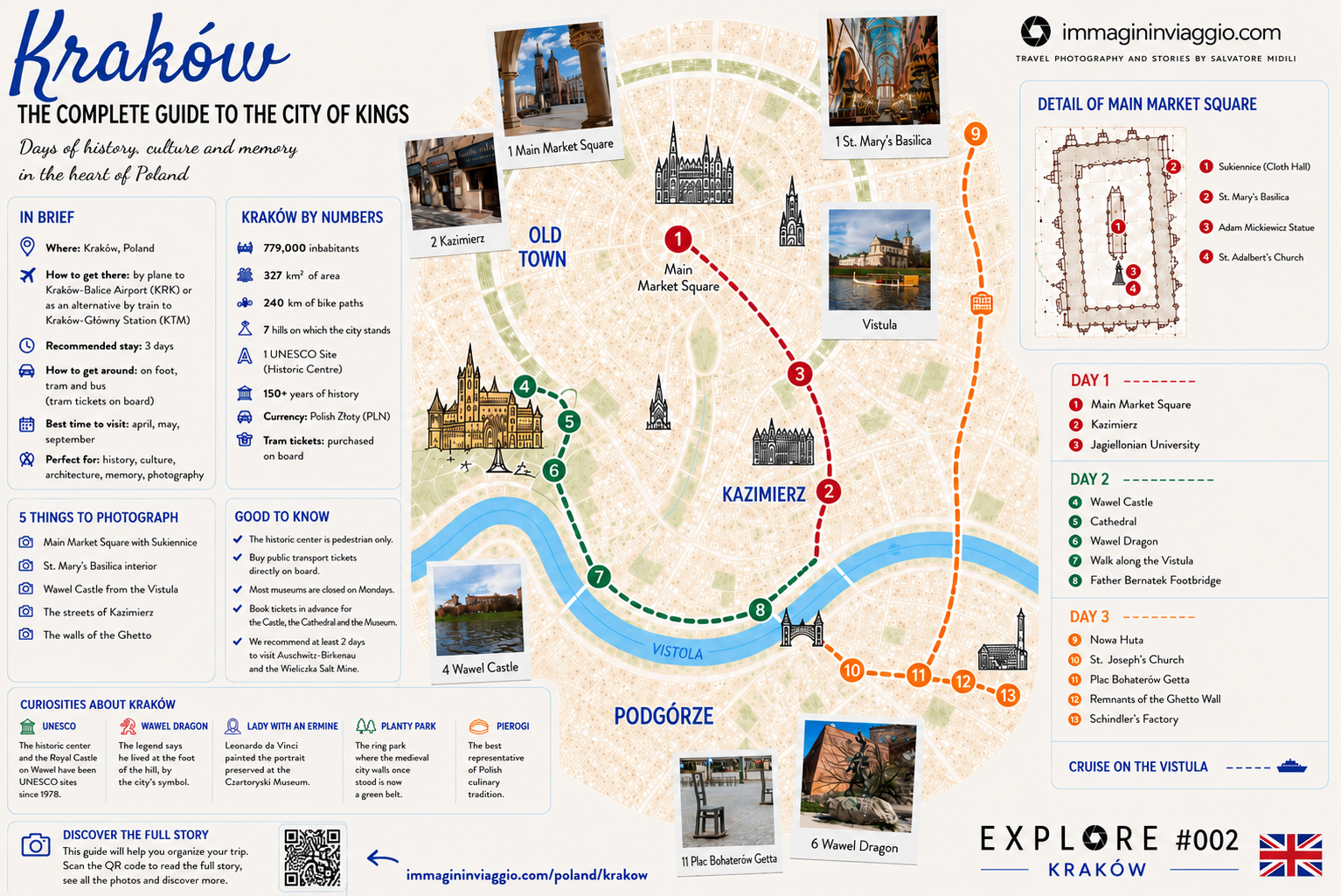
Piero: and anyway, okay to live it slowly, but not too much… The things to see are really many in the city and I don’t want to miss even one. And I also organized two special stops right nearby: Auschwitz-Birkenau and the Wieliczka Salt Mines.
Angela: I had no doubts! There will certainly be walking and I imagine you took into account the fact that Poland is a very Catholic country: many attractions from Good Friday to Easter Monday could be closed.
Piero: no cash will be needed: even though in Poland there is no euro, cards are accepted everywhere and it is not worth doing the exchange into zloty; the rate is one to four but it is almost never respected…
Angela: also for the power sockets there are no problems: plugs are identical to the Italian ones; mobile phones work using the normal European Union tariffs.
Piero: let’s fasten the seatbelts then: we go!
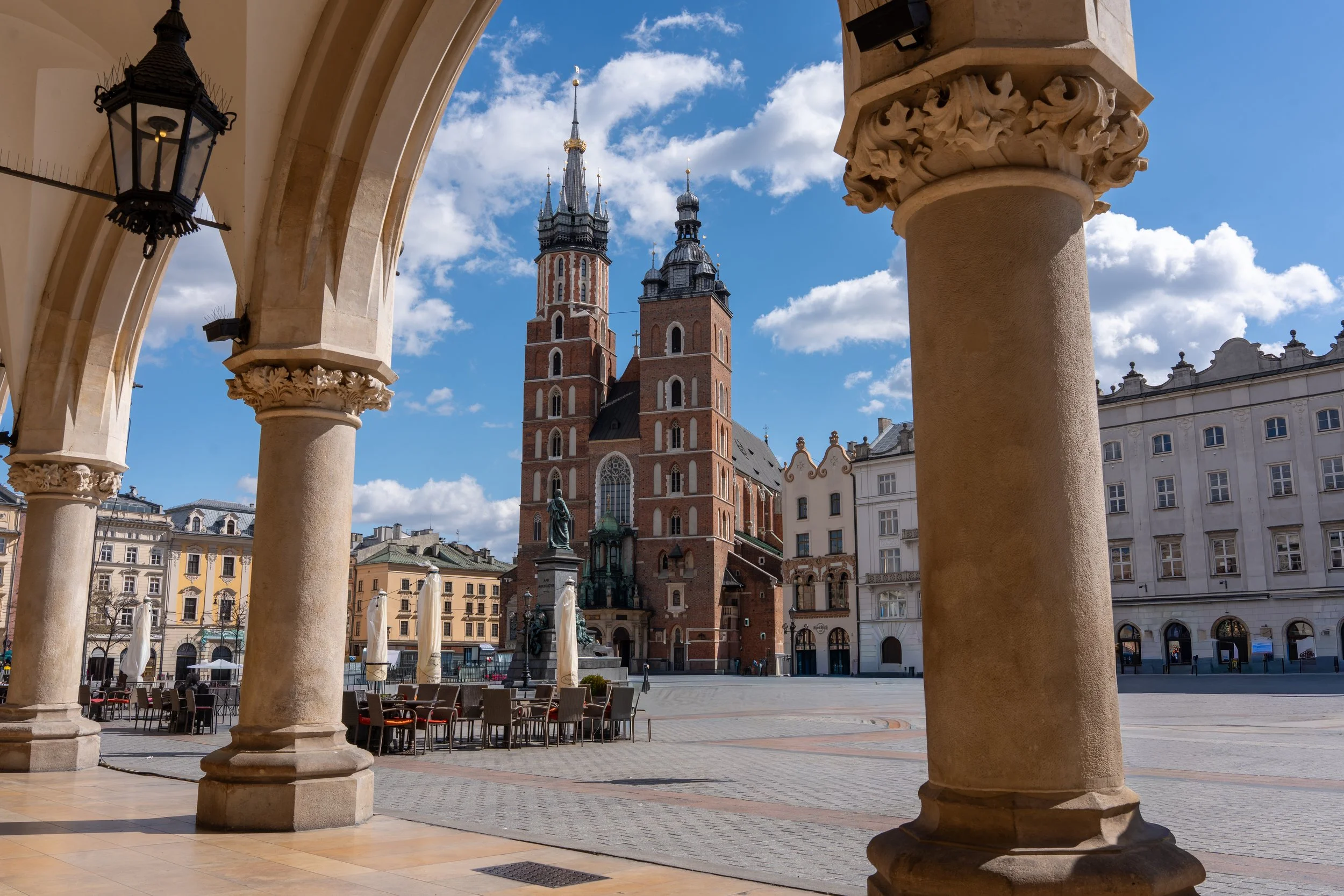
Kraków and Poland: centuries of history in the heart of Europe
Angela: before even starting our journey through squares, castles, and medieval alleys, I think it is important to stop for a moment and understand where we really are. Because Kraków is not just one of the most beautiful cities in Europe: it is the historical soul of Poland, the place where this country built its identity over the centuries.
Piero: and perhaps the history of Poland is one of the most complex on the entire continent. Its geographical position, in the heart of Central Europe, makes it a vast plain that over the centuries has been crossed by armies, trade, invasions, and migrations and has deeply shaped the country’s history. Practically a huge European corridor, with a position that is at the same time strategic but difficult to defend: the great Polish plains, lacking significant natural barriers, have made the territory vulnerable to attacks from both west and east.
Angela: at the same time, Poland has always been a cultural bridge: here Slavic, Germanic, Jewish, and Eastern cultures met. In the Middle Ages, the Polish kingdom became one of the most important powers in Central Europe.
Piero: it all begins in the 10th century with the Piast dynasty and with Prince Mieszko I, considered the founder of the Polish state. With him, the Poles begin to become the very Catholic people they still are today. In 966, Mieszko I converts to Christianity, an event considered symbolically the official birth of Poland. From that moment the country enters permanently into the cultural orbit of Western Europe.
Angela: and Kraków begins to become important. Thanks to its position along the Vistula River, the great river that crosses the country from south to north, the city quickly becomes a strategic commercial centre. Merchants from all over Europe passed through here transporting salt, fabrics, spices, and precious metals.
Piero: the wealth of the city, however, does not come only from trade. Kraków soon becomes the political centre of the kingdom: in 1038, King Casimir I moves the capital here and from that moment the city begins its golden age.
Angela: and the Wawel Hill, overlooking the river, becomes the symbol of Polish royal and religious power. Here the royal castle and the cathedral where the sovereigns were crowned rise in that period, practically the heart of the monarchy: every Polish king had to be crowned in the Wawel Cathedral. Even today that place represents a kind of national sanctuary for Poles.
Piero: with wealth and power also come difficult times. In the 13th century the devastating Mongol invasions arrive: in 1241, Kraków is almost completely destroyed by the Tatars. From this episode comes the very regular structure of the old town: after the destruction the city is rebuilt following a very precise medieval urban plan, with a huge central square and an orderly network of streets. And it is incredible to think that this urban layout has remained almost intact until today.
Angela: so when we walk through the old town we are basically seeing the original medieval city. And this is what makes Kraków so special. Many European cities have lost their ancient face due to wars or modern reconstructions. Here instead the Middle Ages are still perfectly readable.
Piero: meanwhile Poland was becoming increasingly powerful. With the Jagiellonian dynasty, between the 14th and 16th centuries, one of the largest European states of the time was born: Poland united with Lithuania forming a gigantic federation that stretched from the Baltic almost to the Black Sea.
Angela: it was a huge and very advanced country for its time. Imagine that in the 16th century the Polish-Lithuanian Commonwealth was considered one of the most tolerant states in Europe: here Catholics, Orthodox, Protestants, and Jews coexisted.
Piero: and this is also why the Jewish community of Kraków became so important. For centuries the city hosted one of the largest and most vibrant Jewish communities in Europe, especially in the Kazimierz district, which we will visit later.
Angela: then decline begins: continuous wars, Swedish invasions, economic crises, and political instability gradually weaken the country. Until the tragedy of the Partitions of Poland in the 18th century.
Piero: between 1772 and 1795, Russia, Prussia, and Austria completely divide Polish territory. For over 120 years Poland ceases to exist as an independent state, literally disappearing from the map.
Angela: and yet the Poles continue to defend their language, culture, and traditions. During that period Kraków, under Austrian rule, remains a very important cultural and patriotic centre.
Piero: almost a guardian of national memory. Here artists, writers, and intellectuals continued to study and keep Polish identity alive. And this is also why the city is still today considered the spiritual and cultural symbol of the nation.
Angela: then comes the 20th century… and another immense tragedy: the Second World War deeply marked all of Poland. In September 1939, the country was invaded by Nazi Germany, marking the beginning of the world conflict.
Piero: and Kraków was occupied almost immediately. The Nazis turned the city into the capital of the General Government: the city lived through terrible years—persecutions, deportations, and the destruction of the Jewish community. Here the memory of the Shoah is still very strong.
Angela: impossible to forget it. Just a few kilometres from the city lies Auschwitz, the largest Nazi extermination camp. Millions of people were deported and killed there.
Piero: and yet the historic centre of Kraków was almost completely saved. Unlike Warsaw, which was almost entirely destroyed during the war, Kraków managed to preserve much of its original architectural heritage.
Angela: today’s Kraków is not a reconstruction: much of what we see is authentic. Medieval buildings, Gothic churches, Renaissance courtyards, cobbled streets… everything tells more than a thousand years of history.
Piero: not by chance, UNESCO included it among World Heritage Sites already in 1978. It was one of the very first sites in the world to receive this recognition. And honestly, just a few steps in the old town are enough to immediately understand why.
Angela: Kraków is also linked to one of the most beloved figures in Polish history: Pope John Paul II.
Piero: Karol Wojtyła, although born in nearby Wadowice, lived here for many years, studying at the Jagiellonian University, becoming first a priest and then archbishop of the city. During the Nazi occupation he even worked in a quarry and in a chemical plant to avoid deportation.
Angela: the war directly marked his life; the loss of friends, the persecution of Jews, and Nazi violence deeply influenced his thinking. His election to the papacy in 1978 represented a huge historical and emotional moment for Poles.
Piero: and of course his relationship with Poland also had political weight; Pope John Paul II’s visits to his homeland during the communist period gave moral strength to millions of Poles, and many historians believe that his spiritual support contributed to the birth of the Solidarność movement and indirectly to the fall of the communist regime.
Angela: here we are not talking only about religion, but also about national identity. Even today Kraków preserves the memory of Wojtyła everywhere: churches, squares, monuments, and even the windows of the archbishop’s palace where he used to appear to speak to the faithful.