The Alcantara Gorges
Alberto: I’m here again to continue our journey discovering Sicily…
Angela: where are we going this time?
Piero: you’re doing great so far: the places we’ve seen are stunning and the kids have had a great time!
Angela: you’ve been very good at combining the two main ingredients we expect from Sicily: wonders to discover and, above all, lots of sea!
Alberto: this time, though, we’re changing things up a bit: no sea — but don’t worry, I won’t disappoint you this time either!
Angela: are you the one telling the kids that today they won’t see the sea?
Alberto: don’t worry, you’ll see it will be a wonderful adventure for them, with plenty of room for fun too. Start the van — we’re heading to The Alcantara Gorges!
All aboard!
Alberto: this time we’re heading a bit farther away, towards Catania, right on the border with the province of Messina; about an hour and a half on the road to reach our destination. Most of the journey is along the motorway: first the A20 towards Messina, then the A18 towards Catania. We exit at Giardini Naxos and from there continue inland along State Road 185 for about twelve kilometres.
Piero: we arrive very early in the morning at the Botanical and Geological Park of the Alcantara Gorges (https://www.golealcantara.it/). Parking is easy and there’s a short wait at the ticket office (be careful, because waiting times can become much longer, especially in August!). Entrance is paid, with discounts for teenagers, children, and especially for families. The various activities available inside the park are also paid, and you can buy combined tickets that allow you to save a bit. Inside there are bars and restaurants, but we take advantage of the day for a picnic, bringing what we need from home: there’s no need to carry everything with us, because once the ticket is purchased, we can easily go back to the van and then re-enter.
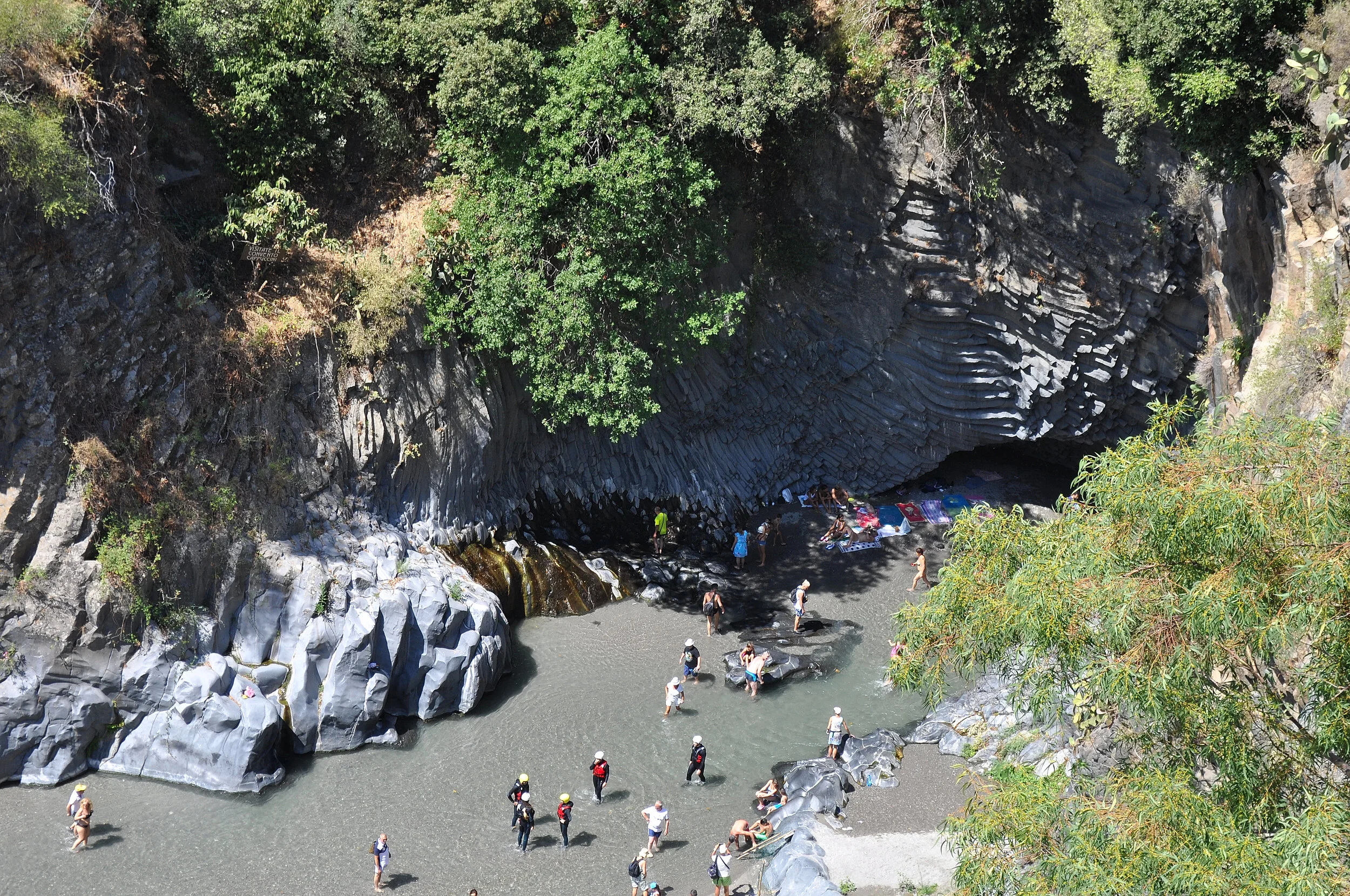
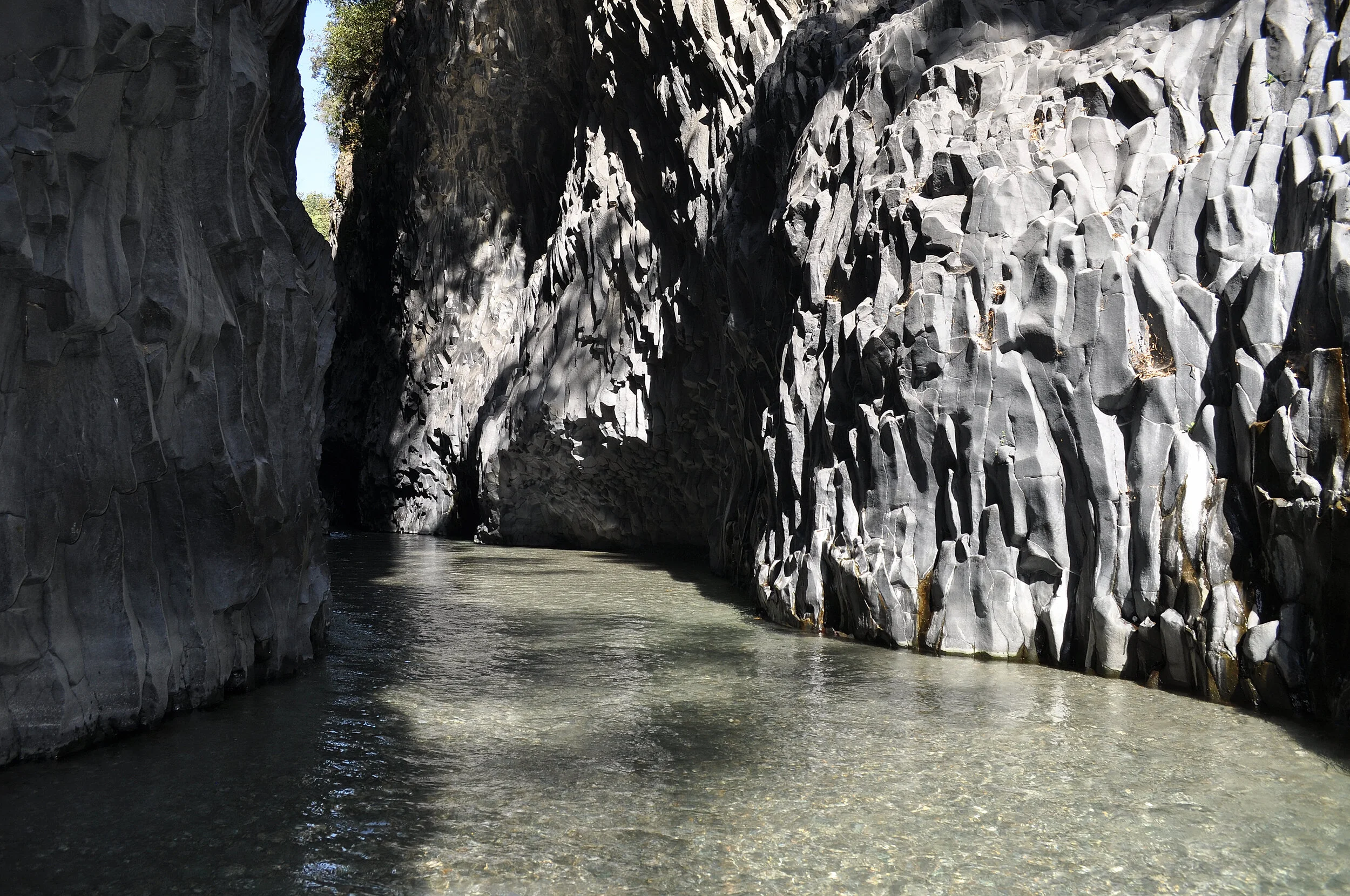
Alberto: the park lies right on the border between the two provinces, between the towns of Castiglione di Sicilia and Motta Camastra. The main attraction is certainly represented by the so-called “gorges”, a series of canyons up to fifty metres high and between two and five metres wide, through which the Alcantara River flows. The river rises on the southern slopes of the Nebrodi Mountains and ends its 52-kilometre course in the Ionian Sea, after skirting the northern and eastern slopes of Mount Etna. It is precisely the action of the river that, over the course of three hundred thousand years, has spectacularly shaped the Etna basalts, distinctive volcanic rocks.
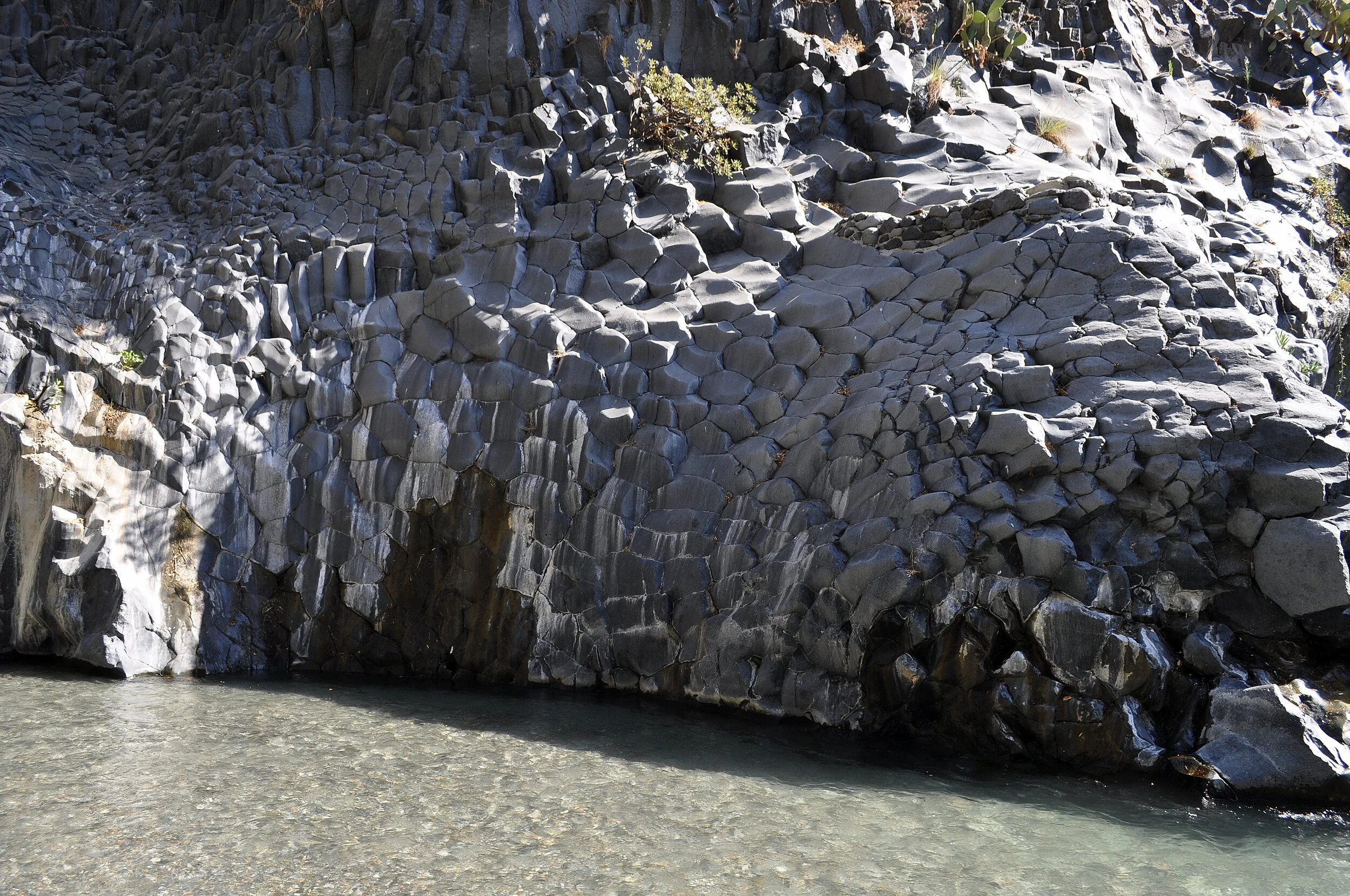


Piero: It is not certain whether this distinctive scenery was created by the erosive action of the river, which over time carved this particular path through the rock, or whether the riverbed originated from a fault formed as a result of a seismic event; this second hypothesis is supported by the fact that the canyon walls are intact and sharply defined, and that the flow of water would have contributed only partially to shaping them.
Alberto: only science here and no history or myth — so let’s move straight on to the fun!
Piero: you’re mistaken, my dear! Do you really think I wouldn’t have found something here as well?
Angela: I expected that — by now we’re used to it…
Piero: according to myth, the gorges are said to have formed because of the dishonesty of a farmer who, through his bad behaviour, unleashed the wrath of the Gods in ancient times, giving rise to an impressive volcanic eruption. Clearly this is only a legend, but in antiquity it served to explain eruptions and seismic phenomena; let’s remember that we are very close to Mount Etna, and that the Alcantara River valley was evidently a preferred route for more than one powerful eruption that carried lava all the way to the sea, presumably forming Capo Schisò, near Giardini Naxos. Over time, these lava flows would repeatedly have blocked and altered the course of the river, as well as creating this natural wonder.
Alberto: the river owes its name to the Arabs: Alcantara in fact comes from Al-Qantarah, meaning bridge, in reference to the one of Roman origin that the Arabs found in the area. For the Greeks, this was the river of healing, known as Akesine.
The “Gorges”: a spectacle of nature

Angela: the wonder of this place is immediately striking and leaves both adults and children open-mouthed, faced with such beauty and power of Mother Nature.
Alberto: the park extends for more than two thousand hectares along the course of the river, forming several gorges and ravines, but above all offering a magnificent landscape that alternates between rock formations and lush vegetation, where citrus groves and prickly pear cacti are also found. Clearly, within the park and along the river area there is no shortage of wonderful, long trails to explore on foot, by mountain bike, or even by quad bike: from the Alcantara riverbanks trail, which follows the river’s course and is suitable for everyone, to the Mojo volcanic cone trail, much more demanding and leading to the discovery of this now-extinct volcanic cone at about 700 metres above sea level. We obviously stop at the most famous, best-known, and most impressive section of the gorges, right at the very beginning.
Piero: from the park’s access area, a system of lifts takes us down to the level of the river. The cheaper alternative to the lift would have been the municipal path, made up of 240 steps… The starting point of our visit is the small beach of the gorges.


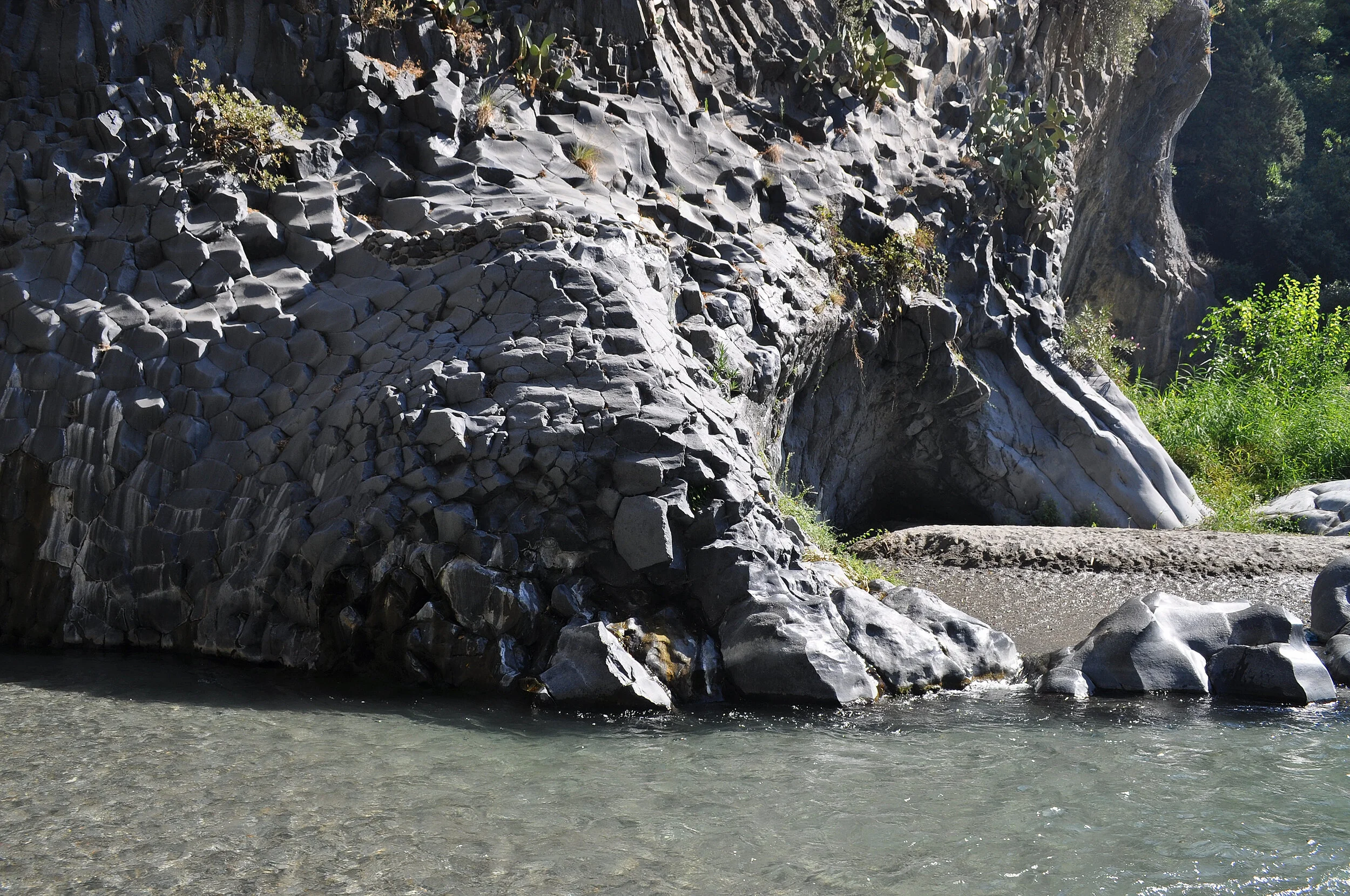
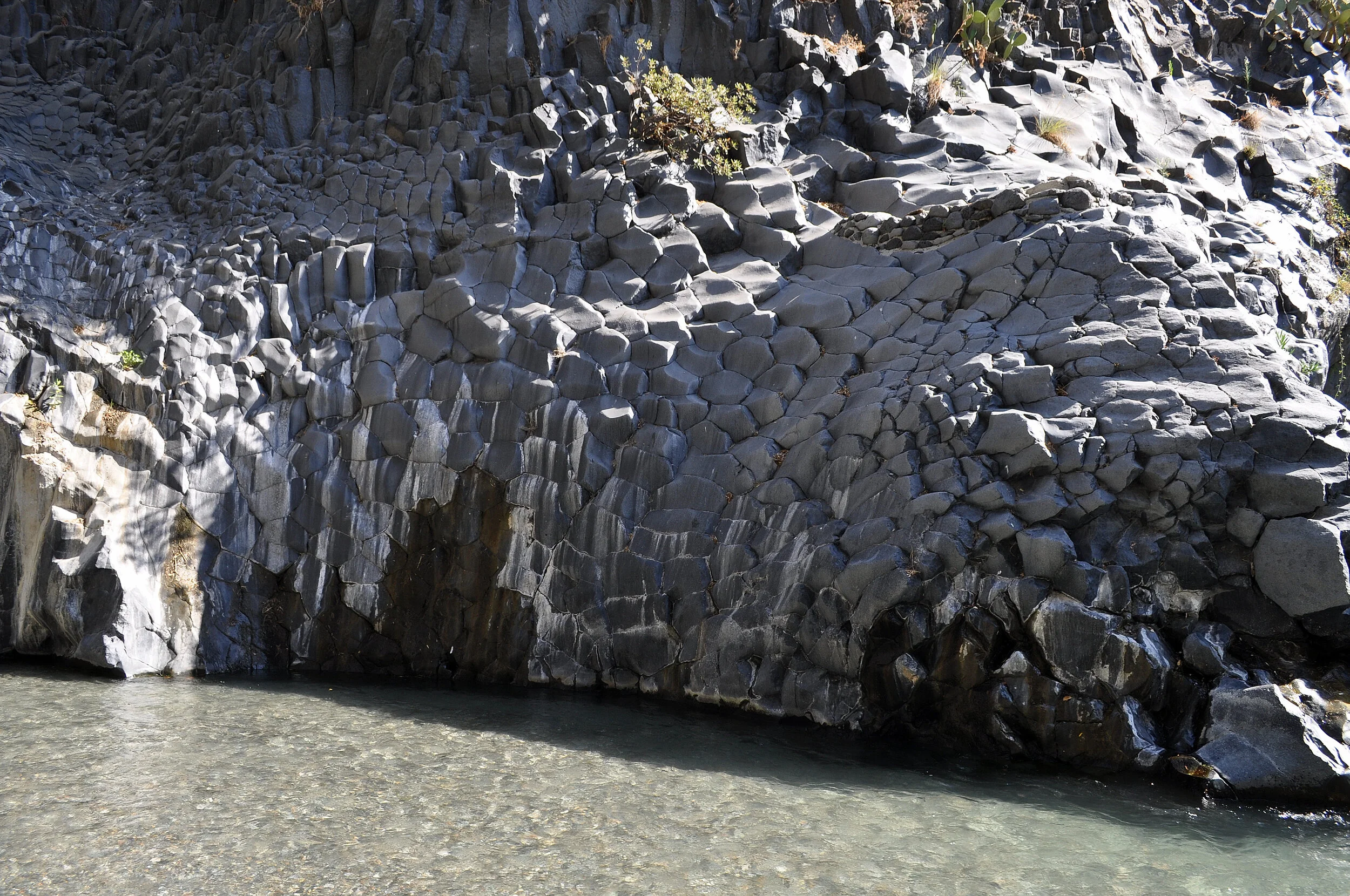

Alberto: in front of the small beach, the river water is really very shallow, and the children can play and have fun. Be careful, though: the water is always very cold — actually freezing! If needed, it’s possible to rent boots and waders to stay dry, but in August, where would the fun be in that? Water shoes, however, are definitely recommended because of the rocks.
Piero: from this more open area, walking in the water, we make our way deeper into the gorges proper, with the water gradually rising in level.
Angela: the spectacle becomes truly unique: the river flows through an increasingly narrow space between two very high basalt walls, with geometric shapes that look as if they have been carved!

Alberto: for those who brave the freezing water, you can reach a point where the water is over one metre deep — a truly unique experience!

Piero: for those who feel adventurous, it’s also possible to do rafting and body rafting: the organizers provide all the necessary equipment along with instructions on how to behave during the descent along the river. There’s even the option for kids to try these experiences. Needless to say, seeing the gorges from this unusual perspective and being carried by the river’s current must be truly thrilling…
Angela: in the late morning, especially during July and August, this area starts to get crowded. So we return to the starting point, again by lift, to enjoy in peace the various trails along the left bank of the river.
Alberto: these are all fairly easy paths to walk, none of which take more than half an hour.
Piero: first, we take the Saja trail, longer and partly more exposed, which leads us all around the park, until we reach the enchanting Source of Venus: a truly magical viewpoint over the gorges!

Angela: from here, the Saja trail merges with the Gorges trail; we then continue towards the Tumult of Vulcano and the Balcony of Venus.


Piero: at this point, we continue along the Gorges trail and reach, in order, the Balcony and the Amphitheatre of the Muses, the Balcony of the Small Waterfalls, and finally the Terrace of Love.


Alberto: we then pass under the prickly pear tunnel to reach the Balcony of the Three Lava Flows, located right next to the picnic area.
Angela: after choosing our spot and setting up our space, we take the children to see the last attraction along the Gorges trail: the reconstruction of prehistoric animals of the park.
Piero: in addition to all this, the park also offers several other attractions for the little ones: first of all, the MOL, Museum of Land, which has a fantastic multimedia room simulating a 4D volcanic eruption, showing how the gorges were formed; and for those who don’t feel like walking much, there are electric minibuses available to explore the trails.
ZazzaMike and the SprayPark
Alberto: now it’s time to relax with our picnic. In the afternoon, the children will be waiting for ZazzaMike!
Angela: what is that?
Piero: it’s the little lizard you meet while walking in the park, the friendly mascot.
Alberto: ZazzaMike will take us to spend a wonderful afternoon at the SprayPark, a 600-square-metre water playground full of fountains and sprays, suitable for both adults and children.
Piero: it’s really fun, and you don’t need to know how to swim (there are no pools)!
Angela: it’s perfect for us adults too, together with some relaxation on the deck chairs and under the umbrellas provided by the facility.

Piero: we gave up the sea for a day, but I must say it was absolutely worth it: this is also Sicily!
Angela: I have to say that, once again, you chose well, making both adults and children happy.
Alberto: an incredible landscape, like something from another planet; a wonderful mix of nature, sport, discovery, and fun. Until next time!