The Scala dei Turchi
Piero: Hi Alberto, here we are again!
Alberto: ready to continue our journey discovering Sicily?
Angela: of course! That’s why we’re here…
Alberto: until now, we’ve stayed close to our “base” in Milazzo: all the destinations were reached in a day, with at most an hour of driving.
Piero: what do you have in mind this time?
Angela: should I be worried?
Alberto: I’d say no, or at least not too much. You’ll have to pack your bags again, because I plan to take you for two days on the opposite side of the island: to discover two true Sicilian gems!
Piero: you’re keeping us on the edge of our seats; I’ll start the van in the meantime…
Alberto: perfect! Our first stop will be the Scala dei Turchi!
Angela: what a spectacle! Let’s go then…
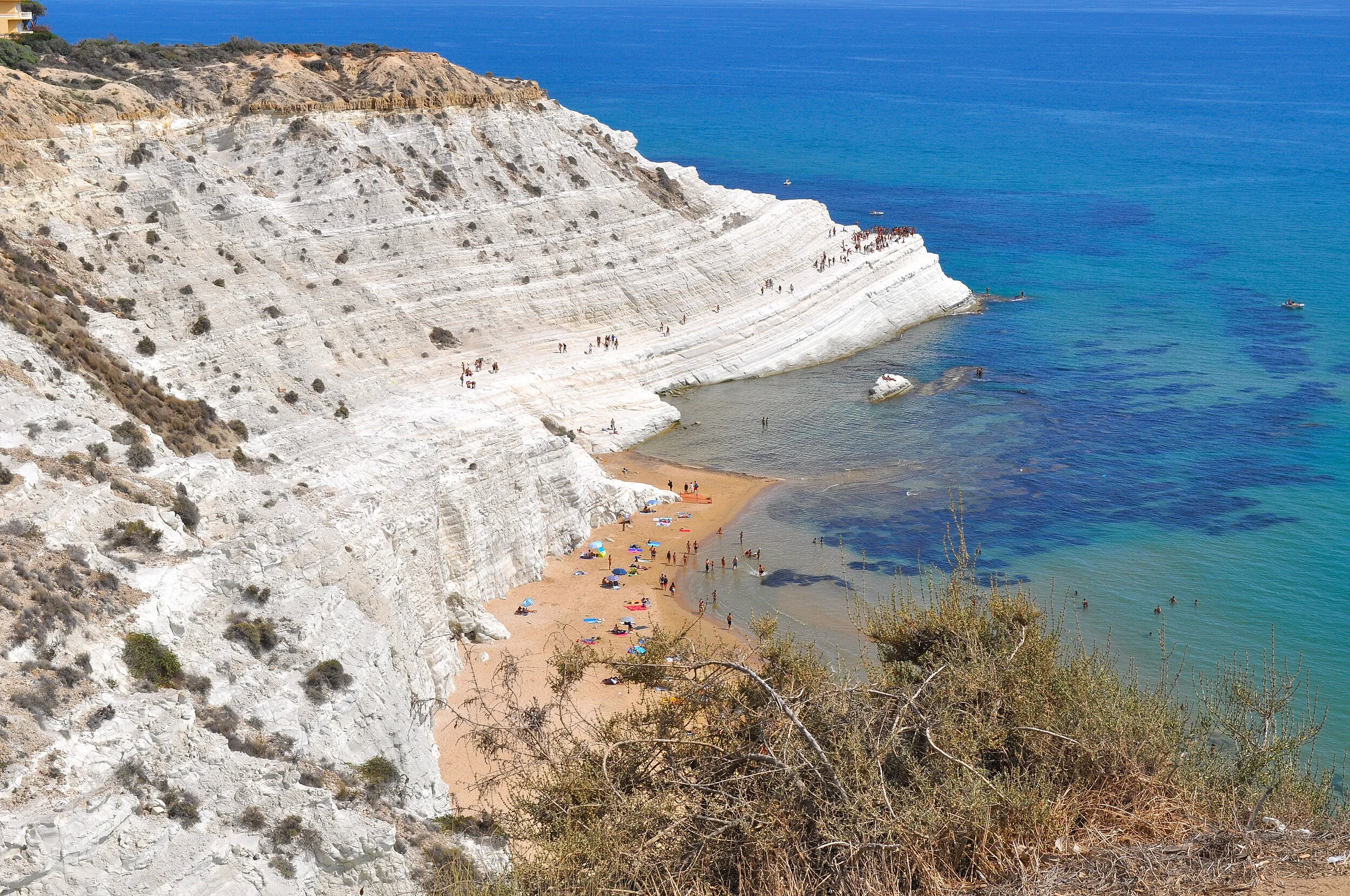
On the way to the Scala dei Turchi
Piero: I have to say that from Milazzo it’s not exactly easy to reach the Scala dei Turchi, which is located in Realmonte, in the province of Agrigento, not far from Porto Empedocle — so right on the opposite side of the island from us. On board our van, we’ll cover a full three hundred kilometres, which will take roughly three hours.
Alberto: we have two alternatives, but they don’t differ much in terms of distance or duration. We can go towards Palermo on the A20, exit at Buonfornello to take the A19 towards Catania until the Caltanissetta junction; from here we continue on State Road 640 to Agrigento, then proceed to Porto Empedocle; from there, continuing for 5 kilometres along the State Road 115 by the sea, we reach Punta Grande, where parking is available to reach the beaches around the Scala dei Turchi on foot.
Piero: the alternative is to take the A20 towards Messina, then continue on the A18 towards Catania; once past the Etna city, take the A19 towards Palermo, exiting again at Caltanissetta.
Angela: either way, it’s still three hours by van… thankfully, we’re going to see some amazing places!
Here we are in Realmonte!
Alberto: parking won’t be easy, nor too cheap; there are plenty of parking lots to choose from, and honestly, one is as good as another. The alternative would be a nearly certain fine for wild parking…
Piero: once we leave the van, we have a short walk to get closer to the Scala dei Turchi. We chose a spot at one of the beach resorts on Majata Beach: it will be useful for relaxing, having a bite to eat, and taking a nice swim.
Alberto: the walk on the fine sand is also pleasant and lasts about ten minutes; of course, be careful of the heat during the summer months.
Angela: obviously, if you come like us with children and teenagers, it’s better to be prepared with water and rock shoes — you never know…
Piero: arriving at the foot of the Scala, the spectacle is truly unique! It feels like standing in front of a real iceberg.


Alberto: we visited it when it was still possible to access it directly.
Piero: the Scala dei Turchi takes its name from the Saracen pirates, wrongly called Turks by the local populations, who in the 1500s landed on this particular rock formation to plunder coastal villages. The stepped cliff became a real staircase, making it easier for the pirates to land from the sea, especially in a spot sheltered from the wind and probably less monitored. The staircase has a wavy and irregular shape, with smooth, rounded lines; it is made of marl, a sedimentary rock partly clayey and partly calcareous, with its characteristic pure white colour due to the presence of fossils and marine microorganisms. Beyond its natural beauty, the site is also significant from a geological point of view.

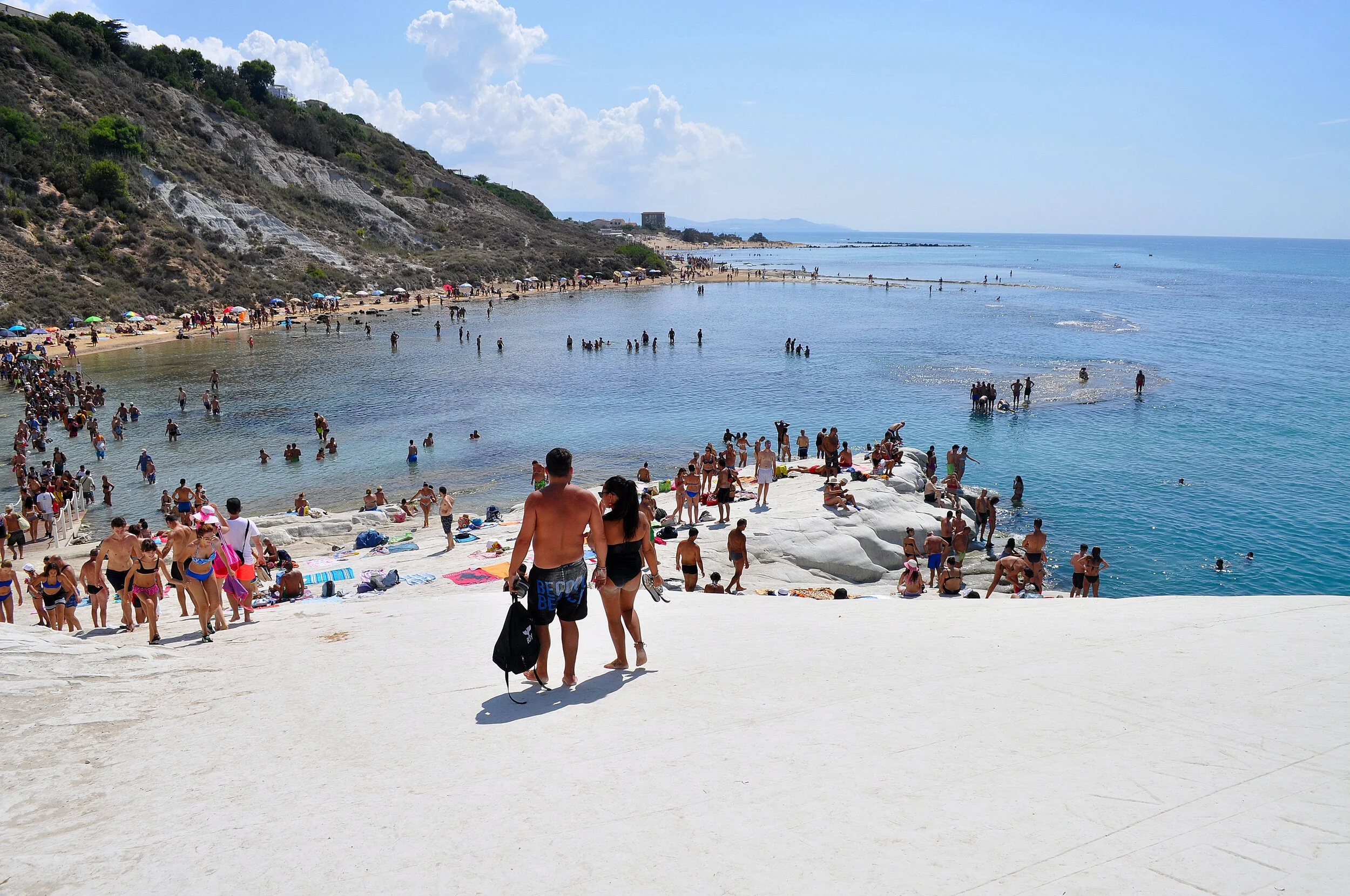


Angela: It’s not really the time to venture into topics we don’t fully understand. Geopop helps us with this, explaining very well how the Scala was formed in this wonderful video: https://www.facebook.com/geologiapop/posts/976191856542034.
Piero: wonderful! And our images are even included — did you notice that?
Angela: the walk along the steps is truly fascinating: the eye is drawn to the striking contrast between the pure white of the cliff and the blue of the magnificent sea below.


Piero: being one of the most sought-after tourist destinations in all of Sicily, the Scala attracts millions of visitors. However, the excessive footfall at this site poses a threat, compounded by neglect and poor supervision. For all these reasons, it is necessary to protect it, either by limiting the number of visitors or even by prohibiting direct access altogether. It would also be appropriate for the site to be included as soon as possible under UNESCO protection.
Alberto: the Scala dei Turchi lies between two beaches: we’ve reached the first, which was our starting point; to get to the second, one would need to walk along the entire rock face — but our fear of heights suggests we shouldn’t…

Piero: Before leaving Realmonte, however, we have one last short stop to make: the “belvedere” of Contrada Scavuzzo. Let’s hurry to get our van…
Angela: It’s a wonderful viewpoint, from which you can admire the Scala dei Turchi from above. Practically a balcony with a breathtaking view of the white cliff, rising just a short distance away over a sea that looks even bluer from here!


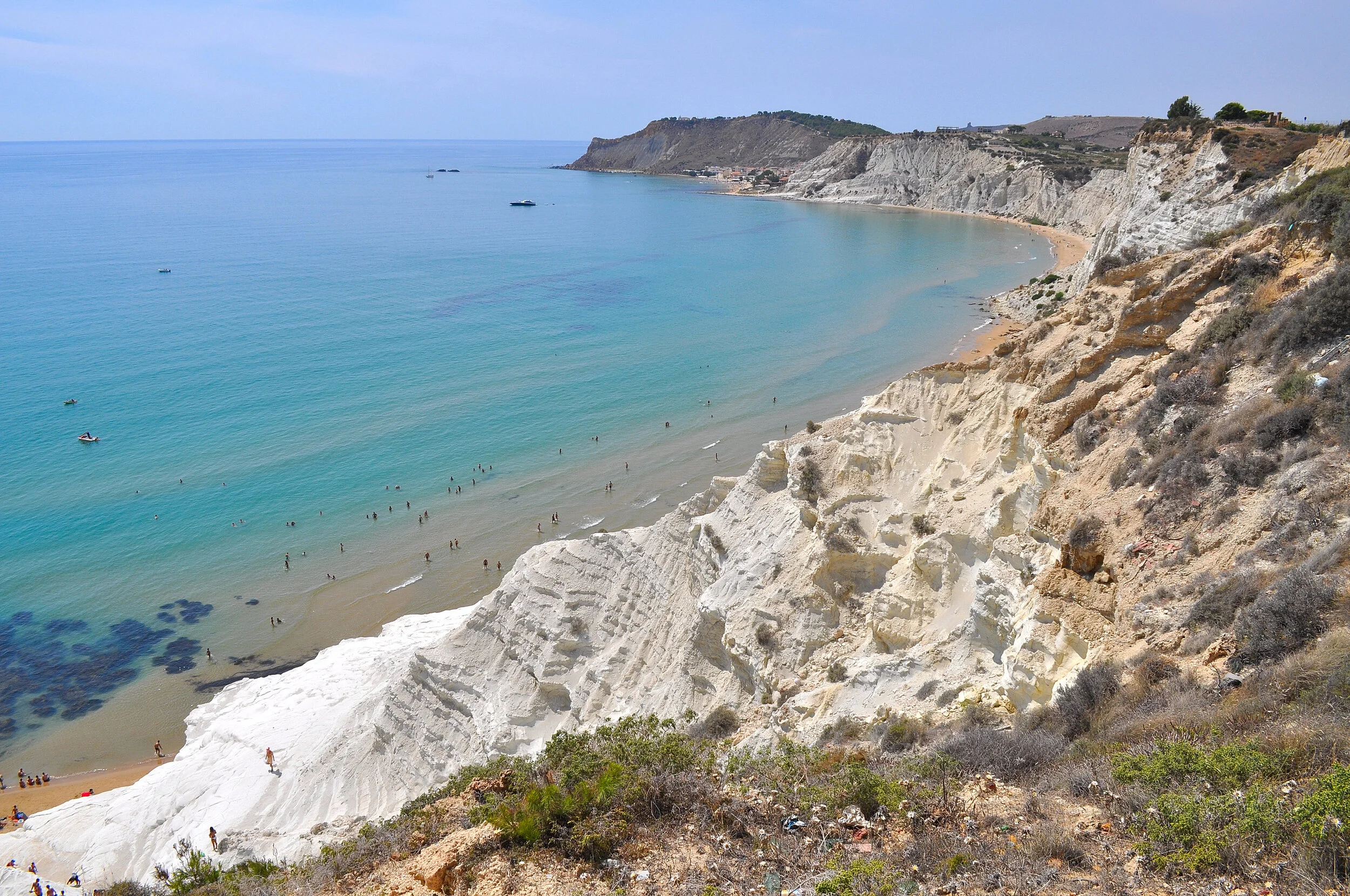


Piero: thanks to its beauty, shaped by waves and wind over millions of years, the Scala dei Turchi has served as the set for many famous films with its white marl walls.
Alberto: I immediately think of Malèna, the film written and directed by Giuseppe Tornatore, with some scenes set at the Scala dei Turchi. And how could we not think of Camilleri and his Inspector Montalbano: in the episode titled “La prima indagine di Montalbano”, the Scala dei Turchi is mentioned directly.
Alberto: visiting the Scala dei Turchi is a must, especially for those, like us, planning to visit the Valley of the Temples. Around it, however, there are plenty of other things to see: certainly Realmonte and Porto Empedocle, with Capo Rossello and especially the 1st-century Roman villa; and then the salt mine with the “Salt Cathedral” and the Monterosso Tower, concluding with the birthplace of Pirandello.
Angela: our day was definitely a special seaside day, spent around this unique and unusual staircase. It’s a truly spectacular stretch of coast that, thanks to its peculiar features, has become an icon of Sicilian beach tourism. Nature has played the role of a great artist here: it worked on the coast over time with the help of the sea and wind, gradually smoothing the corners and making it softly sinuous, until forming these wonderful terraces! And the sea, taking advantage of this pure white and dazzling cliff, displays the most intense shades of blue and azure…
Piero: it’s definitely worth seeing it all again in this wonderful video!