Neapolis Archaeological Park
Alberto: wake up, guys! It’s another beautiful morning here in Syracuse, and we still haven’t finished discovering the wonders of this city!
Angela: here we are! You said our visit wasn’t over yet, but we don’t have much time left. We only have this morning.
Alberto: you’ll see, it will be enough. Syracuse has so much to offer, but there are basically two places you absolutely cannot miss, and we have already visited the first one.
Piero: the second one is easy to guess: it’s the Neapolis Archaeological Park.
Alberto: exactly! It is a true wonder that will leave you speechless. We are also lucky to visit it during a season with mild temperatures and, above all, with far fewer crowds.
Angela: are you ready then? Let’s go!

Here we are at the Neapolis Archaeological Park…
Alberto: it is located in the heart of Syracuse, in the north-western part of the city, and the distance to cover is really short. If you are staying in town, around Ortigia, you can even reach it on foot.
Angela: I imagine that in spring and summer finding parking must be quite difficult, despite the presence of a large car park. Between Christmas and New Year’s Eve, however, we have almost no trouble at all…
Piero: even the queues for tickets and entrance are practically non-existent. Be careful during the months of mass tourism: it might be better to buy your tickets online in advance.
Alberto: we get our tickets and we are ready to begin our visit. Before that, though, let’s make a short stop at the bar in front of the ticket office for a coffee…
Piero: a useful piece of advice, especially during the summer: if you haven’t brought any water with you (especially for children), don’t forget to buy some. It can get really hot here, and many sections of the route are open-air and exposed to the sun.
Alberto: to fully appreciate everything (and above all to take photographs…), we’ll need about two hours.
Angela: let’s begin right away!
Let’s dive into history

Alberto: we immediately begin our journey through the place that perhaps more than any other in Syracuse best represents its thousand-year history.
Piero: the Neapolis Archaeological Park as we see it today is the result of a long and complex process of restoration and preservation that began in the 1950s. The main part of the park is certainly represented by its Greek and Roman monuments, but the evidence from other historical periods should not be overlooked, from the prehistoric age to the Byzantine period. The feeling is that of walking through an incredible open-air museum!
Angela: the park covers an area of 240,000 square metres, on the southern slopes of the Epipoli plateau. The true heart of the park is located on a hill called Temenite, from the Greek word temenos, meaning sanctuary. This was in fact the area where a sanctuary dedicated to Apollo once stood. During the Greek period, this area was outside the city walls that protected the actual urban centre. However, there is evidence of human settlements dating back to the Bronze Age.
Piero: although an early theatre already existed from the 5th century BC, it was the tyrant Hieron II who gave this area much of its splendour. Thanks to him, the theatre was completed and the magnificent altar of Hieron was built. Later, during the Augustan age, the Romans constructed the amphitheatre, right near the Greek theatre.
Angela: the true protagonist of this park is undoubtedly archaeology, but what makes the landscape unique is also the lush vegetation of the latomie. This term comes from ancient Greek and is composed of lâs, meaning stone, and tomíai, meaning to cut. These were therefore stone quarries or marble quarries that, during the Greek-Roman era, were used as prisons for slaves, war prisoners, and other captives. It is a true natural spectacle within an extraordinary archaeological landscape!
Piero: remembering what we saw in Ortigia and thinking about what we are about to discover here, it is easy to understand why Cicero described Syracuse as “the greatest and most beautiful of all Greek cities.”
The Latomies and the Tomb of Archimedes


Angela: our route begins precisely with the latomies. We visit, one after the other, the Intagliatella Quarry and the Santa Venera Quarry.
Piero: continuing our walk, we reach the so-called Tomb of Archimedes. However, this is actually a historical misconception. The monument dates back to the Roman period, but it is the most impressive tomb in the area, and for this reason it was believed to be the final resting place of the most famous citizen of Syracuse of all time.
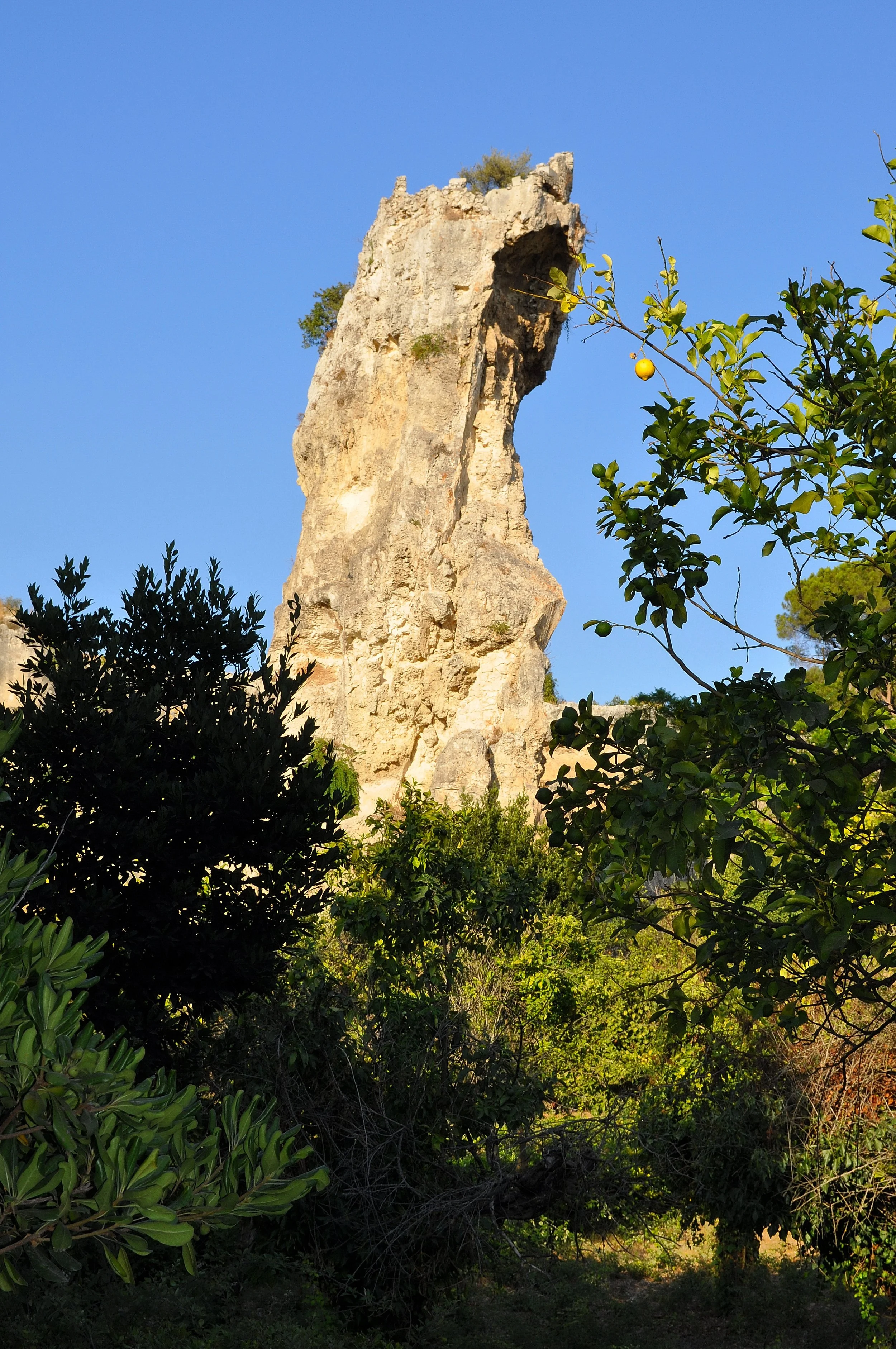
Angela: we then move on to the most beautiful of the latomie, the Paradise Quarry. It is the largest and certainly the most spectacular, thanks to its lush vegetation made up of orange trees, cedars, lemon trees, palms, caper plants, and prickly pears. It feels like an enchanted place of extraordinary natural beauty. Only part of the quarry can be visited today, but this was once the place where the largest stone blocks were extracted, and in some sections it reaches the remarkable depth of 45 metres.
The caves and the Ear of Dionysius
Piero: right inside the Paradise Quarry there are three large cavities that represent three of the most important attractions of the Neapolis Archaeological Park. They are the Ear of Dionysius, the Grotta dei Cordari, and the Grotta del Salnitro.
Angela: the Grotta del Salnitro takes its name from the colour of its walls, which resemble the shades of the mineral itself. It is not a natural cave, because it was created after a collapse occurred within the latomie, when the fallen rocks accumulated and gave rise to its formation.

Piero: the Grotta dei Cordari is particularly fascinating and is also an artificial cave. It takes its name from the craftsmen who, from the Middle Ages until the last century, produced ropes here using natural fibres, taking advantage of the natural humidity of this unique place.
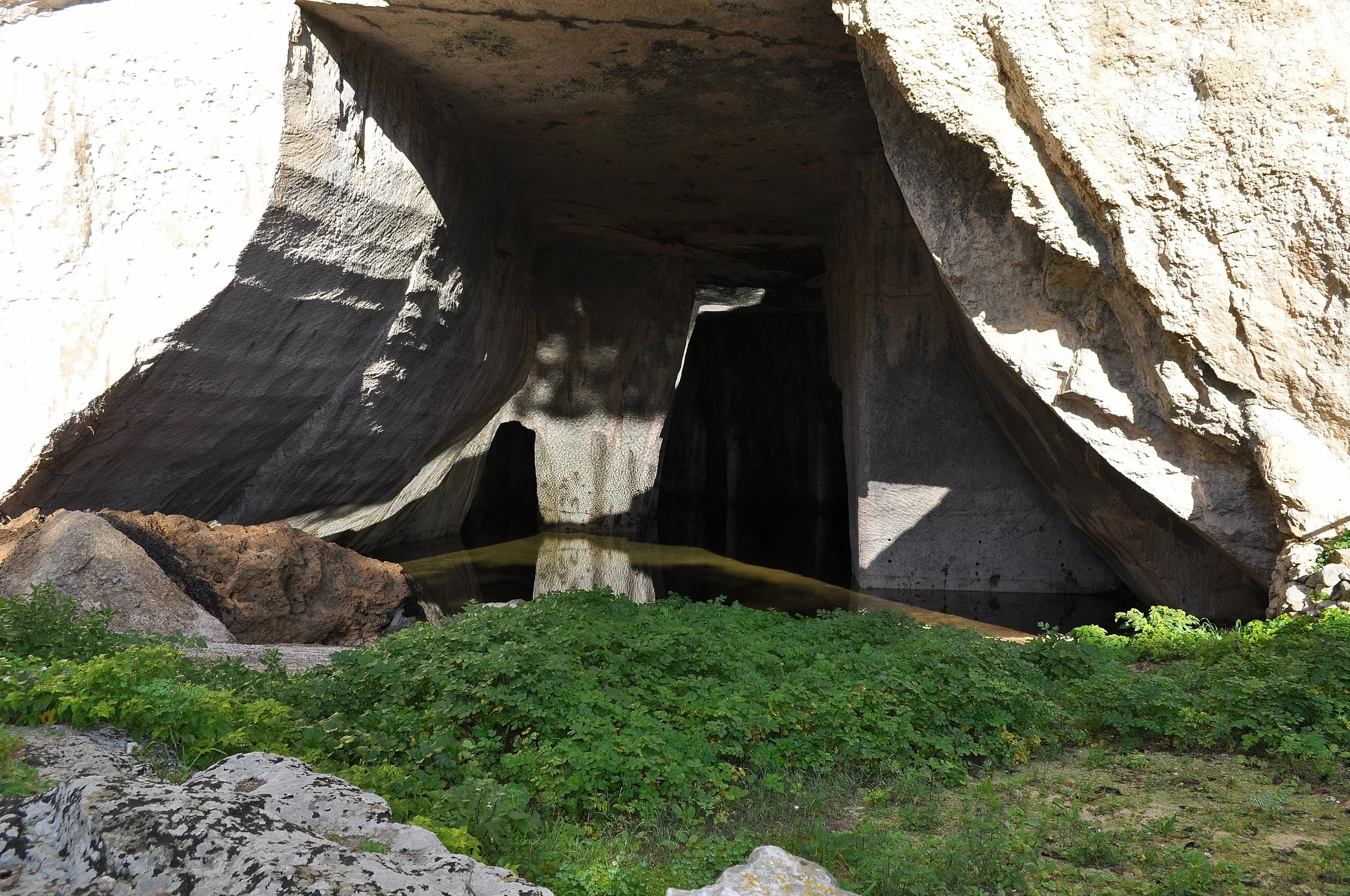
Angela: we now arrive at the most famous of these cavities, the Ear of Dionysius. It is a truly impressive cave: its height is 20 metres at the entrance and increases inside up to 35 metres. Its width varies between 5 and 11 metres, and it extends 65 metres deep into the rock.

Piero: this too is an artificial cave, with a unique shape and a very particular acoustic effect. It was precisely by combining these two features that Caravaggio gave it its name. Its shape, in fact, resembles an ear, while thanks to its extraordinary acoustics, the most famous tyrant of Syracuse could listen to the conversations of his prisoners, amplified by the echo. According to legend, Dionysius had his prisoners locked inside this cave, fully aware of its remarkable acoustic properties, while from a small opening he could listen to their conversations without being seen. Of course, if anyone said something inappropriate or was plotting against him, the tyrant would discover it… and their fate was certainly not a pleasant one.

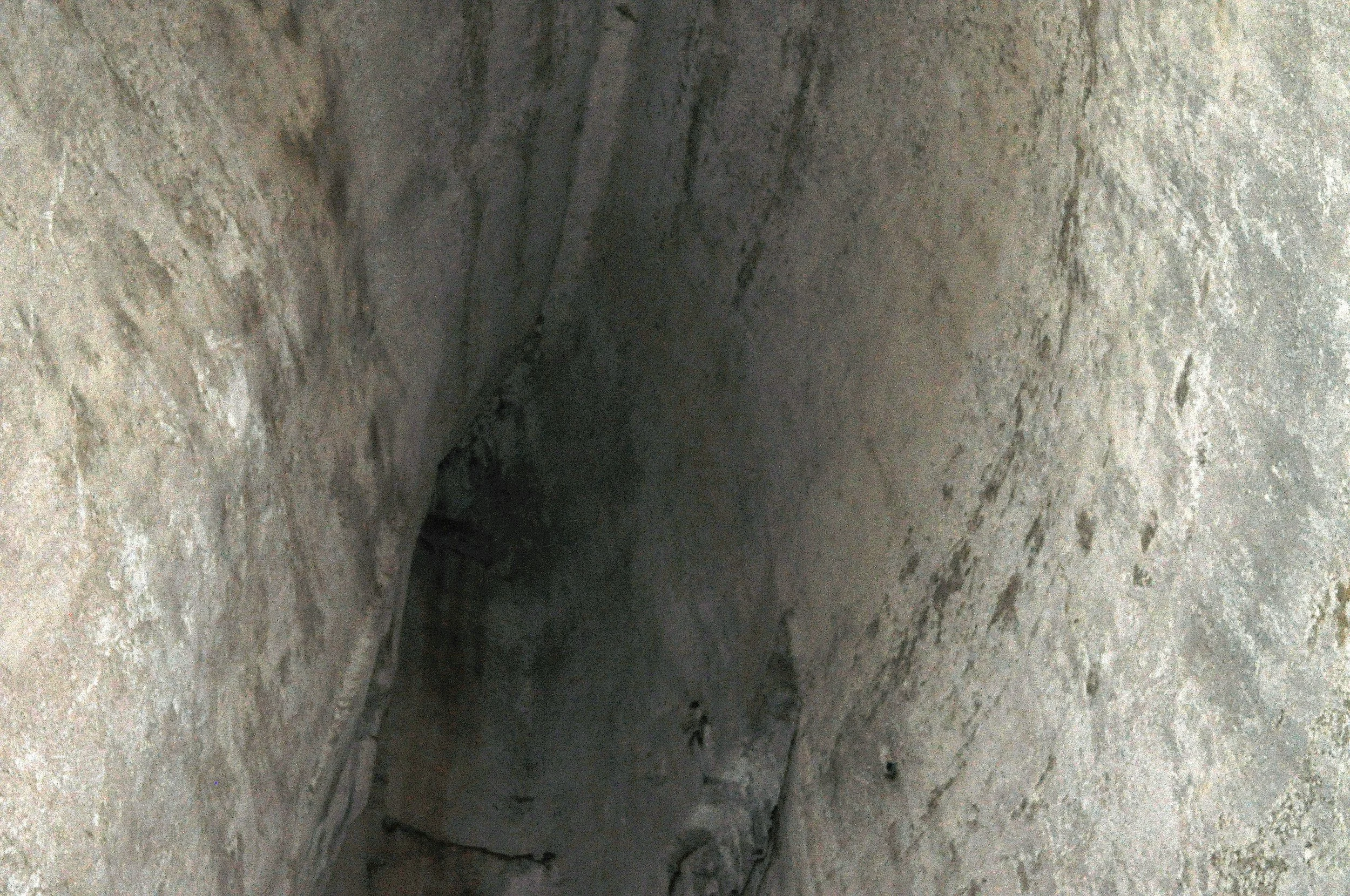


Angela: it is definitely worth experiencing the echo of this cave once you enter. It is not uncommon to hear shouts and whistles that allow you to truly appreciate its extraordinary acoustics.
The Greek Theatre
Piero: after leaving the Ear of Dionysius, we reach the true heart of the Neapolis Archaeological Park: the Greek Theatre.
Angela: a true wonder that seems to unite the sea and the sky!
Piero: this is one of the most impressive and famous theatres of the ancient Greek world. It was built by carving it directly into the rock (which is perhaps the reason why it has been preserved so well) and probably dates back to the 5th century BC. Its current appearance, however, is mainly due to the tyrant Hieron II, who embellished and completed it during the 3rd century BC.
Angela: the cavea has a diameter of about 140 metres, making it one of the largest in the entire Greek world. Originally, it had 67 rows of seats, capable of accommodating well over 10,000 spectators. The stage must have been truly magnificent, made even more spectacular by the surrounding landscape and the natural play of sunlight.
Piero: to admire its beauty and grandeur, there are several possibilities. To immediately appreciate it as a whole, it is best to reach the lower part of the theatre. The steps are remarkably well preserved, while the areas dedicated to the actual performances have survived less completely. From this viewpoint, the extraordinary majesty of this ancient masterpiece is immediately clear.
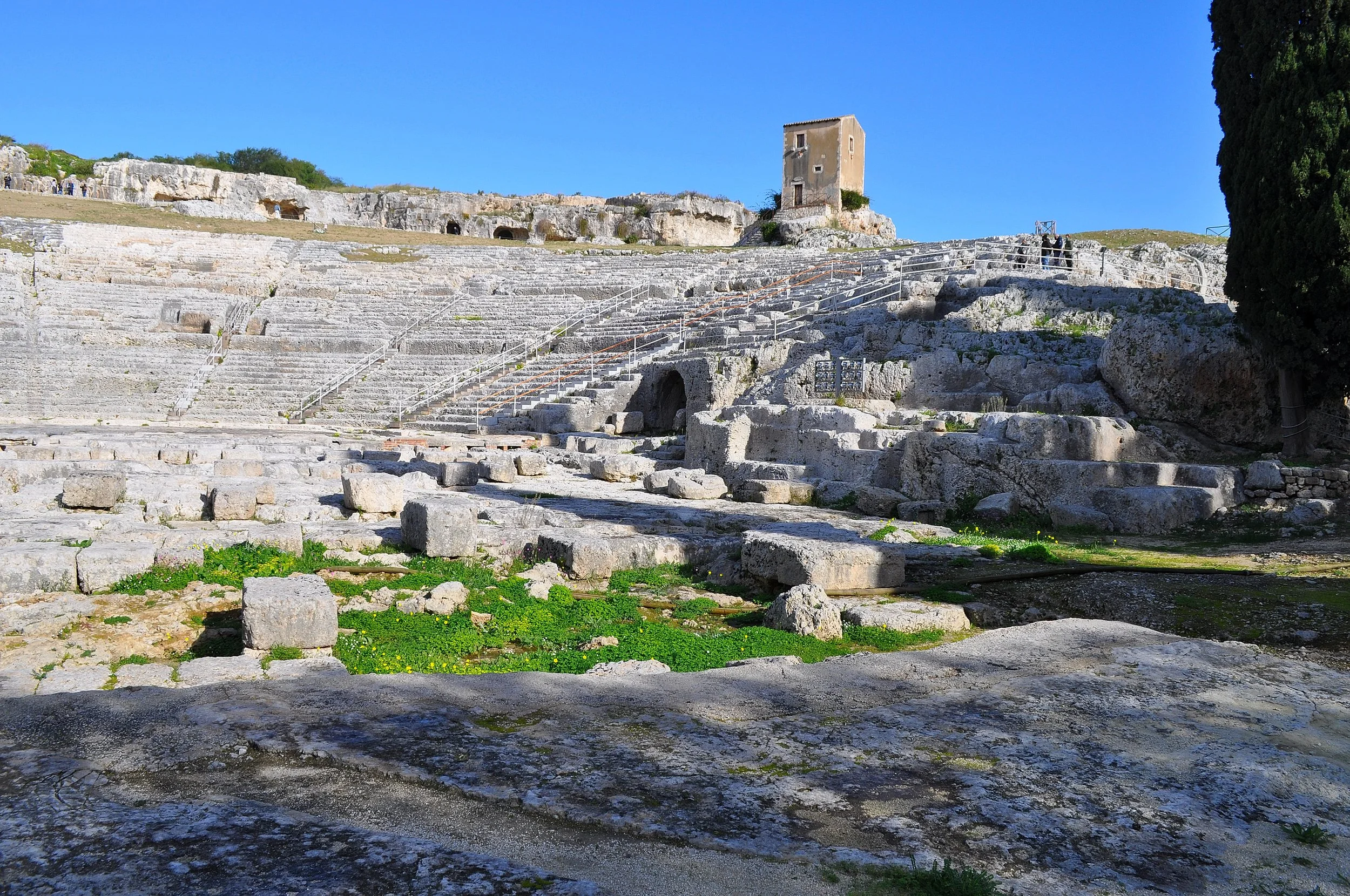


Angela: the other option to admire the Greek Theatre of Syracuse is to view it from above. You can reach this viewpoint by following a dirt path. I strongly recommend making a stop about halfway along the route, where a passage provides access to the different sections of the seating area. Here you can admire up close the stone steps with the names of the various sections written in Greek.
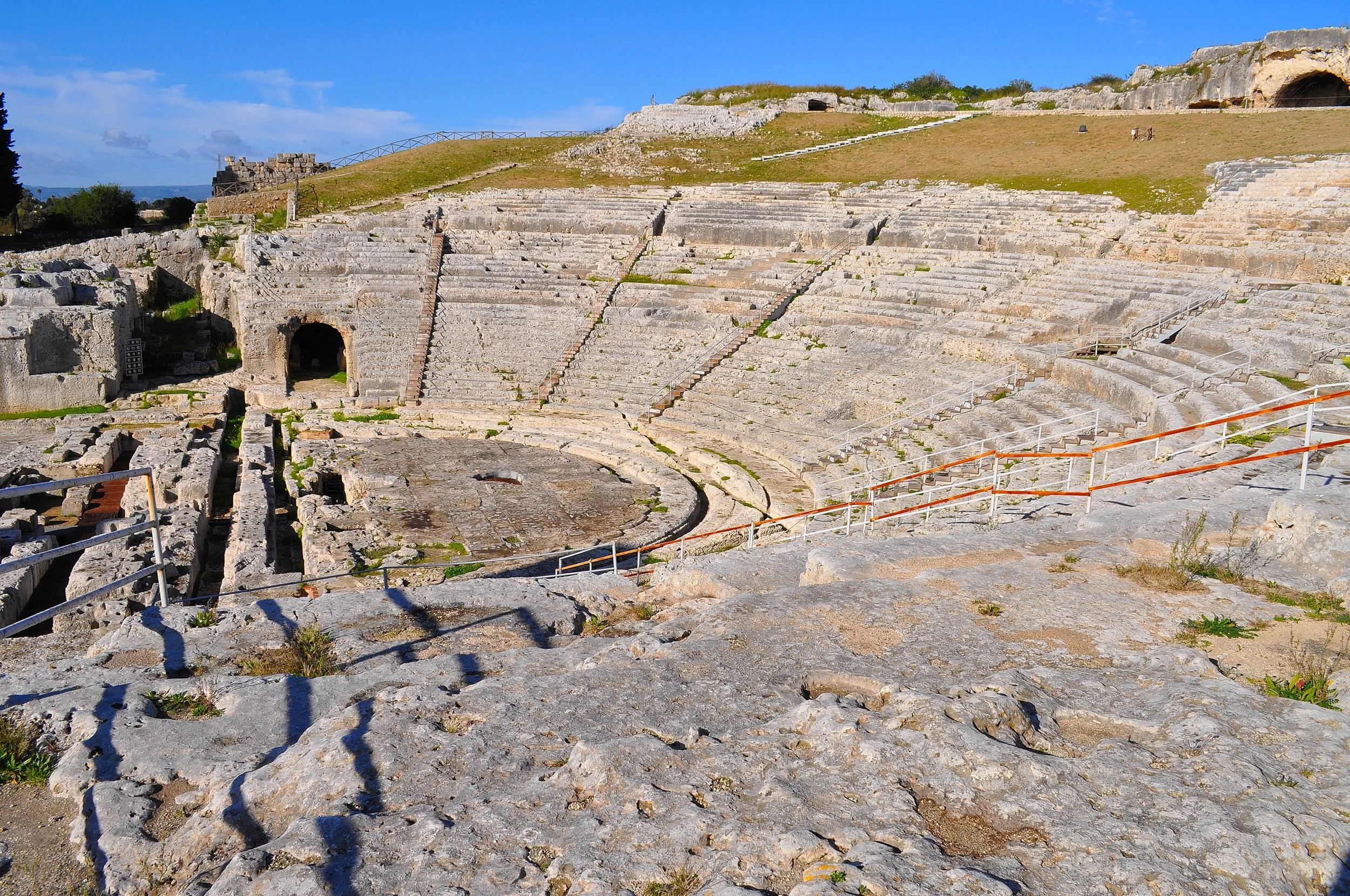
Piero: following the same path, we reach the highest point of the theatre. From here, once again, we can admire the entire Greek Theatre in all its grandeur, together with the Bay of Syracuse and the Great Harbour. Looking towards the east, you can clearly see the impressive dome of the Basilica of Our Lady of Tears.

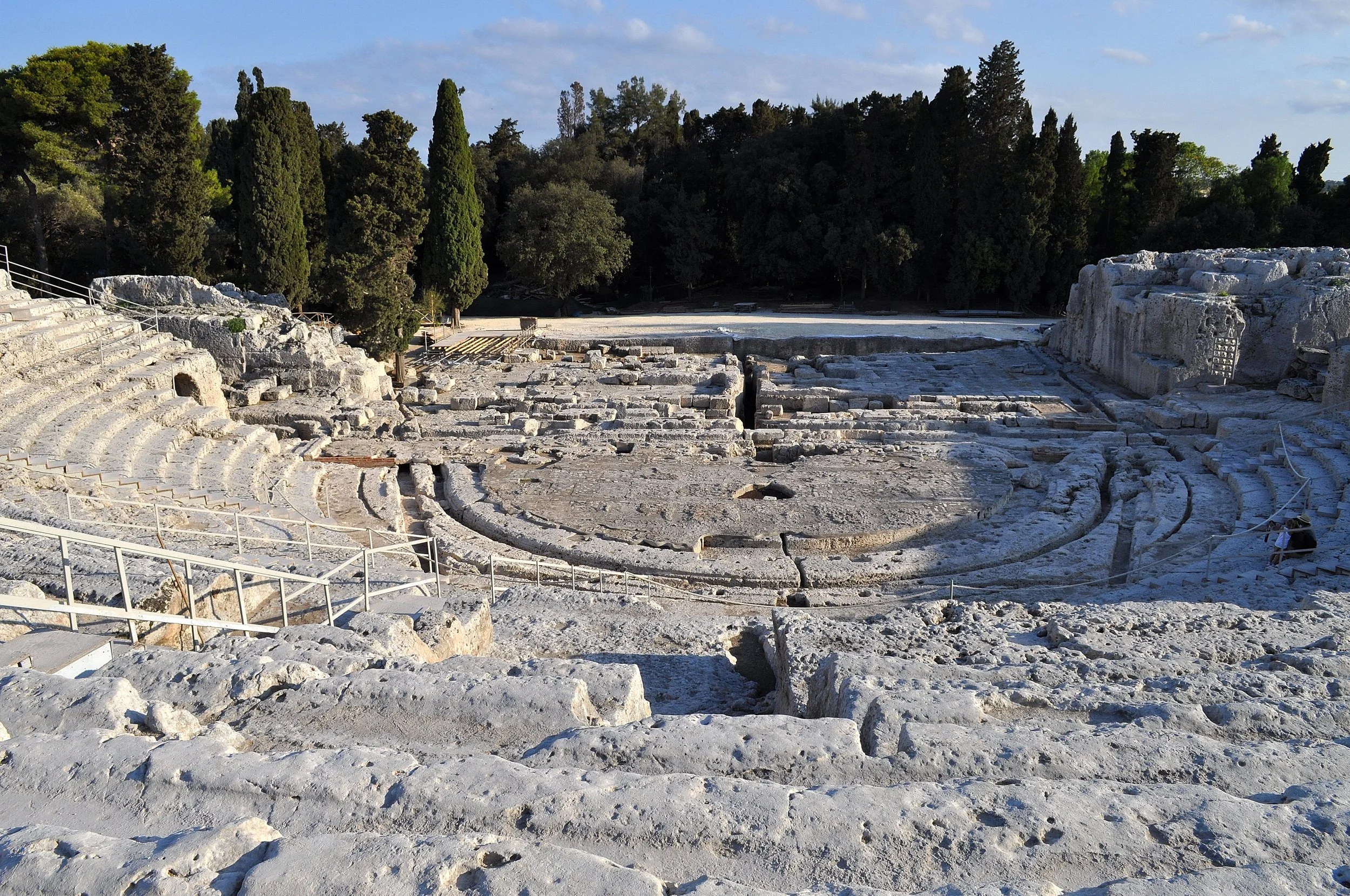


Angela: every year, during the months of May and June, the classical performances take place at the Greek Theatre of Syracuse. The ancient Greek tragedies and comedies are brought to life once again, featuring the works of the great classical authors. It is an extremely important event for Syracuse, one that has been held for more than a century.
Piero: I had the pleasure of attending one of these performances, and I can assure you that it is truly spectacular!
Angela: from this same viewpoint, with your back to the theatre, you can see a fountain: this is the Nymphaeum Cave. It was most likely the headquarters of the artists’ guild, where the actors gathered before entering the theatre to perform.

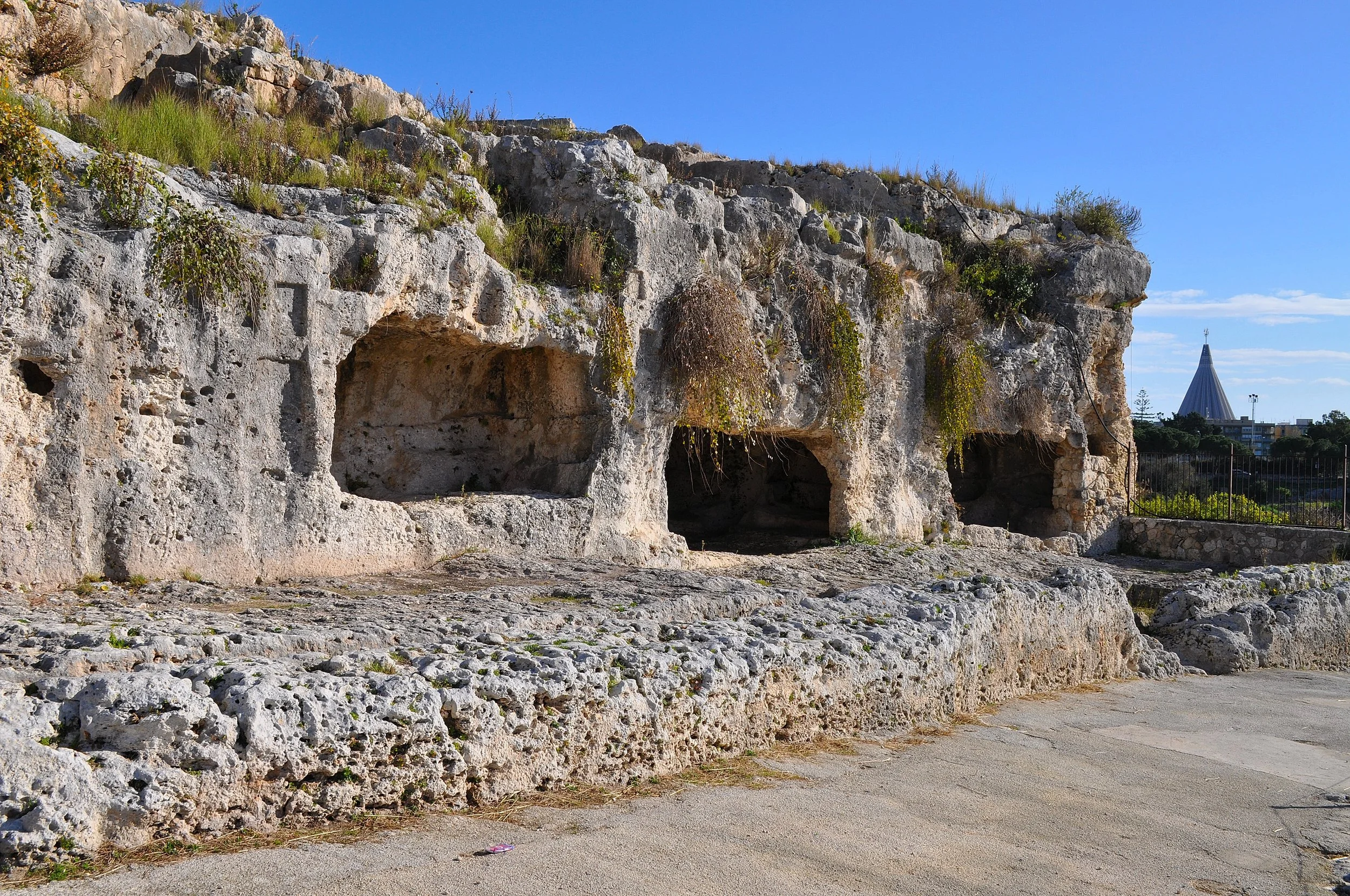
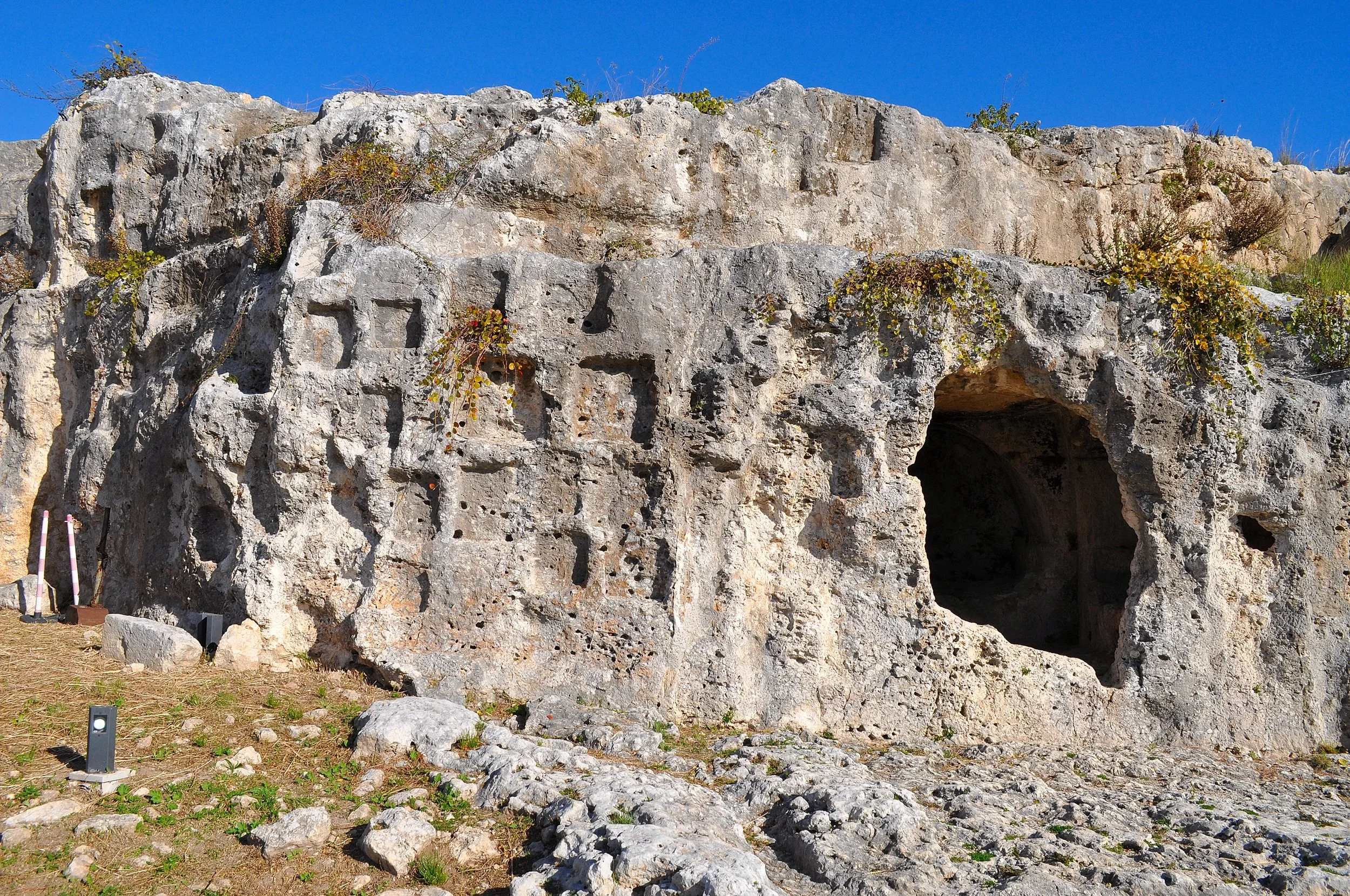
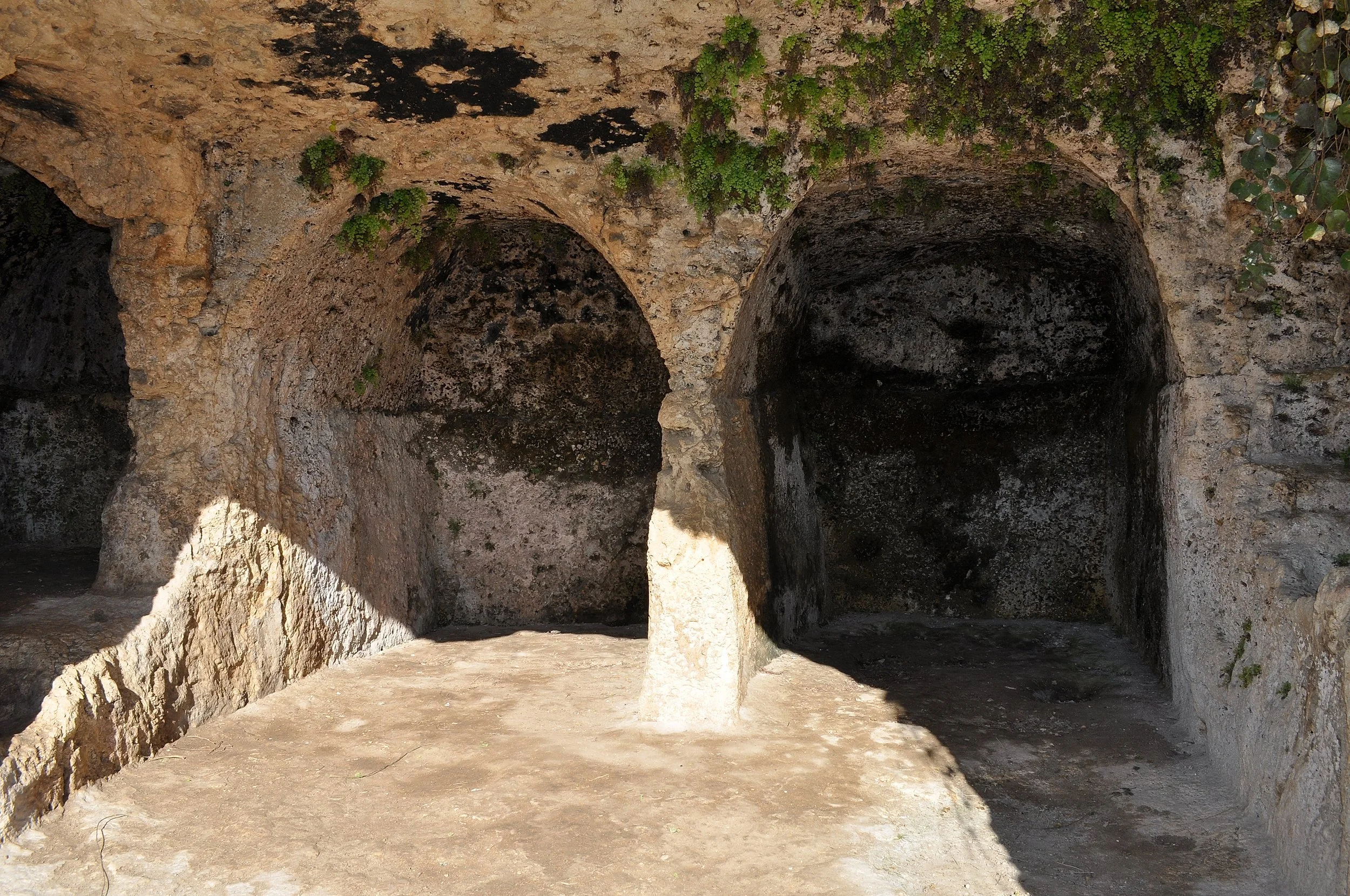
Piero: in this area, on both sides, there are numerous caves and niches carved into the rock. They date back to the Christian period and were used as family tombs. Alongside these, there are also many rectangular openings carved into the stone, which were used to hold small votive paintings dedicated to the cult of heroes, following a tradition that was common in the Greek world.

The Ara of Hieron
Angela: at this point, we retrace our path and head towards the lower part of the park, in the direction of the exit. Here, another impressive monumental work awaits us: the Altar of Hieron.

Piero: what remains today is almost entirely the base, because the upper structure was almost completely removed in the 16th century to be reused in the construction of the city’s Spanish fortifications.
Angela: the altar commissioned by the tyrant Hieron II, as part of his work to complete the Neapolis, was dedicated to Zeus Eleutherios, meaning “the Liberator”. In his honour, the Eleutheria festival was celebrated, featuring the sacrifice of as many as 450 bulls at a time. This altar was probably the largest in the Greek world, considering that its base was about 200 metres long and 22 metres wide. The entrance was decorated with two telamons, of which only the feet of the right one remain today.
The Roman Amphitheatre
Piero: next to the Altar of Hieron, we find the final monument of our journey through the Neapolis Archaeological Park: the Roman Amphitheatre.

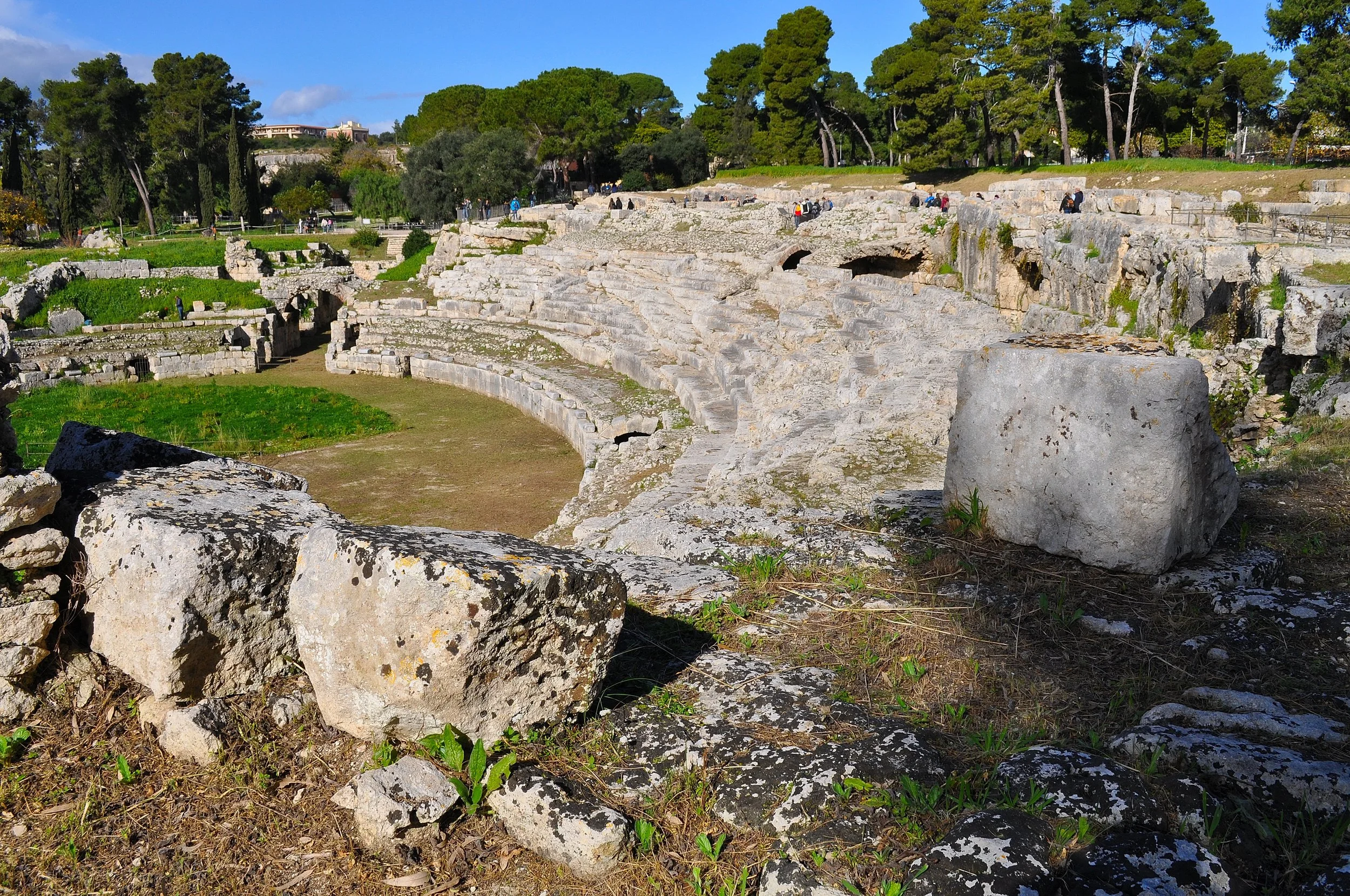
Angela: equally impressive and with an elliptical shape, it measures 190 metres in length and 90 metres in width. It was carved into the rock on three sides, with the exception of the southern side. Just like the Altar of Hieron, many of the large stone blocks that formed the structure were removed in the 16th century by the Spanish, who reused them to build the defensive bastions of the island of Ortigia.
Piero: this amphitheatre is certainly one of the largest still existing and the largest in Sicily. In the centre of the structure, you can see the remains of a large underground area that was used for machinery. Its exact dating is uncertain, but it probably dates back to the Augustan age, with later modifications carried out in subsequent periods.




See you soon, Syracuse…
Angela: the Neapolis Archaeological Park is truly extraordinary and a magnificent symbol of the ancient splendour of Syracuse. Let’s take another look at everything we have discovered in this video:
Piero: it is a real shame, however, to see the clear organisational and management shortcomings that have a negative impact on visitors. The maintenance is often not worthy of the extraordinary historical and architectural value of these sites, and it is disappointing that, at certain times, some areas of the park cannot be accessed.
Angela: despite everything, the park and the entire city are a fantastic destination for anyone who wants to discover the charm of a thousand-year-old history. With this visit, our time in Syracuse comes to an end.
Alberto: but I ask you to promise that you will come back! Syracuse has much more to offer beyond Ortigia and the Neapolis Archaeological Park. And above all, you still haven’t seen its sea and its beautiful beaches.
Angela: we will definitely come back!