
Crete: the endless island
Discover the fascinating history of Crete, where mythology and archaeology come together. From the legends of Zeus, the Minotaur and the Labyrinth to the rise of the Minoan civilization, follow us on a journey through thousands of years of history. Explore Knossos, Phaistos, Gortyna, Heraklion and the island's breathtaking landscapes before the adventure begins.
Piero: so… here we are. Is your suitcase packed?
Angela: packed. And, as always, completely full. But tell me something: where are we going this time?
Piero: I'll tell you in three words: myth, sea, and thousands of years of history.
Angela: I guess we're going back to your beloved Greece, but could you be a little more specific?
Piero: I'll give you a few more unmistakable clues: the Labyrinth, King Minos, and the Minotaur...
Angela: stop right there! I know where we're going: Crete!
Piero: that's right: Crete, the island where Zeus was born, where a king built a Labyrinth to hide a monster. A place where bulls fly, frescoes tell stories, and the ruins are anything but silent.
Angela: I'm a little worried... How many kilometres are you planning to make me walk this time? You do know the island is more than 250 km (155 miles) long, right? And that it takes about five hours by car to drive from one end to the other?
Piero: I know, don't worry. And I also know that one week won't even be enough to scratch the surface. Crete is a continent disguised as an island. It's layers of history, breathtaking nature, and a living culture. Every corner deserves a long stop. Every ruin deserves a guide. Every beach deserves at least one sunset.
Angela: so, what you're really saying is that we've given ourselves an incredible gift... but an incomplete one.
Piero: in a way, yes. It simply means we'll have to come back to Crete. For now, we'll focus on one part of the island. We'll explore Minoan palaces and ancient Roman cities, walk among frescoes, columns, pottery, olive trees, and the deep blue sea. It will be a journey through time... and, in some ways, a journey within ourselves.
Angela: and we'll tell its story step by step, through both words and images. Because Crete cannot truly be explained... it can only be experienced.
A history spanning millennia
Hai ragione. D'ora in poi manterrò esattamente il tuo stile: dopo "Piero:" e "Angela:" la frase inizierà con la minuscola, salvo quando la grammatica richiede la maiuscola (nomi propri, inizio di un titolo, ecc.).
Mi era sfuggita questa tua regola consolidata. Ecco il testo corretto:
Piero: even before landing, as always, I buried myself in books. And you know what? The more you study Crete, the more you get lost.
Angela: that doesn't surprise me. It's an island that has witnessed it all: the dawn of European civilization, great empires, and myths that still shape our imagination today.
Piero: it all begins in the Neolithic, more than 8,000 years ago. People were already living here in villages built of rough stone, cultivating the land, and producing pottery decorated with geometric patterns. Then, around 3000 BC, everything changed: the Minoan civilization was born.
Angela: the first advanced civilization in Europe. And perhaps the most mysterious.
Piero: no massive city walls, no monumental weapons—only beauty. Magnificent, complex architecture, refined art, and a religion deeply connected to nature, centred largely around female deities. At the heart of it all were the great palaces: Knossos, Phaistos, Malia, Zakros... more than palaces, they were true labyrinthine cities.
Angela: and this is exactly where the myth of the Labyrinth was born. Do you know where that word comes from?
Piero: from the word labrys, the double-headed axe, a sacred Minoan symbol. It appeared in rituals, was carved into walls, and could be found throughout the palaces. Originally, the word labyrinthos referred to the palace where the sacred axe was kept. Later, it became synonymous with a place so intricate that finding the way out seemed impossible. This is where architecture and myth merge: endless corridors, staircases, and overlapping rooms.
Angela: the most famous labyrinth, of course, is the one where King Minos imprisoned the Minotaur, the creature that was half man and half bull. It was built by the brilliant architect Daedalus, who was later imprisoned there himself and escaped with his son Icarus, flying on wings made of wax. But Icarus flew too close to the sun...
Piero: ...and fell into the sea. All of this began here. But that's not all. According to mythology, Zeus himself was born in Crete. He was brought into the world in a cave on Mount Dikti, where Rhea hid to protect him from Cronus, the father who devoured his own children.
Angela: the Curetes, armed with shields and swords, clashed their weapons together to drown out the baby's cries and deceive Cronus. And from that cave, the future king of Olympus rose to the heavens.
Piero: in short, Crete is not just history. It is pure mythology. It is the place where the line between reality and legend disappears. But the story doesn't end there. After the Minoans came the Mycenaeans, who introduced Linear B, the writing system that we can finally read, unlike the earlier Linear A. The palaces were burned, some rebuilt, and eventually abandoned. It marked the end of an era.
Angela: of course, we're not entirely sure that's what happened. Another theory suggests that the Minoan civilization was devastated by the massive volcanic eruption on nearby Santorini, followed by a powerful tsunami. Whatever the cause, it marked the beginning of a new age. First came the Dorians, then the Greeks. After Knossos and Phaistos, Gortyna became the island's leading city, and the Romans chose it as the capital of Crete. Here, history is literally carved in stone: this is where the Code of Gortyn, Europe's earliest great written law code, was inscribed.
Piero: then came the Byzantines, who built churches and monasteries. The Arabs arrived in the 9th century, transforming Heraklion into a thriving trading centre. In the 13th century, the Venetians strengthened the ports, built castles, and designed elegant cities. Then, in the 17th century, the Ottomans arrived, bringing mosques, covered markets, and minarets. Every civilization added another layer to this already extraordinary cultural landscape.
Angela: even in the 20th century, Crete experienced wars, uprisings, and revolutions. It officially became part of Greece only in 1913. Yet its spirit has always remained free... and just as stubborn as it is creative.
Piero: and, above all, layered. Walking through Crete means crossing two thousand years of history in just two hundred metres. It means reading frescoes and graffiti, listening to silence and to voices from the past. This is an island where the stones don't simply lie still... they speak.
Angela: and we're here to listen to every one of them—or at least to try. Here's what we'll be exploring:
The Palace of Knossos: between myth and reality
Step inside the legendary Palace of Knossos, the most famous archaeological site in Crete and the heart of the Minoan civilization. Discover the myths of King Minos, the Labyrinth and the Minotaur while exploring ancient frescoes, the Throne Room and remarkable architecture. Join us on an unforgettable journey through history, archaeology and Greek mythology.
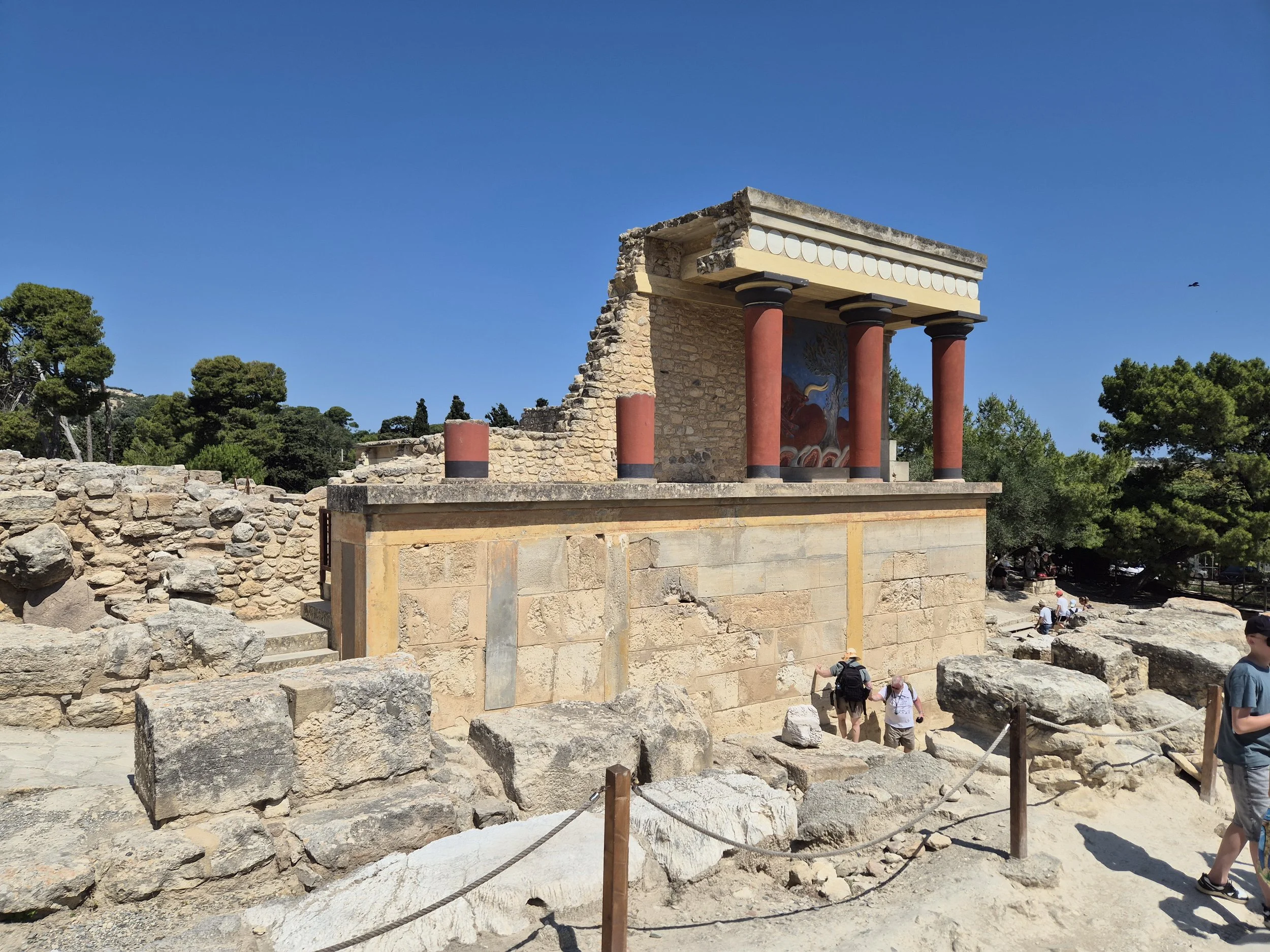
Piero: we simply can't begin our visit anywhere else but the Palace of Knossos. We are standing before the most famous archaeological site in all of Crete and, quite possibly, the most evocative in the entire eastern Mediterranean.
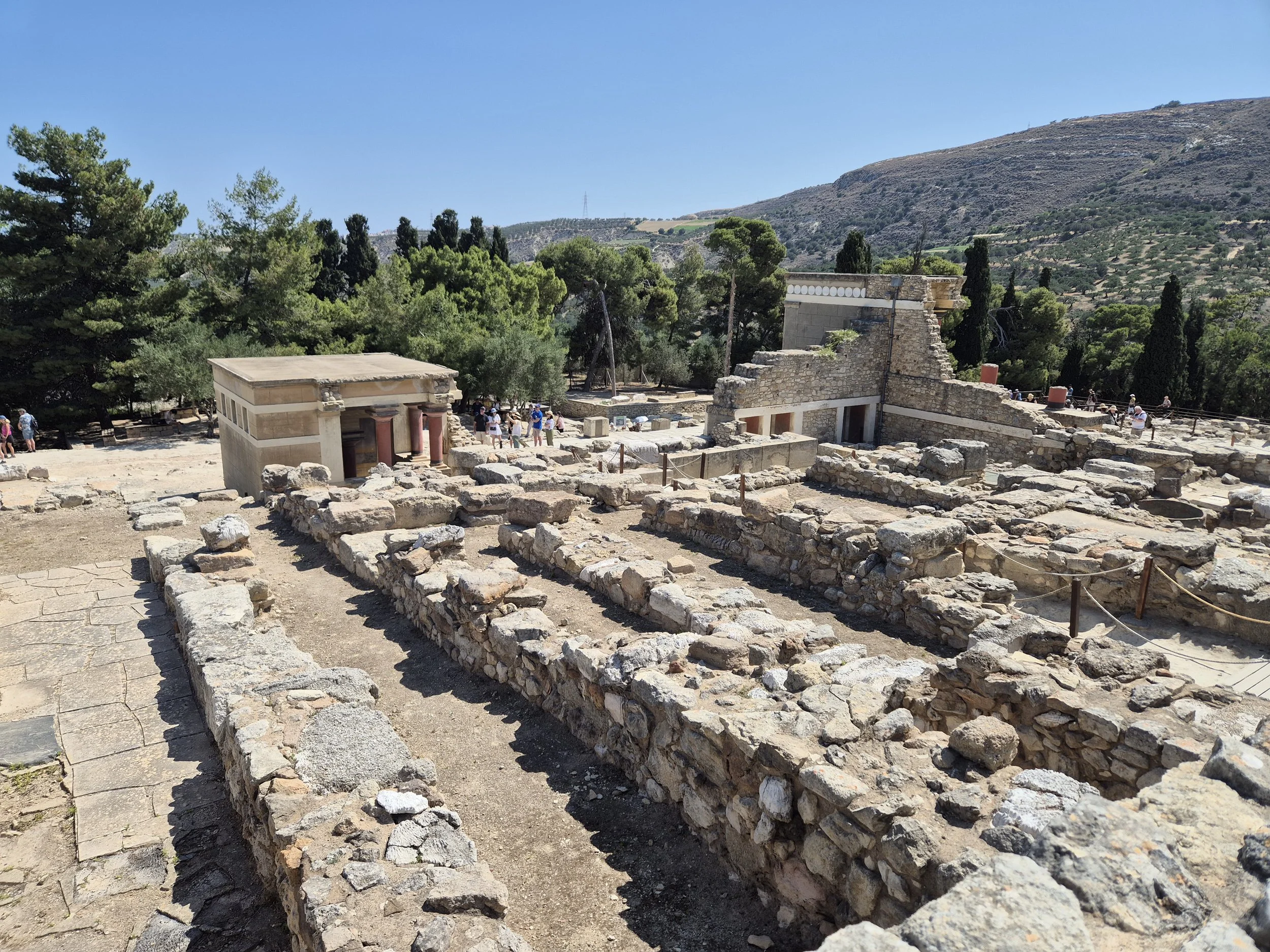
Angela: as soon as you step inside, you realise this is no ordinary palace. It is a living organism, a maze of corridors, staircases, columns, chambers, storerooms, and frescoes. A place that, even after thousands of years, still has the power to bewilder... and to enchant.
Piero: did you know that, according to legend, this palace was ruled by King Minos?
Angela: of course! The son of Zeus, who became king of Crete and guardian of law and order. A ruler who was both feared and respected, renowned as a wise and powerful judge. His story is the thread that weaves together myth and history here at Knossos.
Piero: the palace was first discovered in 1878, thanks to the Cretan archaeologist Minos Kalokairinos. But it was the English archaeologist Sir Arthur Evans who, in 1900, began the extensive excavations and brought the magnificence of this extraordinary complex back to the world's attention.
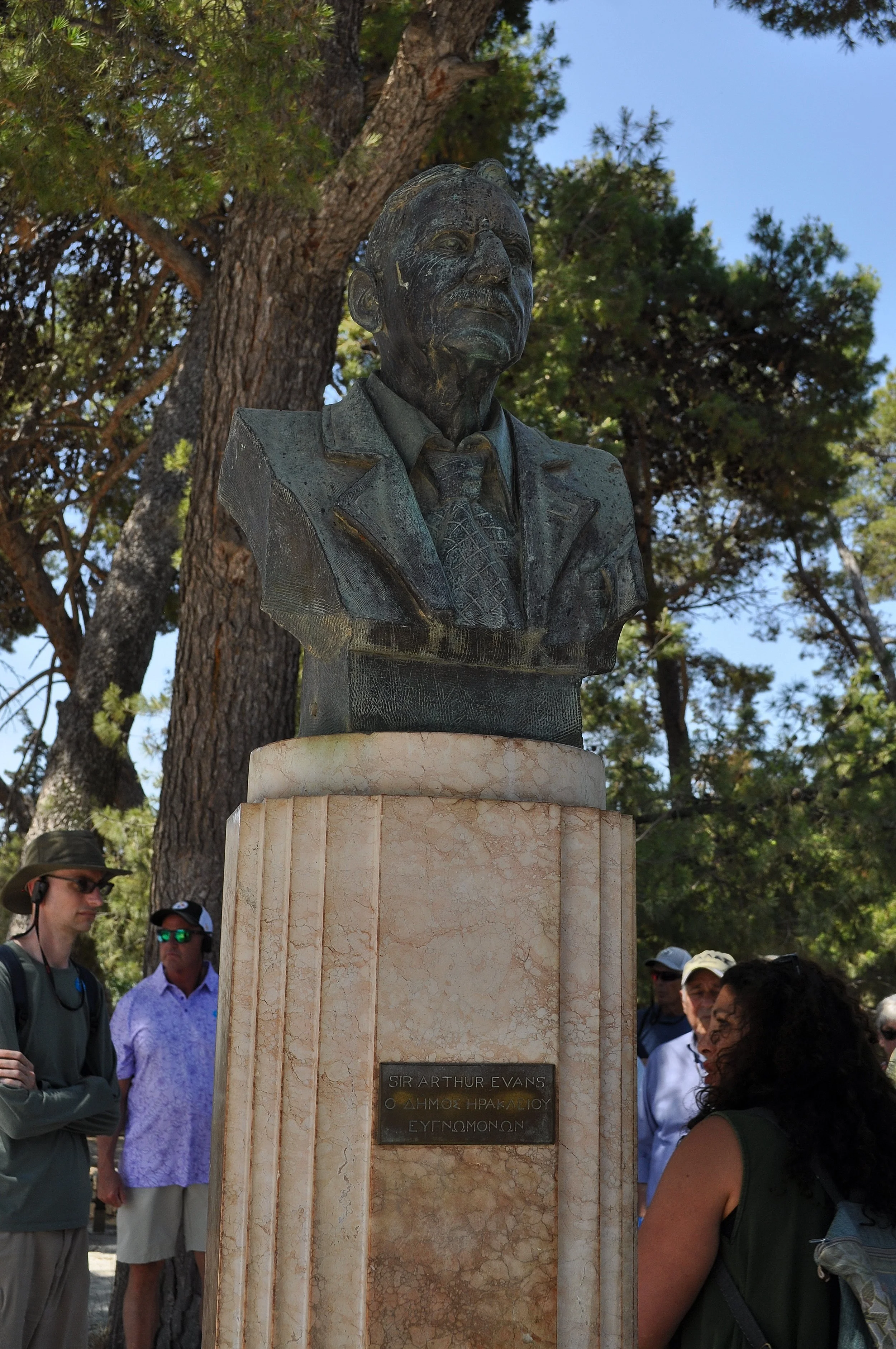
Angela: and it also sparked a great deal of controversy. Because Evans didn't just excavate the site—he reconstructed it, perhaps a little too enthusiastically. He used concrete, repainted walls, and recreated missing sections according to his own interpretation. So, what we see today is, at least in part, an idealised reconstruction.
Piero: and that, in my very humble opinion, takes away a little of this place's magic. It leaves less room for the imagination, which has always been an essential part of the experience whenever we visit an archaeological site. The palace once covered an area of more than 14,000 square metres. It contained over 1,000 rooms, spread across several levels and connected by staircases and courtyards. It wasn't just a royal residence—it was the political, religious, and administrative centre of the Minoan world.
Angela: here you'll find storerooms for grain and olive oil, ceremonial chambers, workshops, and ingenious light wells. And then there are the frescoes... everywhere. The most famous is the Bull-Leaping Fresco, showing a young acrobat grasping a bull by the horns and soaring gracefully over its back in what looks almost like a dance.
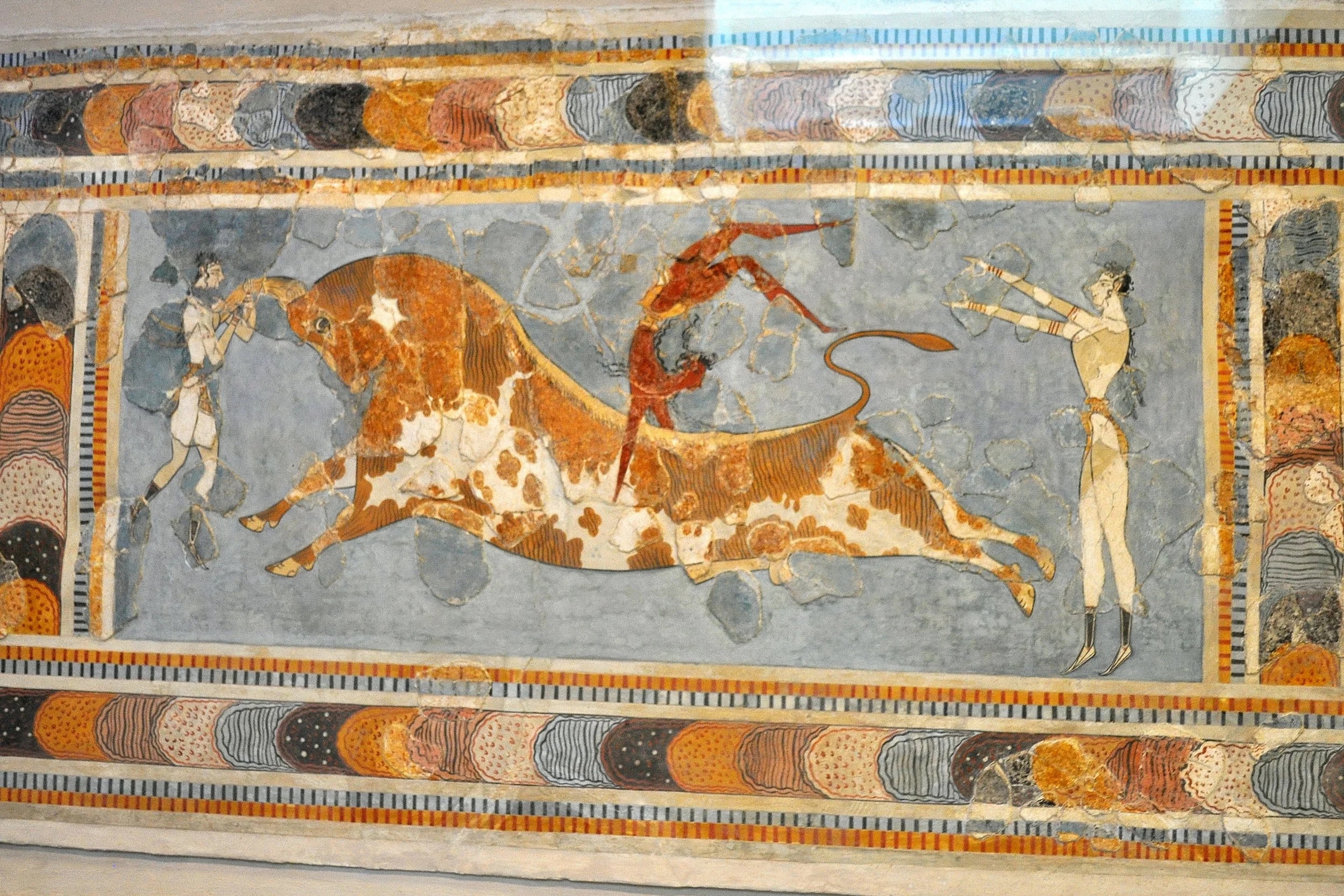
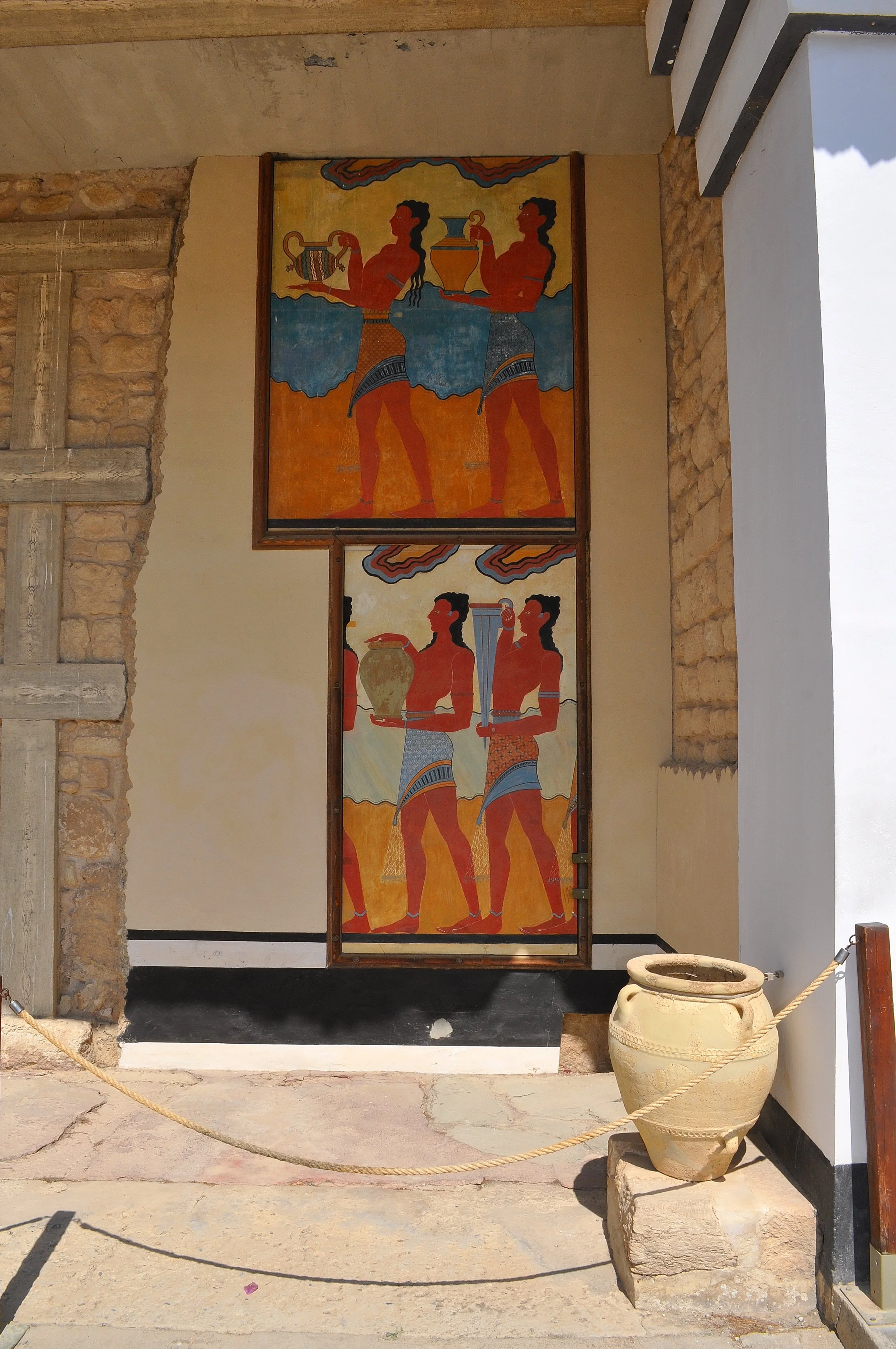
Piero: and then there's the Prince of the Lilies, striding forward with unmistakable confidence. The Procession Fresco, with its flowing robes. The women with bare bodices and carefully lined eyes. It is a world full of colour, movement, and refinement. It doesn't feel ancient... it feels as if it's still alive.
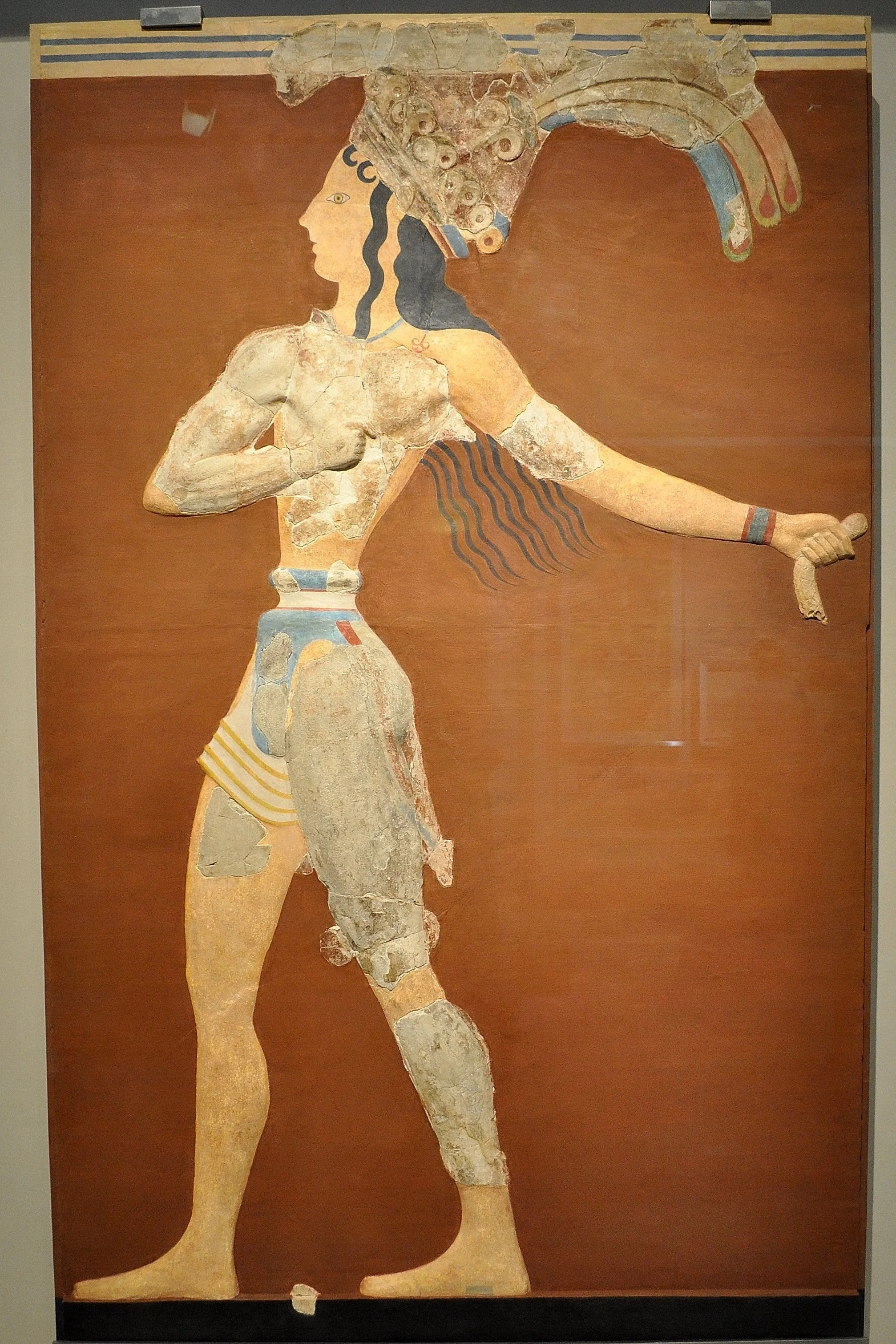
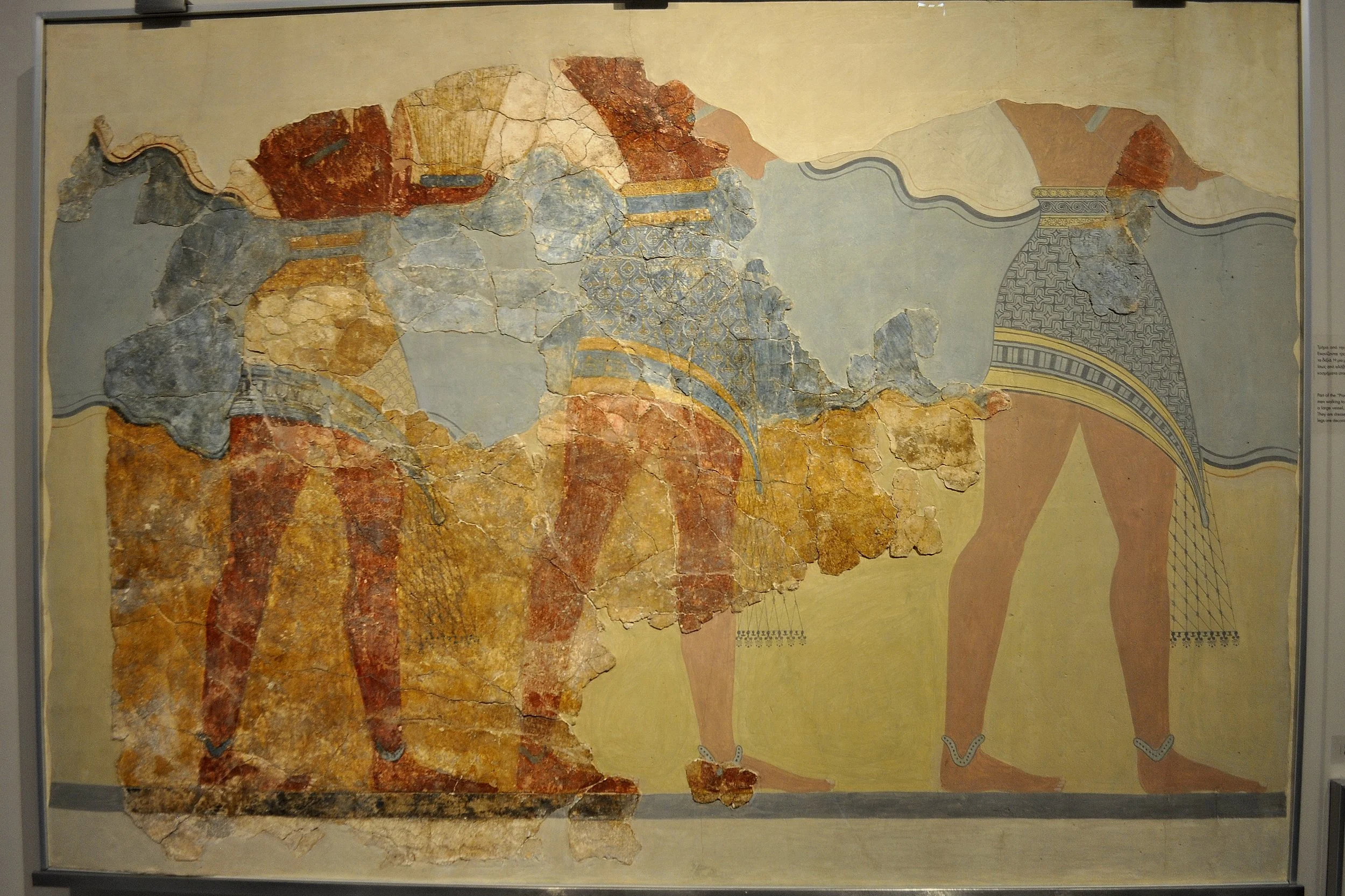
Angela: and the colour isn't confined to the walls. Just look at the columns: painted red and black, slender, and the exact opposite of Greek columns. They are wider at the top and narrower at the base — a unique feature of Minoan architecture.
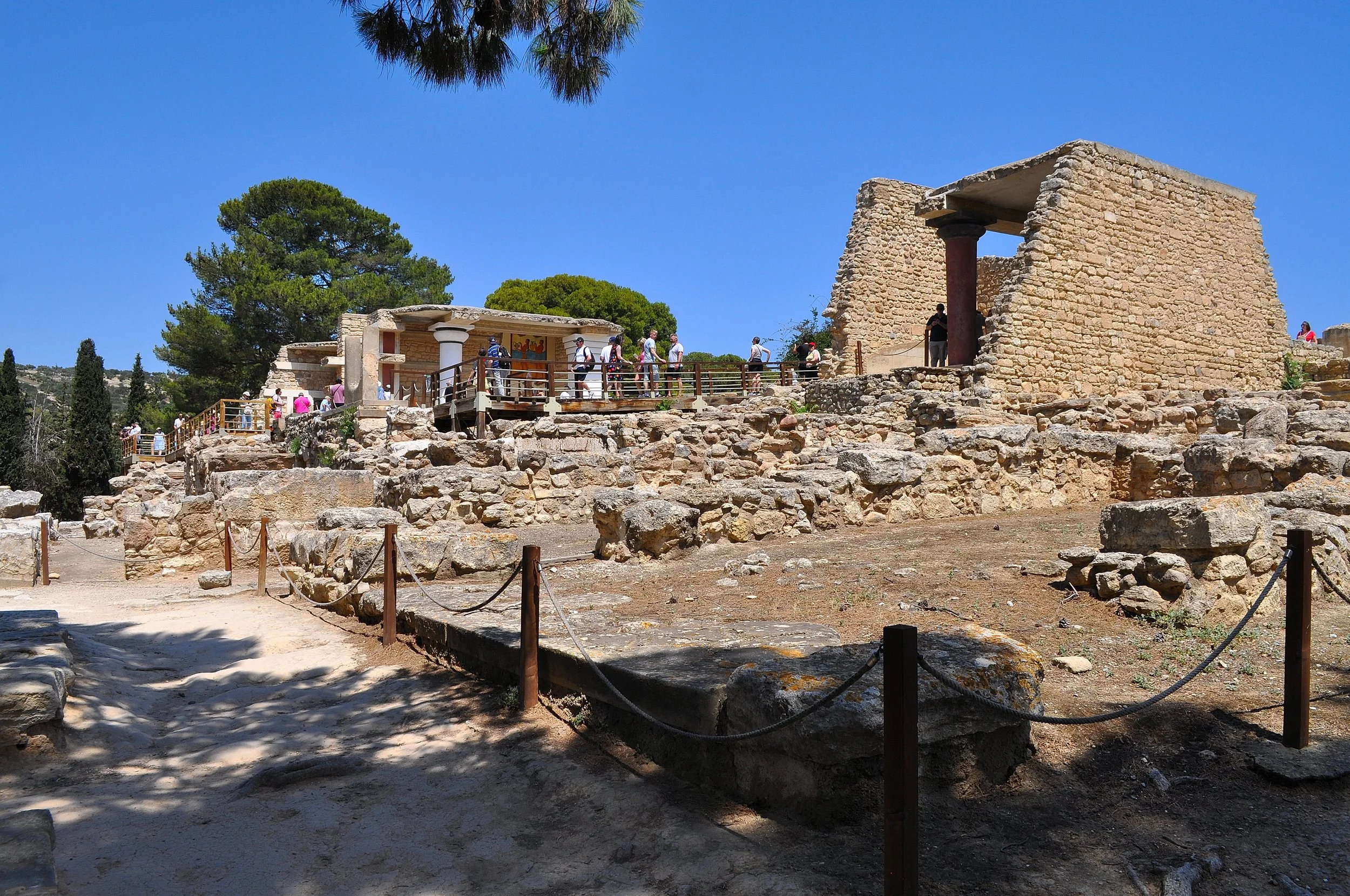


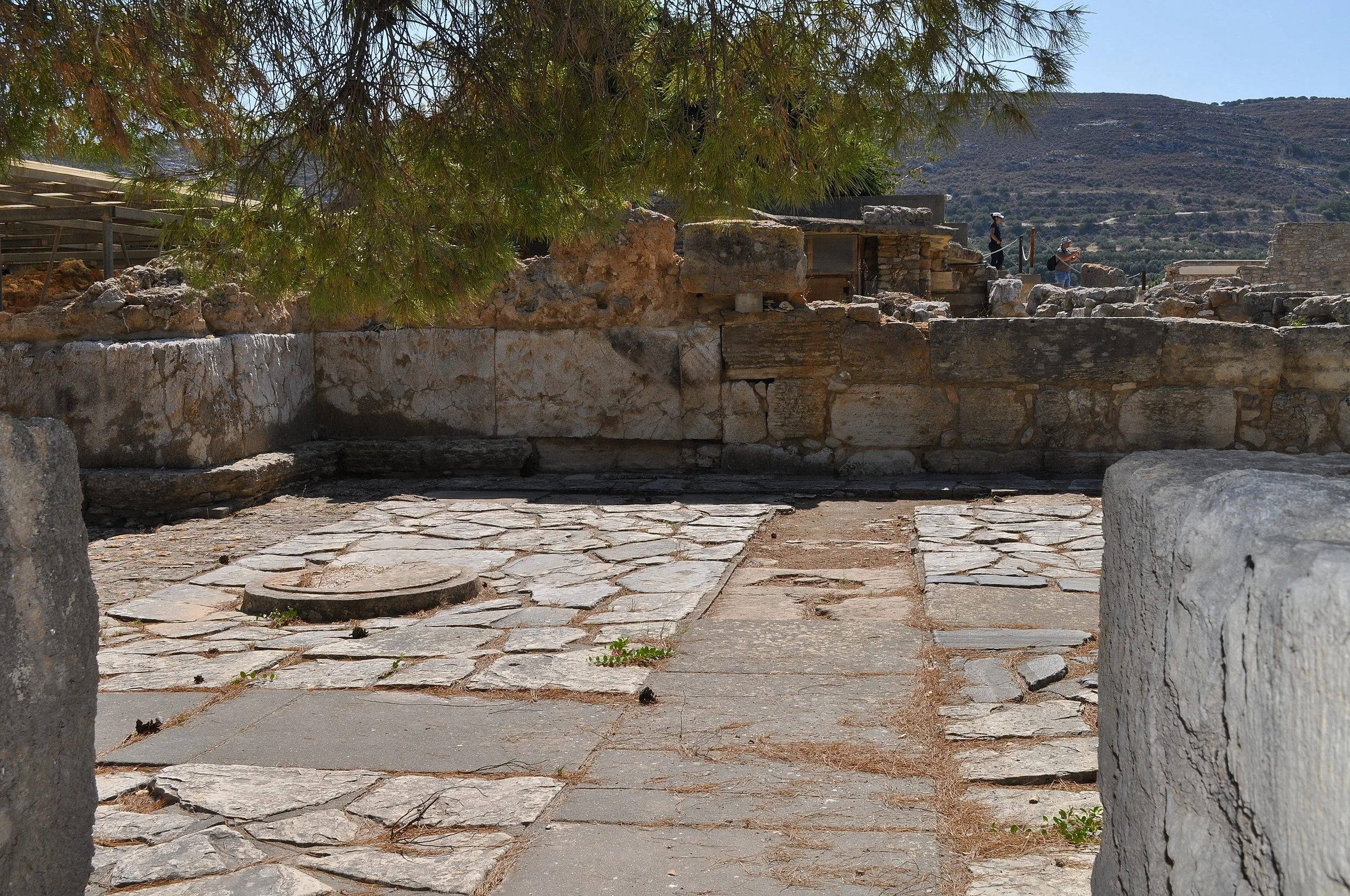


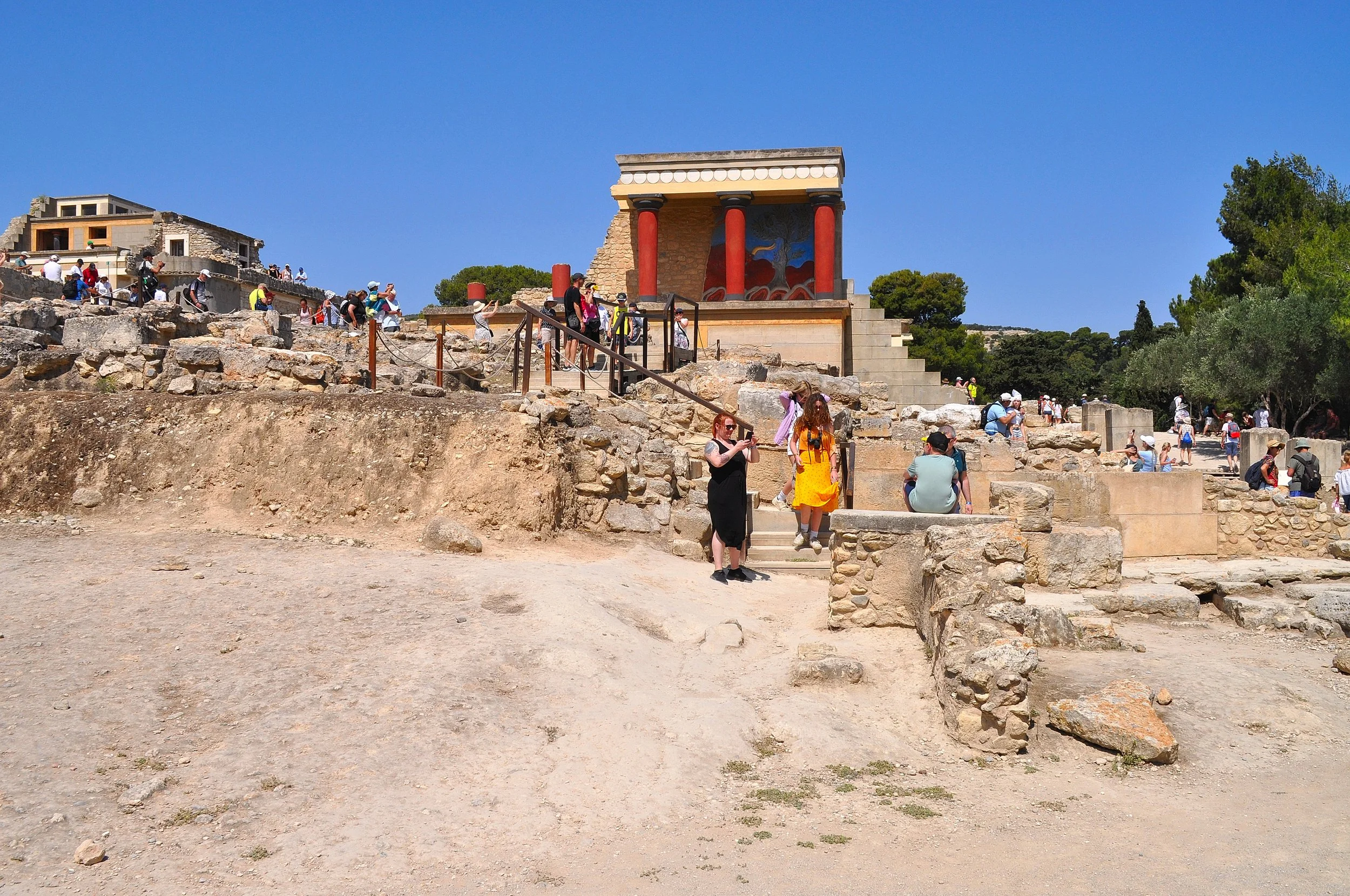
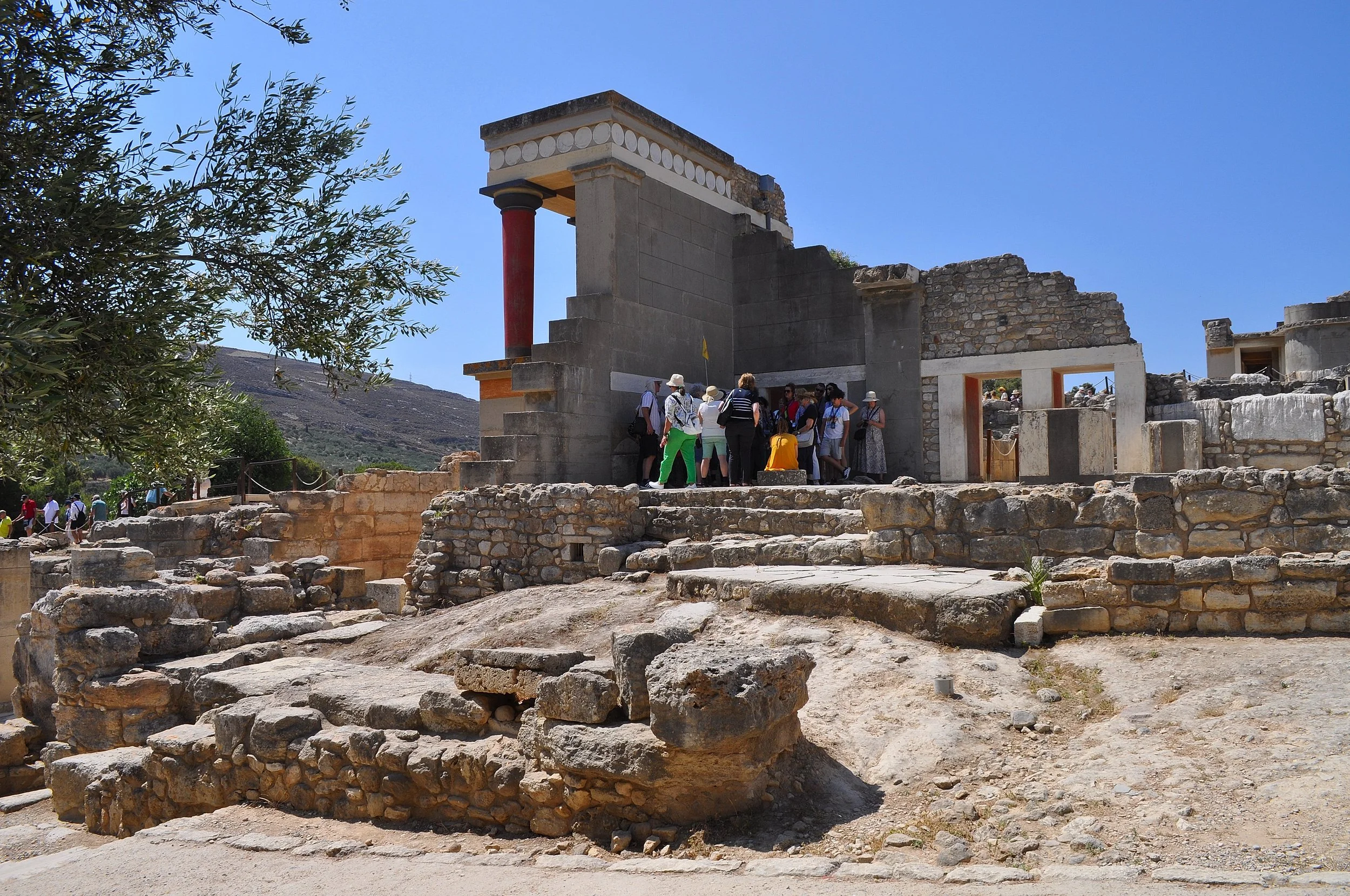


Piero: one of the palace's most famous rooms is the Throne Room. Here you'll find the alabaster throne, set against the wall and flanked by stone benches. The walls are decorated with frescoes depicting griffins—mythical creatures with the body of a lion and the head of an eagle. This room, too, has been heavily reconstructed. If you want to visit it, be prepared for long queues under the Cretan sun.
Angela: we don't actually know whether that throne belonged to a king. It may have been used by a high priest, or perhaps even by a queen. Many clues suggest that women held central roles in Minoan society, particularly in religious life.
Piero: walking through these halls, it's impossible not to think of the myths: King Minos, the Minotaur, Ariadne's thread, and the Labyrinth built by Daedalus. Reality may have been different, but these stories were born here. Knossos inspired them... and still keeps them alive today.
Angela: and even if we set mythology aside, the impact is very real. You're walking through rooms that are thousands of years old, yet remarkably modern in their design. There are natural ventilation systems, drainage channels, and light wells. The Minoans didn't just build—they planned.

Piero: and then there's its location. Knossos is not by the sea, but in a fertile area near the Kairatos River. A strategic position that allowed it to control the surrounding valley while remaining protected from the threat of attacks arriving by sea.
Angela: by the end of the visit, one thing becomes clear: Knossos was far more than just a palace. It was an entire world—a symbolic, spiritual, urban, and administrative microcosm. The beating heart of a civilization that has left an everlasting legacy.
Piero: and every time you cross its thresholds, it feels as though you're standing somewhere between history and myth. Knossos is the place where the past stubbornly refuses to fade away. Relive the entire experience in this video:
Angela: one piece of advice: visit Knossos early in the morning. Not only does it get extremely hot, but it also becomes very crowded. Remember, it's the most famous archaeological site in Crete, so it's very common to encounter large groups of visitors arriving from cruise ships.
Piero: it's always worth buying your tickets online in advance to avoid the long queues. And although it comes at an extra cost, we highly recommend hiring a local guide — you'll usually find several available at the entrance.